Here's the thing — when college graduates and high school graduates tackle the same business problem, the college grads usually come out ahead. We've always just accepted that gap as a given. But a single AI tool shrunk it to a quarter of its original size. This comes from a randomized controlled trial (RCT) published by NBER.
What Is It?
A research team from Argentina and the UK (Cruces, Galiani, and colleagues) ran an online randomized controlled trial with 1,174 adults between ages 25 and 45. Participants had a wide range of education levels — from high school graduates to those with advanced degrees — and they worked through business problem-solving tasks that mirrored what you'd encounter in an actual job.
Half got a generative AI assistant; the other half tackled the same tasks without one. Here's what they found:
Without AI, higher-educated participants outperformed lower-educated ones by 0.548 standard deviations. With AI, that gap collapsed to 0.139 standard deviations. 75% of the productivity gap tied to education level simply disappeared.1
What makes this notable is how it differs from previous company-internal studies. Earlier research compared top and bottom performers within the same company and role — people who'd already passed through the same hiring filters. This study compared people who were fundamentally different in educational background. No pre-selection bias. Genuinely diverse backgrounds.
One more thing. The researchers had participants redo the tasks without AI after they'd used it — and the education gap came right back. The key is that AI doesn't change underlying capability; it buffers the impact of capability differences. AI is an equalizer, not a teacher.
What Changes?
One study could be a fluke. But the evidence keeps pointing the same direction.
| Study | Participants | AI's Gap-Closing Effect |
|---|---|---|
| Cruces et al. (2026)1 | 1,174 adults (diverse education levels) | 75% reduction in education-based gap |
| Dell'Acqua et al. (2025)2 | 776 P&G professionals | Expertise boundaries dissolved; non-specialists match specialist-level output |
| Dell'Acqua et al. (2023)3 | 758 BCG consultants | Bottom 50% improved 43% vs. top 50% improved 17% |
| Brynjolfsson et al. (2023)4 | 5,179 customer service agents | Low performers: +35% productivity; top performers: minimal change |
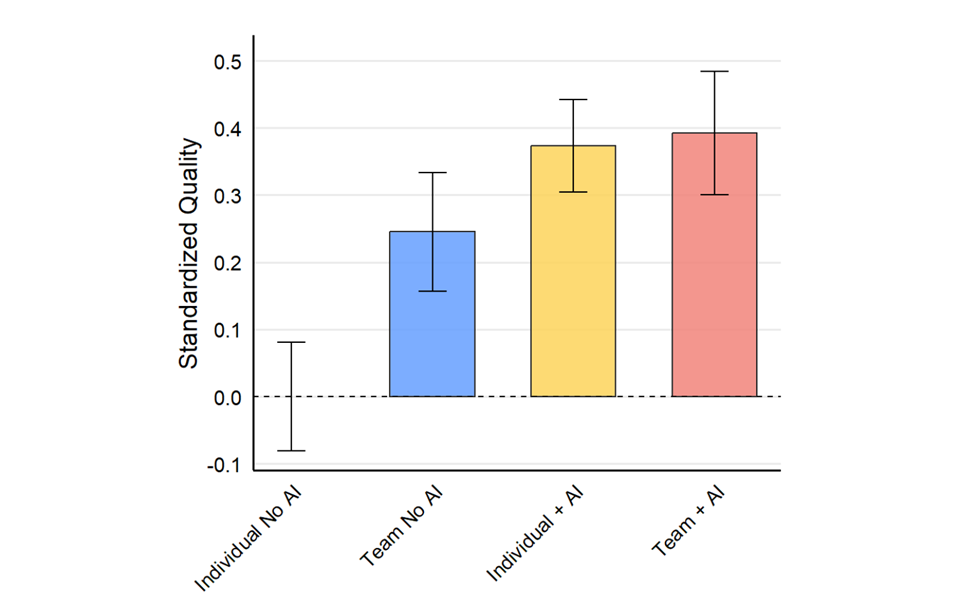
The Cybernetic Teammate experiment at P&G is especially striking. 776 R&D and marketing professionals worked on real product innovation challenges — and individuals using AI matched the output of two-person teams working without it. Even more surprising: expertise boundaries dissolved. R&D specialists produced marketing-oriented solutions when paired with AI; marketing specialists produced technically grounded ones.
The BCG consultant study confirmed the same pattern even among an already elite group. The bottom 50% of consultants improved 43% with AI; the top 50% improved just 17%. AI drives upward leveling.
The common pattern across all these studies comes down to this:
AI lifts everyone's performance, but it gives more to those who have less.
Getting Started: How to Apply This in Your Organization
If AI can close 75% of the education gap, it's worth asking whether a four-year degree requirement still makes sense as a hard filter. Especially for roles where AI tools are central — evaluating how someone uses AI and approaches problem-solving may tell you more than their educational background.
If your current training is built around "filling in domain knowledge," you'll get more ROI from teaching people how to use AI to quickly get up to speed in any field. In the BCG study, the group that received prompt training produced higher-quality outputs than the group that didn't.
In the P&G study, an individual using AI matched the output of a two-person team without it. Work that used to require two specialists can potentially be done by one person with AI. Instead of scaling headcount, give it a try with small teams plus AI. That said, the top 10% of exceptional outputs still came most often from human+AI team combinations.
AI closing the gap is great, but it doesn't change underlying capability — remove AI and the gap comes back. That's why you need to evaluate both "performance with AI" and "judgment without it." In management roles especially, the ability to catch errors in AI output still matters a lot.
Deep Dive Resources
The original Cruces et al. paper. Detailed breakdown of the 1,174-person RCT design, performance comparisons by education level, and the statistical basis for the 75% gap reduction.
Mollick's own writeup of the P&G field study with 776 participants. Clear breakdown of how AI changed teamwork, expertise boundaries, and even emotional dynamics on the job.
A living document by a University of Chicago economics professor synthesizing micro and macro evidence on AI productivity research. Great for situating individual studies within the bigger picture.