I told the AI "build me a to-do app" and it was actually done by the end of the weekend. Turns out submitting it to the store is where the real story started.
Coding is basically free now
A thread on Hacker News recently asked "what's the actual state of app development in 2026?" and it pulled in over 300 replies. Former Apple evangelist CharlesW compared AI coding to the desktop publishing revolution — beginners get an easier way in, but experts end up even further ahead because they can wield the tools better.
The data backs that up. 84% of developers are already using AI-assisted tools regularly, and Kotlin Multiplatform has moved past "experimental" into genuinely production-grade territory. A Moments NFC Android app got shipped in 12 days. The specialized knowledge that used to gate cross-platform apps just isn't the barrier it was.
So you hear it everywhere now: "anyone with an idea can ship an app." Weekend hobbyists really are turning MVPs around in days and putting them on the store.
But the numbers are moving in a weird direction
App Store submissions hit 235,800 in Q1 2026 alone — up 84% year over year, the biggest quarterly jump in a decade. That works out to roughly 1,865 new apps a day.
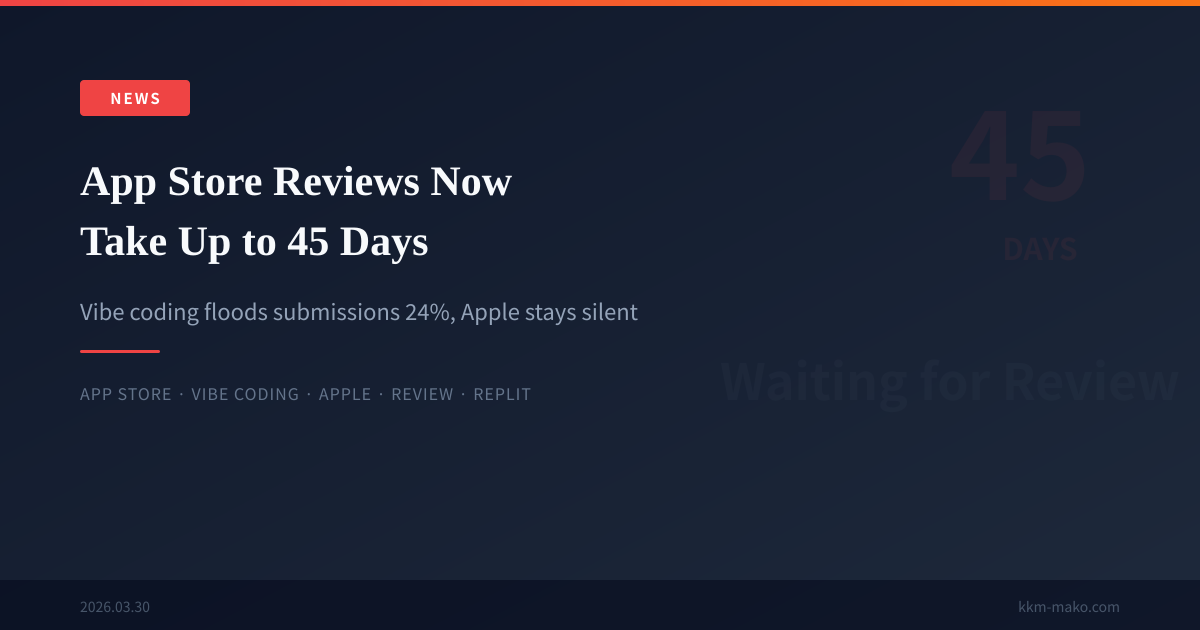
Here's the catch. Apple review used to wrap up in 24-48 hours. Now it's taking anywhere from 14 to 45 days. There are reports of apps submitted December 12, 2025 still sitting in "Waiting for Review" as of January 26, 2026.
| Normal times (~2024) | 2026 reality | |
|---|---|---|
| New app review (iOS) | 24-48 hours | 7-45 days |
| Annual submissions | 448,000 (2024) | 557,000 (2025, +24%) |
| Apps with AI features | not yet tracked | 27.1% of all apps |
| Usage/review index | baseline 100 | up to 180, but usage is flat |
What's stranger: the app count exploded while the number of people actually using them didn't move. The iOS release index climbed from 100 in 2024 to nearly 180 by early 2026, but the share of apps with meaningful usage and reviews barely budged. Supply exploded, demand stayed flat — classic oversupply signal.
The bottleneck moved from writing code to the store's front door
Per Forbes' analysis, the top 1% of apps capture 92.2% of all in-app purchase revenue. The other 99% split less than half of what that top 1% makes. Layer discoverability on top — 70% of visitors find apps through search, and 90% never scroll past the 10th result. Most of the 550,000+ apps out there are just sitting on the store with no users and no revenue.
Naval Ravikant's take was that software, like writing or music, was always going to proliferate once the barrier to entry collapsed. Replit's CEO said something similar — you don't need dev experience anymore, but marketing and distribution are still just as hard.
This bottleneck shift is bleeding into careers too. Entry-level hiring dropped 60% between 2022 and 2024, and new-grad hiring at Big Tech has been cut in half over the past three years. The more common "being able to build something" gets, the less it counts as an edge on its own.
Here's the summary. What AI actually removed was the coding barrier. What replaced it is the review queue and the fight for discoverability. Coding got easier, so competition got heavier — the bottleneck didn't disappear, it just relocated.
So here's what to actually do about it
- Submit something fully functional, not a demo
With "vibe-coded" apps flooding in, reviewers are scrutinizing real-use scenarios harder than before. Fill in loading states, empty states, and error handling before you hit submit. - Spell out your AI features and data usage in the review notes
Failing AI transparency requirements is one of the top rejection reasons. Write out exactly what data goes where and what your AI feature actually does, upfront. - Justify every permission you request
If you're asking for camera, location, or contacts access, explain why inside the app itself. Unjustified permission requests are a top rejection cause. - Line up your first users before you're even approved
With 90% of visitors never scrolling past result 10, you can't count on organic search on day one. Build a waitlist through communities, newsletters, or social before launch. - Go shared-core-plus-native-UI if you're cross-platform
Something like Kotlin Multiplatform — shared business logic, native UI per platform — cuts both review risk and long-term maintenance load.
Want to go deeper?
The Apple App Store Is Flooded With AI Slop Forbes' breakdown of revenue concentration and the discoverability crisis, backed by data forbes.com
App Store Review Delays in 2026 A practical checklist for getting approved on your first submission appbot.co
App Store reviews hit 45 days A report on the submission surge driven by vibe coding and the longest review cases kkm-mako.com
Kotlin Multiplatform 2026 How the shared-core-plus-native-UI architecture matured into production-ready jetruby.com
The Future of Junior Developers in the Age of AI The hiring market and survival strategies for junior developers in the AI era codeconductor.ai
The Next Two Years of Software Engineering Addy Osmani's analysis of AI tool adoption rates and shifting developer roles addyosmani.com