If you keep tweaking your prompt but your AI makes the same mistakes, the problem might not be the prompt.
In June 2025, a single line from Shopify CEO Tobi Lutke spread quickly among AI developers: "Context engineering is a better term than prompt engineering. The core skill is designing all the context so that the task is plausibly solvable by the LLM." It''s also why 82% of IT and data leaders now say prompt engineering alone is no longer enough.
4 Reasons AI Fails Even With a Perfect Prompt
Prompt engineering is the skill of optimizing how you tell AI what to do. In 2023–2024, it felt like the central skill. But once you hook AI into real production systems — complex workflows, RAG, agents — you hit walls prompts alone can''t fix.
Firecrawl and DataCamp research identified 4 failure patterns:
| Failure Mode | Symptom | Example |
|---|---|---|
| Poisoning | One wrong fact keeps polluting later responses | Mention a wrong date once, and all downstream reasoning inherits it |
| Distraction | Longer conversations cause AI to ignore early instructions | After 10 exchanges, the AI forgets the persona you set at the start |
| Confusion | Irrelevant documents cause off-target responses | Drop a 50-page doc and the AI misses the key section in the middle |
| Clash | Contradictory info in the same window causes performance collapse | OpenAI o3 dropped from 98.1% to 64.1% accuracy |
Context clash causes an average 39% performance drop. Databricks analysis found even large models like Llama 3.1 405B start losing accuracy around 32,000 tokens — meaning million-token windows aren''t a free pass. Stanford''s "lost in the middle" research confirmed it: AI processes the start and end of context reliably, but loses what''s in between.
So What Is Context Engineering, Actually?
Anthropic defines it as "the set of strategies for curating and maintaining the optimal set of tokens during LLM inference". Simply put: if prompt engineering is "what to say," context engineering is "what to let the AI see".
Think about visiting a doctor. Saying "I have a headache" is very different from bringing your medication list, sleep data, stress levels, and medical history. Prompt engineering is getting better at saying "I have a headache." Context engineering is designing all the background the doctor needs for an accurate diagnosis.
| Prompt Engineering | Context Engineering | |
|---|---|---|
| Core question | How should I phrase this? | What does the AI need to know? |
| Scope | Single input-output optimization | Everything the model sees |
| Best for | Simple chatbots, one-off tasks | Agents, RAG, complex workflows |
| Failure cause | Vague or unclear instructions | Information architecture problems |
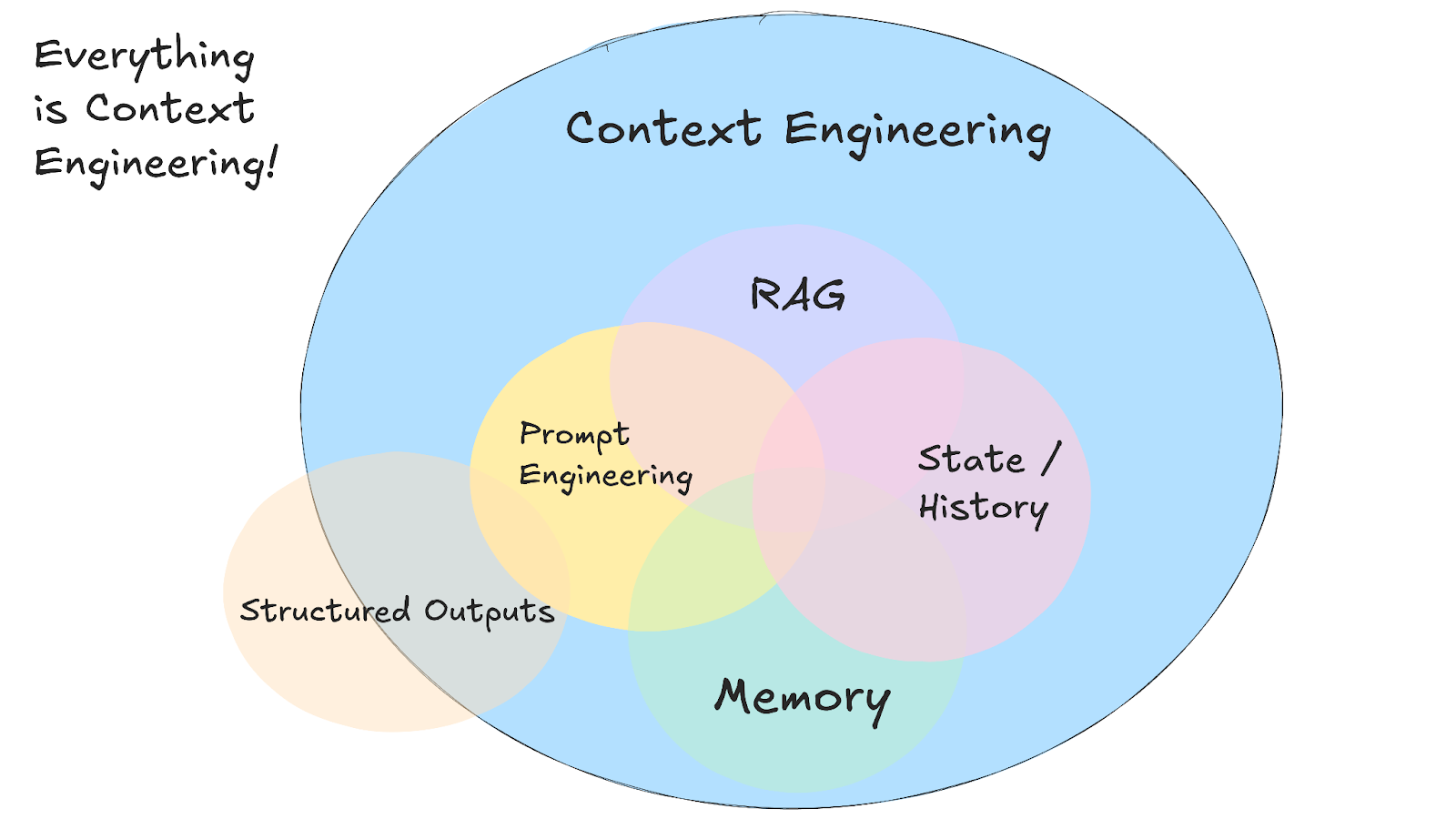
Prompt engineering isn''t obsolete — context engineering is the superset that includes it. But once you use AI beyond simple chat — complex agents, RAG, copilots — context architecture determines the outcome.
5 Context Engineering Techniques You Can Apply Today
Here are the 5 highest-impact techniques from Anthropic, Firecrawl, and DataCamp research — practical for non-developers too.
- Put critical info at the beginning and end
Stanford''s "lost in the middle" research shows AI processes context boundaries best. Place your most important rules at the top of your system prompt. Put the user query at the very end. Place the most relevant reference data right before the query. - Less is more — Minimum Viable Context
Firecrawl calls this the "Minimum Viable Context (MVC)" principle. Instead of pasting entire documents, extract only the relevant sections. Selecting 19–30 relevant tools instead of 46 improved tool selection accuracy by 300%. - Cache what doesn''t change
Re-sending the same system prompt, DB schema, or policy doc every time wastes tokens. Claude and Gemini''s context caching cuts costs 75–90% on repeated context blocks. Put static content first, dynamic content last for best cache efficiency. - Summarize long conversations — don''t truncate (Compaction)
When conversations approach context limits, summarize instead of deleting. Keep: key decisions, unresolved issues, critical choices. Drop: intermediate attempts, repeated confirmations, failed experiments. Anthropic recommends starting recall-first, then refining toward precision. - Distribute complex work across sub-agents
Don''t give one AI everything — build specialized sub-agents per task type. Each gets a clean context window and passes compressed summaries (typically 1,000–2,000 tokens) back to the coordinator. This produced 54% performance gains in specialized agent benchmarks.
Try this right now
In Claude or ChatGPT, write your non-negotiable rules in the very first section of your system prompt, and paste only the relevant excerpts from documents instead of full files. You''ll see quality differences without changing a single word of your prompt.
Go Deeper
Effective Context Engineering for AI Agents Anthropic''s engineering team guide — compaction, just-in-time retrieval, sub-agent patterns anthropic.com
Context Engineering vs Prompt Engineering for AI Agents 4 failure modes, MVC principle, measurement metrics firecrawl.dev
Context Engineering Guide Comprehensive guide covering RAG, memory systems, and dynamic context promptingguide.ai
Why AI Teams Are Moving from Prompt Engineering to Context Engineering Context pyramid model and GraphRAG knowledge graph approach neo4j.com
Context Engineering: A Guide With Examples Tool loadout optimization, context offloading, rich experimental data datacamp.com
Context Engineering: LLM Memory and Retrieval for AI Agents 6 pillars and agentic RAG framework introduction weaviate.io