Sent 100 cold emails to investors and got 3 replies back?
Finding investors, getting introduced, booking meetings — founders redo this from scratch every round. A startup just launched an AI agent that takes the whole thing off your plate.
What does it actually do for a burned-out founder?
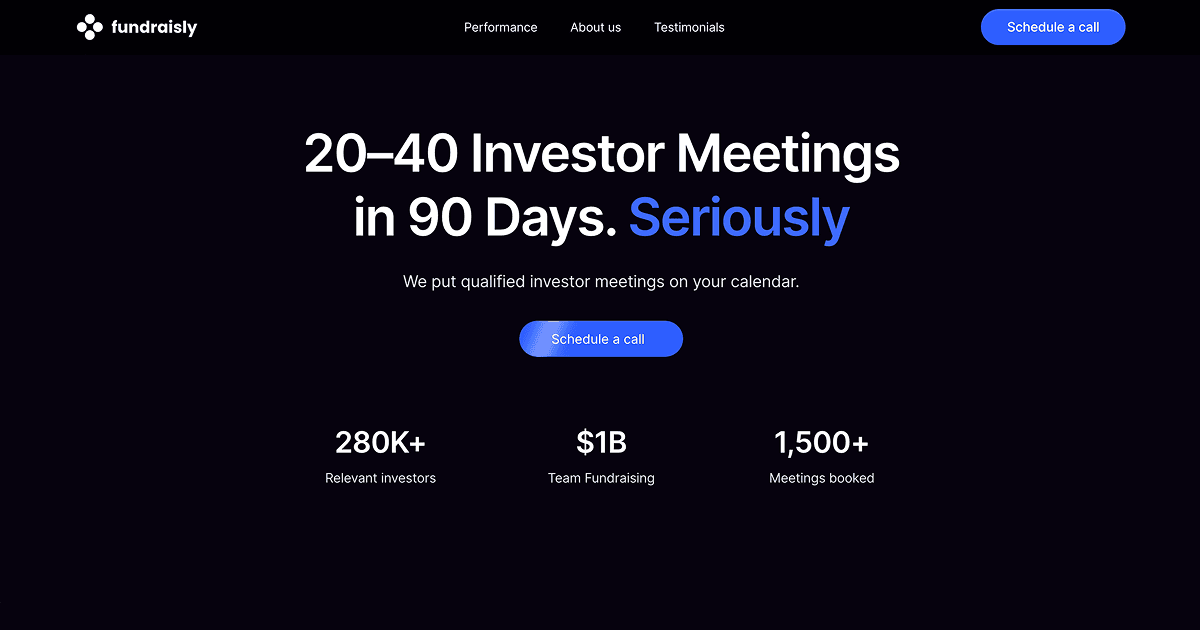
Fundraisly was the #1 Product of the Month, Week, and Day on Product Hunt when it launched in June 2026. In one line: an "AI sales team that finds investors and books your meetings." In practice, it runs on three mechanisms.
It pulls from 13+ data sources — Crunchbase, LinkedIn, outreach feedback, public sources — to build a database of 300,000+ investors, then filters by actual portfolio history to match your stage, market, and geography. Next it scans your Gmail, Outlook, and LinkedIn connections to auto-map warm-intro paths to those investors, and for anyone with no path, it covers the gap with cold outreach to 40,000+ VC funds.
The team behind it has been through this themselves. Fundraisly's Product Hunt page describes itself as "Built by founders who raised over $1B". One outlet summed up the pitch this way: it frees up all the time founders would spend hunting investors to put into "product or customer conversations" instead.
Why does a warm intro even matter that much?
There's a reason Fundraisly runs warm-intro mapping before cold outreach. A 2017 DocSend study found that warm intros are roughly 13x more likely to lead to funding than cold emails. It's still one of the most cited stats in fundraising circles.
Getting a warm intro isn't just "ask whoever you know" either — there's an actual hierarchy. Tier 1 is your existing investors (the strongest signal), tier 2 is other founders in that investor's portfolio, tier 3 is advisors, customers, and operators, and tier 4 is LinkedIn second-degree connections (lowest conversion). And the intro itself isn't just fired off blind — it runs on a double opt-in: the connector asks the investor "are you open to this?" first, and only after the investor says yes does the actual intro email go out. That path-finding and double opt-in process is exactly what Fundraisly automates.
So does it actually work? What does it cost?
The testimonials are specific. Serg Safonov of Savvy says he landed "49 investor pitches in 2 months, including a call with a16z" and raised $500K. Alexey Shagraev of Lovi/Palta says he went from 7 investor calls in his first round to 43 this time. Slava Akulov of Jupid reports around 100 investor calls.
Here's the catch, though: every one of those numbers is self-reported. Fundraisly isn't listed on G2 or Capterra, so there's no independently verified track record yet. And it only connects to Gmail, Outlook, and LinkedIn — no Salesforce, no HubSpot — so moving your pipeline into a team CRM means manual work.
Pricing isn't light either. The basic plan (warm-intro mapping only) starts at $1,000/month, the standard plan (cold + warm outreach) is $3,000/month, and the premium plan (everything) runs $5,000/month, with a 2-month prepaid minimum. Reviewers specifically flagged it as a poor fit for "teams with a strong existing network" or "rounds targeting strategic/corporate (CVC) investors".
| Tool | Price | What it does |
|---|---|---|
| Fundraisly | $1,000-5,000/mo | Warm-intro mapping + cold outreach, done for you |
| Metal | $249/mo ($200/mo annual) | AI investor matching + fundraising CRM, YC-backed |
| Foundersuite | $99-299/mo | 300k+ investor DB + email tracking |
| OpenVC | Free | 5-6k investor directory, request warm intros yourself |
If you're cash-strapped and early-stage, it's more sensible to start with free OpenVC and request warm intros yourself, then reach for a paid service like Fundraisly once the round is big enough — or your bandwidth thin enough — to justify it.
How to check if a fundraising tool is right for you
- Audit your own network first
Count how many investors or portfolio founders are already in your LinkedIn and Gmail contacts. The more you have, the less automation is worth to you. - Confirm your target investor type
Decide whether you need pure VC/angel money or also strategic/CVC capital. Fundraisly-style tools are weak on the latter. - Do the budget math
Expect at least $1,000/month with a 2-month prepaid minimum. If you're pre-seed, work out the runway impact first. - Practice with a free alternative
Run a few warm-intro requests through a free directory like OpenVC before you decide whether paid automation is actually worth it. - Ask for references before signing
Skip the self-reported testimonials and ask them to connect you directly with a founder at your stage and sector. How fast they respond tells you a lot.
Want to go deeper?
Fundraisly's official site Check pricing, founder testimonials, and the actual process yourself fundraisly.com
The AI Agent Index review The most critical breakdown of pros, cons, and competing tools theaiagentindex.com
Evalyze.ai's Warm Intro Playbook The full guide to the 4-tier connector hierarchy and double opt-in protocol evalyze.ai
Metal's 2026 AI fundraising platform comparison A pricing table covering 7 other tools beyond Fundraisly metal.so
Qubit Capital on investor-matching intelligence A technical look at how AI turns scattered investor signals into structured matches qubit.capital
OpenVC's free investor directory Start here if you want to request warm intros yourself with zero budget openvc.app