Nvidia is officially a GPU company. It doesn't build robots directly.
Amazon already runs 750,000+ robots in its warehouses. There's seemingly no reason to invest in a competing startup.
Qualcomm makes chips for smartphones and cars. The link to humanoid robots isn't obvious.
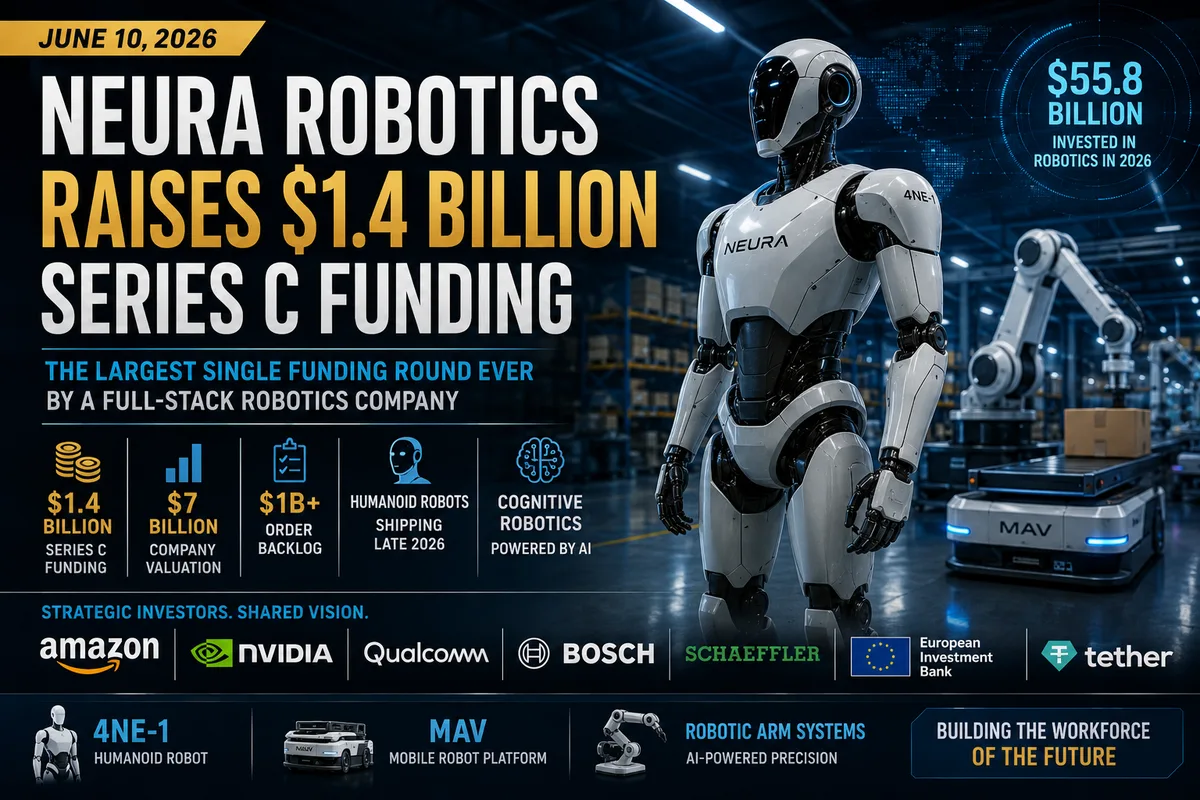
And yet all three companies put money into the same German robot startup at the same time. $1.4B raised. $7B valuation.
This investor lineup wasn't a coincidence
Nvidia supplies the brain for Neura's robots. The 4NE-1 runs on the NVIDIA Thor T5000 processor and Isaac GR00T XX foundation model. Every unit sold expands Nvidia's robotics ecosystem. By investing in a certified GR00T ecosystem partner, Nvidia is locking in the platform standard before anyone else does.
Amazon's angle is different. They already have 750,000+ fixed-task robots, but those robots can only do one thing. Any change in warehouse layout or new SKU means weeks of reprogramming. Neura's 4NE-1 can retrain for entirely new tasks via software update in hours, not weeks. Amazon doesn't need more robots — it needs more flexible ones.
Qualcomm is playing edge computing. When millions of robots need to make real-time decisions on factory floors, cloud latency simply doesn't work. Low-latency edge AI chips are the requirement — and that's Qualcomm's home turf.
All three companies bought an ecosystem position, not just a financial return. Tether CEO Paolo Ardoino described it as "a bet on machine autonomy infrastructure development." No investor in this round was purely chasing Neura's revenue.
Why physical AI's inflection point is right now
Total investment raised by global robotics companies in 2026: $55.8B. Nearly 2× the 2025 figure. Capital that had been flowing toward AI chatbots and LLMs is changing course.
Three things converged at the same time to make this the moment.
First, the labor gap. Manufacturing and logistics have hit a breaking point with workforce shortages. Companies are now calculating robot ROI before labor costs.
Second, falling AI inference costs. For robots to make real-time decisions at the edge, compute costs had to drop to economically viable levels. Two years ago, this math didn't work. Now it does.
Third — and most interesting — is Neuraverse. An open platform where deployed robots share what they learn in real time. When a factory in Germany teaches its robot a new assembly task, every Neura robot worldwide upgrades simultaneously. The more units deployed, the smarter the entire fleet gets — a fundamentally different model from traditional industrial robots.
South Korea is already moving
The South Korean government announced a 16 trillion KRW investment in AI and robotics for 2026. Of 149 domestic physical AI startups, 47% (70 companies) are in robotics. Holidayrobotics closed a 150 billion KRW Series A. The global wave has reached South Korea.
Where robots arrive first — the current landscape
Let's look at which humanoid robots are actually generating revenue right now.
| Traditional industrial robots | Cognitive humanoids | |
|---|---|---|
| Task switching | Weeks to months of reprogramming | Software update in hours |
| Environmental adaptation | Pre-defined paths only | Autonomous navigation in unstructured environments |
| Human collaboration | Safety fences required | Direct collaboration (artificial skin, sensors) |
| Collective learning | None (individual silos) | Neuraverse: all deployments upgrade simultaneously |
Agility Robotics' Digit has already moved 100,000+ totes at GXO Logistics warehouses and signed paying contracts with Toyota and Mercado Libre. Commercialization is no longer a theory. Neura has over €1B in confirmed orders, with large-scale shipments scheduled for late 2026 and full commercial warehouse deployment targeted for 2027.
The enterprise vs. SMB gap is opening now
Large logistics players like Amazon, DHL, and GXO are building efficiency advantages through early adoption. By the time smaller operators can deploy, the competitive cost structure will already be stacked against them.
What to prepare before 2030
- Set your industry's entry timeline
Warehousing and logistics: commercial deployment starts 2027. Automotive and electronics manufacturing: already in pilot stage. Healthcare: starting with simple transport and material handling. Map when your sector enters. - Quantify your repetitive labor footprint
Robots replace physically demanding, repetitive tasks first — picking, palletizing, quality inspection, patient transport. Calculate the annual labor cost for these roles now. That number is your ROI baseline. - Follow the Nvidia GR00T ecosystem
Neura's 4NE-1 runs on NVIDIA Isaac GR00T. The ability to customize and integrate within this ecosystem will be central to future deployments. If you have a dev team, now is the time to start. - Audit your logistics partner's automation roadmap
Whether your 3PL has a robot adoption plan affects your unit economics three years from now. Ask your logistics partners what their automation roadmap looks like. - Pre-build your pilot cost model
Neura's 4NE-1 Mini is available to reserve from €19,999. With a 2–4 year ROI horizon, a 2–3 unit pilot can generate internal business case data within 24 months.
Want to go deeper?
NEURA Robotics 4NE-1 Official Specs Full pricing, reservation links, and technical specifications neura-robotics.com
Top 8 Humanoid Robot Companies to Watch in 2026 Full competitive landscape including Figure, Agility, Tesla Optimus evsint.com
Amazon & NVIDIA Invest in Humanoid Robotics Deep-dive from a logistics industry perspective with ROI case analysis navilinkglobal.com
Neura Robotics Record Series C Official Announcement Full investor list, milestones, and production plans neura-robotics.com
2026 Physical AI Investment Landscape Analysis of 149 South Korean physical AI startups and investment distribution futurechosun.com
Manufacturing Dive: Neura $1.4B Analysis In-depth manufacturing perspective and Neuraverse technology details manufacturingdive.com