Before YouTube, video belonged to directors. Cameras, lighting, editing suites — you couldn't even start without millions of dollars in equipment and professional crews. When YouTube arrived in 2005 and the smartphone in your pocket became a camera, that wall crumbled. The result? A $550 billion new industry.
a16z general partner Anish Acharya says the exact same thing is happening in software right now. LLMs have compressed the time from "idea → working app" from weeks to hours. levelsio builds apps on livestream, someone else deploys entire ad campaigns from the CLI.
What is this about?
"Software's YouTube moment" is a thesis a16z published in January 2026. The core argument is simple — the barrier to software development is collapsing, just like YouTube did for video production.
Acharya breaks the history of video into three stages.
| Era | Video Production | Software Development |
|---|---|---|
| Traditional | Hollywood directors, multi-million dollar budgets | Professional dev teams, millions in investment |
| Indie | Tarantino & Soderbergh, small budgets | YC founders, outsiders breaking in |
| Democratization | YouTube (2005–), camera in your pocket | LLMs + vibe coding (2025–) |
"Vibe coding" is the key term here. It's a method where you describe what you want in natural language and AI generates the code — it gained traction so fast that it was added to the Merriam-Webster dictionary in March 2025. This concept, first named by Andrej Karpathy, turned the idea of "English is the hottest new programming language" into reality.
The specific examples are impressive.
- Tobi — Built an MRI dashboard himself that would have required commercial software
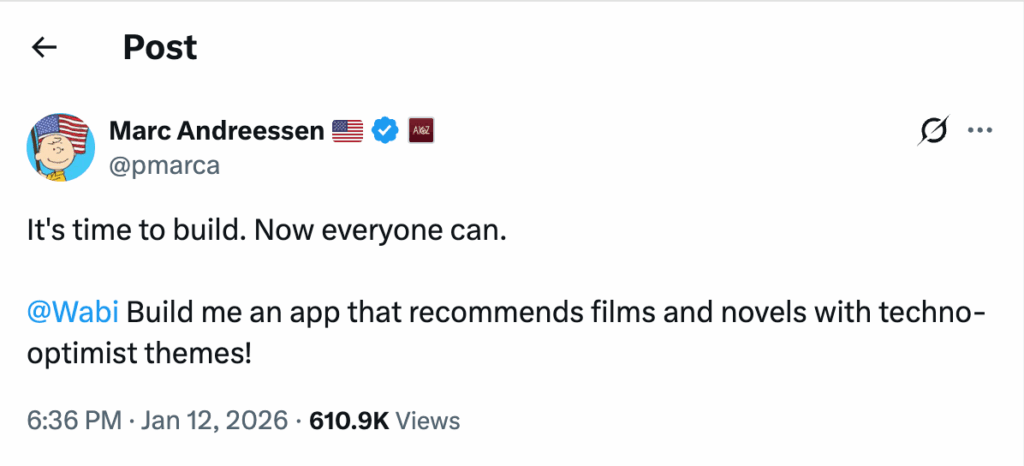
- Marc Andreessen (pmarca) — Created a techno-optimist movie & novel recommendation app with Wabi
- levelsio & Joe Weisenthal — Built app architecture live on stream in front of viewers
- Riley Walz — Launched viral projects back-to-back: SF parking ticket visualizations, Epstein files renderer, and more
What's actually changing?
a16z identifies three structural shifts.
1. The definition of "builder" has changed. Before, "anyone" meant "anyone among developers." Now it's shifted to "anyone with an idea and access to a coding agent." Data showing that 63% of v0 platform users are non-developers supports this.
2. Software becomes a medium of self-expression. Just as people create their own channels on YouTube, people are building their own tools, services, and apps through software. It's moving beyond utility into the realm of personal branding and creative expression.
3. Unlike content, software compounds. A blog post loses interest over time, but an app grows in value as its user base expands. In Acharya's words, it's "content without a depreciation schedule."
Mimicry as an accelerator
The moment someone watches levelsio build an app live and thinks "maybe I should try too?" — that's when social momentum kicks in, just like the influencer phenomenon. a16z calls this "mimetic adoption."
But we need a reality check here. The title of a piece written by another a16z partner, Justine Moore, two weeks later is telling — "Most People Can't Vibe Code. Here's How We Fix That."
Here are the key barriers Moore identified.
- Setup complexity — Terminals, API keys, YAML, environment variables. Second nature for developers, alien language for everyone else
- Security vulnerabilities — According to Veracode's 2025 report, nearly half of AI-generated code contains security flaws
- Imagination gap — Developers have a mental model for "what kind of app is possible," but non-developers don't even know what they can build
- Deployment wall — The "localhost meme" — you built it but it never makes it past localhost
The numbers make it even clearer. According to a Samsung SDS report, Vercel blocked 17,000 deployments in a single month (July 2025) due to security issues, and an analysis of 576,000 AI-generated code samples identified 205,474 non-existent packages.
| a16z's Optimism | Real-World Data | |
|---|---|---|
| Audience | "Anyone" can build apps | Actual vibe coding adoption ~1% |
| Speed | Idea → app in hours | MVP speed up 45%, but senior dev productivity down 19% |
| Quality | Tools are good enough | AI code acceptance rate under 44%, hallucination 5–22% |
| Security | (Barely mentioned) | ~50% of AI-generated code has security vulnerabilities |
Experts in a ZDNet Korea discussion distinguish between "Day 1 problems" and "Day 2 problems." Building apps got faster, but security validation, maintenance, and scaling can take even more time. The consensus among experts: the vaguest belief that "AI will handle everything" is the most dangerous one.
The essentials: How to get started
Whether the YouTube moment is overhyped or not, the environment for building software is undeniably better than ever before. Here's a realistic approach.
- Start by solving your own problem
Not a world-changing app like levelsio's — a small tool you actually need. Just like Tobi built his own MRI dashboard, building one piece of "custom software" for yourself is the best starting point. - Start with "zero-setup" tools
Tools like Cursor, Replit, and Wabi let you start immediately without terminal anxiety. Justine Moore sees the need for product layers like "what Squarespace did for web design, what Canva did for graphics" to come to vibe coding. - Think about "Day 2" early
Building got easier, but maintaining is still hard. The ZDNet experts suggest 3 principles: start with non-core tasks for gradual adoption, build 70%+ test coverage within 90 days, and write an intent specification before development. - Don't compromise on security
Exposed API keys and missing authentication are the most common vibe coding mistakes. There's a reason Vercel blocked 17,000 deployments in a single month. Make it a habit to always review AI-generated code. - Be an architect, not a coder
The developer's role in the AI era is shifting from "code writer" to "designer and auditor." System design, critical thinking, and AI collaboration skills are becoming more important than programming syntax.
"If you had an excuse, it just got a lot less compelling. There's never been a better time to be a young person with a good idea."
— Anish Acharya, a16z