An engineer had AI agents comb old archives and newspapers, and they turned up an 1812 meteorite fall that none of six meteorite catalogs record
Give an AI agent a pile of digitized old documents and one question, and it searches by meaning, narrows down candidate passages, reads and translates them, then checks them against the original scans. One software engineer used this approach on old records and newspapers and found an 1812 meteorite fall missing from all six meteorite catalogs the engineer checked. Historian Benjamin Breen found a dodo hunt in Dutch East India Company records that falls in the 1611–16 gap in the timeline of dodo sightings. Neither find has been confirmed by experts yet. Someone else used a single scan to read a cipher letter that had gone unread for 217 years. Here are the cases.
Oct 13, 2026·3 cases
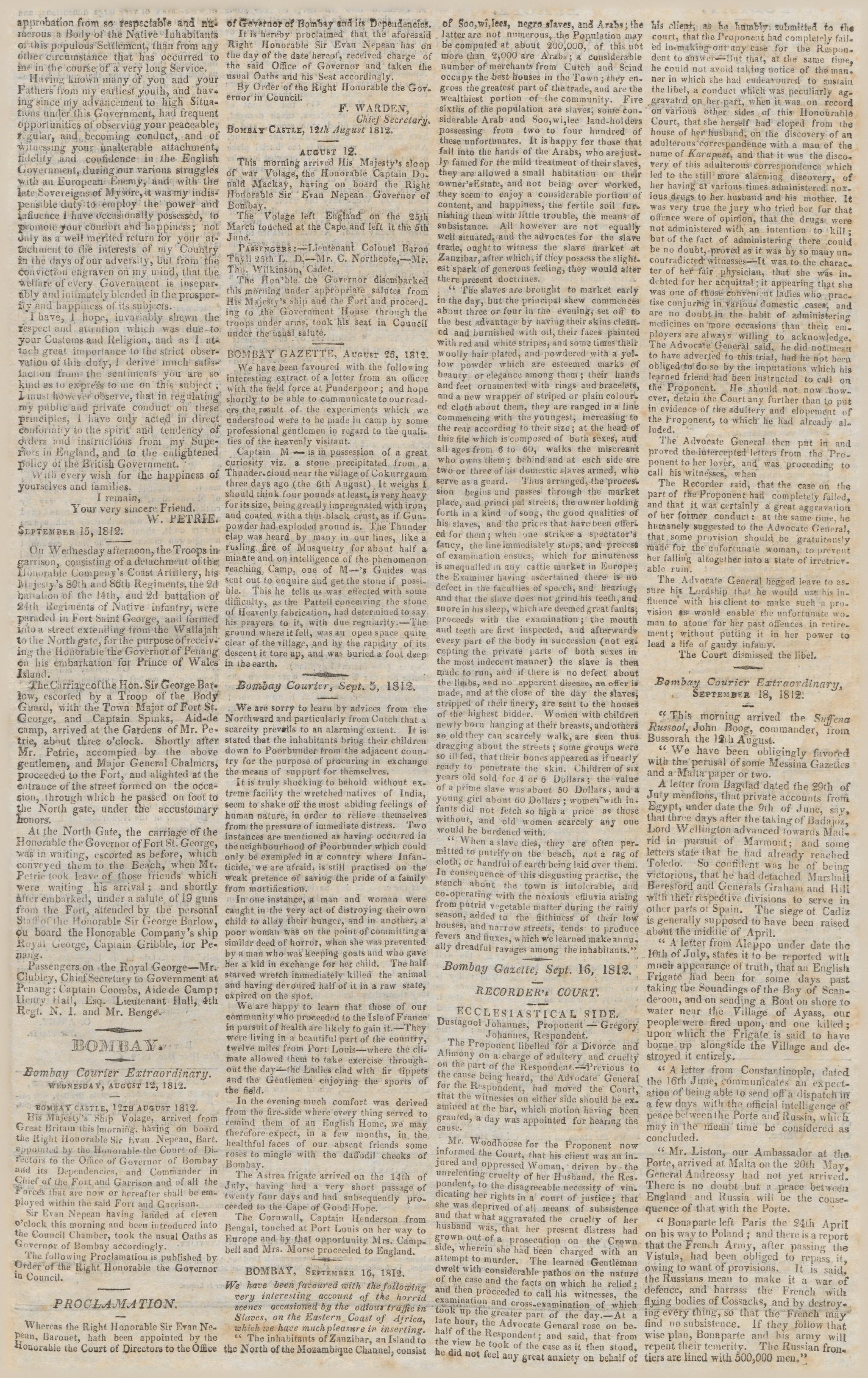
Page 3 of the Java Government Gazette, December 19, 1812. It records a meteorite fall that appears in none of the six meteorite catalogs Waites checked. The original page is on Delpher (National Library of the Netherlands). Source: Jesse Waites's blog
The page at the top is page 3 of the Java Government Gazette from December 19, 1812. The article reprints a letter that had run in a Bombay newspaper that August. It reads: "a stone precipitated from a Thunder-cloud near the village of Cokurrgaum three days ago (the 6th August). It weighs I should think four pounds at least". Software engineer Jesse Waites found the article while combing Dutch East India Company (VOC) records and old newspapers with AI agents. None of the six meteorite catalogs Waites checked lists this fall.
Several finds like this have come out in the past few weeks. On September 30, AI engineer Carter Church posted on X that GPT-6 Astra had read a Napoleonic army cipher letter that went unsolved for 217 years. The post topped 5.38 million views. On October 1, historian Benjamin Breen published a 1615 dodo hunting record found with an Opus 5.5 agent. A week later, Waites's meteorite post scored 184 points on Hacker News.
Here is Waites's process. Build an embedding index so old documents can be searched by meaning, pull a broad set of candidate passages, filter them with a cheap model, then have a large model read and translate them and check them against the original scans. Breen had a large model rank the candidates pulled by embedding search, then reviewed the list by hand. In both cases, the person set the questions and decided what counted as a new discovery.
Reference 01Jesse Waites, software engineer in Boston · personal blog. Attached to Waites's post introducing Antiquity is a note from JTPCK, a company that takes on custom AI document-analysis work, presenting this project as its own case study. Waites's relationship to JTPCK has not been disclosed.
Indexing 4.35 million pages of VOC records overnight on one GPU, plus a sweep of old newspapers, turned up a meteorite fall, rhinos, and eruptions missing from the catalogs
Waites read Breen's dodo post and thought, "I can do this." The first step was asking a Deep Research assistant which historical questions could likely be answered with material already online. It came back with 13 candidates. Next, Waites built a pipeline with Claude Code: index with embeddings, search by meaning, filter with a small judge model called Jev, have Claude Haiku translate and pull out dates and places, then have a Claude Code agent check the results against the original scans and match them against scholarly catalogs of meteorites and volcanoes.
Waites indexed 4.35 million pages of Dutch East India Company records, or 5.7 million passages, on a single GPU running overnight for 12 hours. By Waites's math, a person reading 8 hours a day, 5 days a week, at 2 minutes a page would need about 70 years to get through it. Filtering was cheap too. A search for animal records pulled up 59,000 passages mentioning elephants, and having Jev read and filter them cost about $3. For meteorites, the searches used sentences like 'a heavy stone fell from the sky with a loud report,' according to JTPCK's case study page.
Before the real search, Waites had the system find events that were already known. Checking whether Breen's dodo record, the 1783 Laki eruption, and the 1815 Tambora eruption came up confirmed that the search was working.
There were three results. The first is the 1812 meteorite fall on the page at the top. It came from old newspapers, not the Company archives. Waites searched old newspaper articles alongside the VOC records, and the meteorite story ran in one of them, the Java Government Gazette. The original page can be viewed on Delpher, the National Library of the Netherlands' historical newspaper service. The fall is not in any of the six meteorite catalogs. If confirmed, it predates the earliest known meteorite fall in Maharashtra, India, where Cokurrgaum is located, by 26 years.
The second is three Javan rhinos sent as gifts to the king of Kandy in Sri Lanka in 1738–1740. One was shipped in 1738 and two in 1740 aboard the Loverendaal, and all of them died before arriving. These shipments did not appear in any of the rhino record lists Waites checked. The third is volcanic eruptions. Filtering 769 eruption reports left three eruptions that are missing from the Smithsonian volcano catalog: Gamkonora in February 1722, Ciremai in early 1712, and Slamet in February 1780. The original rhino and volcano records are VOC documents held by the National Archives of the Netherlands.
All three are still candidates that experts have not reviewed. Waites has contacted a meteorite curator, rhino researcher Kees Rookmaaker, and volcanologists, and is waiting to hear back. Waites also tried to pin down the great eruption of 1808–09, whose source volcano is still unknown, but found nothing relevant even after the agents read all 633 articles in the first newspaper published in Batavia (today's Jakarta).
Waites's question to a Deep Research assistant
which open historical questions are most likely to be solvable with data that already exists online?
Questions Jev asked when filtering animal mentions
Is this a real animal? Is it wild? Where is it?
Swap the three questions to fit what you are looking for. They were used to keep only real records out of tens of thousands of mentions.
Reference 02Benjamin Breen, associate professor of history at UC Santa Cruz · Res Obscura (Substack)
A historian writing a book on extinction set an Opus 5.5 agent on VOC records and found a 1615 dodo hunt that fills the 1611–16 gap in the sighting timeline
While preparing the dodo chapter of a book on animal extinction, Breen had an Opus 5.5 agent search the VOC records published by GLOBALISE. GLOBALISE is a project by Dutch research institutions that transcribes handwritten Dutch East India Company documents with AI and makes them available for free. Breen used GPT-6 as well. As Breen describes it, agents like Opus 5.5 spin up copies of themselves to split the reading of sources in several languages, and given an API key, they run embedding searches on their own. On this project, the agents multiplied to around a dozen.
The passage the agents found is in the April 1615 logbook of the ship Wapen van Amsterdam. The crew wrote that on Mauritius they "caught many tortoises, dodos [dodeersen], and some geese and parrots." The original is in the VOC archives at the National Archives of the Netherlands. The timeline of dodo sightings had no records for 1611–16. Breen sees this passage as a new record for that gap and wrote, "I do think that this is a publishable result." In the comments, Breen added that to the best of the author's knowledge, the April 1615 passage had never been reported before.
The agents also reread known records in the originals. In a 1638 document, the word 'velthoenderen' (probably the red rail) had been rendered as 'perdrix' (partridge) in an 1890 translation by a French scholar. Opus 5.5 went back to the original manuscript and corrected that translation. Neither the 1615 passage nor this correction has yet been formally reviewed by specialists in the field.
Reference 03Carter Church, AI engineer at SentinelOne · personal site
One scan and about six hours on GPT-6 Astra cracked a Napoleonic army cipher letter that had gone unread for 217 years
This case is not about searching a pile of documents. It is about reading one document nobody could read. Church gave GPT-6 Astra a single scan of a cipher letter addressed to General Marmont, published in a French military journal in 1969, and ran it for about six hours. Working from that one scan, the agent did everything from transcribing the symbols to breaking the cipher. Church wrote, "I spent six hours of model time and a few evenings of my own."
The letter consisted of 1,300 cipher units drawn from 155 distinct symbols. Only 33 symbol meanings had been published before, and they covered 435 of the 1,300 units. The agent worked out the remaining two-thirds or so from the letter itself. It read the full letter in French and English, and corrected the date, misprinted in the 1969 reprint, to late March 1809.
Church also published a solution package with the key (key.tsv), the transcribed ciphertext, and verification scripts (verify.py, reproduce.py), so anyone can rerun and check it. Israeli outlet Calcalist reported that Satoshi Tomokiyo, who runs the cipher research site Cryptiana, has marked the cipher as solved.
What people who used it say
What worked
“The agents doing the grunt reading while you decide what matters feels like the actual division of labor.”
“For every amount of pages you have the time to read, an LLM provides a means to filter the set of pages you choose to read to a set that is more likely to be useful. It does not need to be perfect at it”
“As an AI "hater", I definitely think there are very useful and net-positive (and underrated yet) applications of the LLM technology. Finding something in archives is definitely one of those.”
“these kind of things are inspiring – especially if you are getting more confidence in that Mauritius-to-India link.”
A reporter on the New York Times visual investigations team. The link refers to a hypothesis Breen discussed: that dodos from Mauritius may have reached the court of the Mughal emperor Jahangir in India.
Nothing in this process is specific to old manuscripts. If you have one question and more documents than anyone could read, such as internal meeting notes or customer support logs, you can follow the same steps. First test the search on something you already know the answer to. Pull broadly, filter with a cheap model, then check what the large model read against the originals. Waites ran VOC records and old newspaper pages through the same process.
For practice material, GLOBALISE offers VOC records for free. The project is transcribing more than 5 million handwritten pages with AI, available through a web viewer and as Dataverse datasets.
When you open a folder created by Antiquity, the agent follows the seven steps written into it. Set the question, and pick an event whose answer you already know as a control to confirm the search works (Antiquity calls this the buried wristwatch). Retrieve broadly with embedding search. Filter with a cheap model. Read closely with a large model. Check against the original pages. See whether the record already exists in scholarly catalogs. Archive the evidence and write it up.
1
Install Antiquity
It is free and open source. The coding agent you open in the folder handles searches and model calls, so model fees are separate.
Install command
go install github.com/jessewaites/antiquity@latest
2
Create a working folder for your question
It asks for four things: a name, a one-line question, a longer description, and an API key (optional). Then it creates a folder containing AGENTS.md, CASE.md, HANDOFF.md, and more.
Create a folder
antiquity new my-investigation
3
Open a coding agent in that folder
Move into the folder and open Claude Code or Codex.
Go to the folder
cd my-investigation
4
Have it find known events first
This is where you confirm the search works. Waites first checked whether the dodo record, the 1783 Laki eruption, and the 1815 Tambora eruption came up.
What you need
Go (to run the go install command)
A coding agent such as Claude Code or Codex
Budget for model API fees and a GPU to build the embedding index (Antiquity is a working-folder tool; it does not run searches or call models itself)
Share this reference
Weekly
Weekly · Free
Collect
Verify
BEST picks
Your inbox
Was this reference helpful?
The week in AI: the BEST just 3, straight to your inbox
Work Smarter with AI
You're in See you in your inbox with the next issue.