Loading...

Planning interview skill · grill-me

Have the AI grill you on decisions before it builds, and plans for a fintech app and a vacation rental site changed course

Install grill-me and call it with /grill-me, and Claude Code or Codex doesn't start building. It groups what needs deciding into numbered questions, each with a recommended answer, and moves on only once you've answered. Here are screens from people who used it on their own work, from developers to a vacation rental owner.

Oct 6, 2026·4 cases

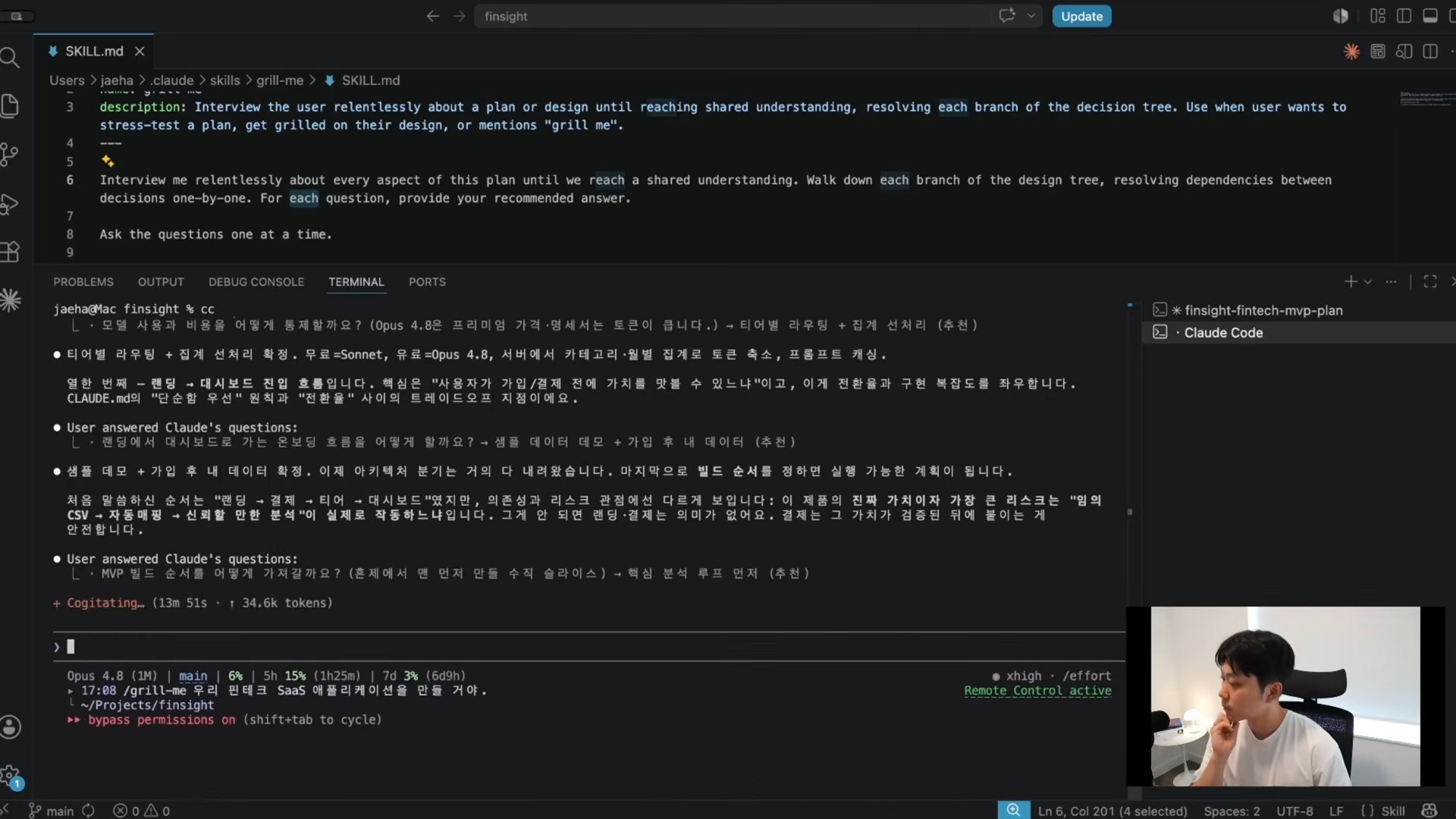
Claude Code terminal. A message proposing a new build order that begins “처음 말씀하신 순서는 랜딩 → 결제 → 티어 → 대시보드였지만” (the order you first gave was landing → payments → tiers → dashboard, but), with '13m 51s · 34.6k tokens' shown
After 12 questions were answered, the AI proposed a new build order. Source: Silicon Valley Developer on YouTube

In the video at the top, the YouTuber Silicon Valley Developer added /grill-me in Claude Code and described a fintech app he wanted to build: upload a credit card statement as a CSV, and the Claude API analyzes it. The plan was to build a landing page and add subscription payments. The AI didn't start building. It asked 12 questions. Then it proposed a new order: “처음 말씀하신 순서는 ‘랜딩 → 결제 → 티어 → 대시보드’였지만 … 결제는 그 가치가 검증된 뒤에 붙이는 게 안전합니다” (the order you first gave was landing → payments → tiers → dashboard, but … it's safer to add payments once the value is proven).

grill-me is a skill that developer educator Matt Pocock released in February. On skills.sh it has 1.28 million total installs, second overall. In August, Theo, a developer tools CEO and YouTuber, wrote on X that “Matt's "grill-me" skill is exceptional,” and the post drew 650,000 views. In May, Matt wrote that “/grill-me is my most popular skill ever,” but added that he no longer uses it for coding work and uses a revised version instead.

When you call grill-me, the actual questioning rules come from the grilling skill you install alongside it. The AI lays out the decisions to make like branches on a tree, then groups the questions you can answer now into one round, each numbered and with a recommended answer. Facts it can find in the repo or in files, it looks up itself. Only decisions go to you. It moves on to the next job only when there's nothing left to ask and you've confirmed. It doesn't save what you decided to a file.
Reference 01Silicon Valley Developer, a Korean-language coding instructor · course practice project (YouTube)

For a card statement analysis app, it first asked whether to keep the originals, then pushed payments back until the value was proven

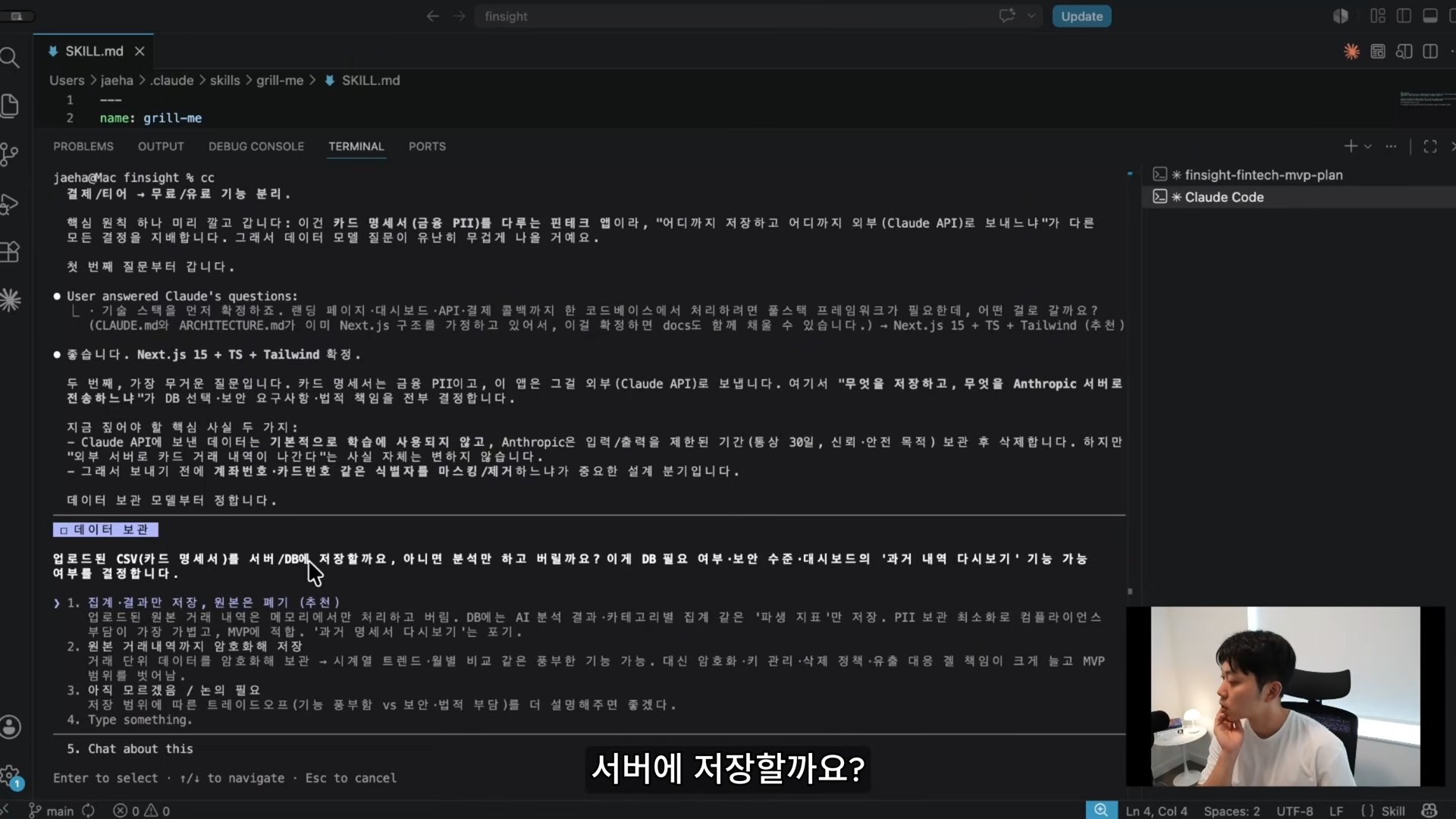
The first question was whether to store uploaded card statements on the server, or analyze them and throw them away. Because the app handles personal financial data, the AI said that “어디까지 저장하고 어디까지 외부(Claude API)로 보내느냐” (how much to store, and how much to send outside to the Claude API) would shape every other decision, and it recommended discarding the originals and keeping only the aggregated results. Each question came with a recommended answer, which he described as “결정 피로를 제거” (removing decision fatigue).

The first question in the Claude Code terminal: “업로드된 CSV(카드 명세서)를 서버/DB에 저장할까요, 아니면 분석만 하고 버릴까요?” (should the uploaded CSVs, the card statements, be stored on the server/DB, or analyzed and discarded?), with the option “집계·결과만 저장, 원본은 폐기 (추천)” (store only aggregates and results, discard the originals, recommended) below
First question · it asks whether to keep the original card statements and recommends keeping only the aggregates
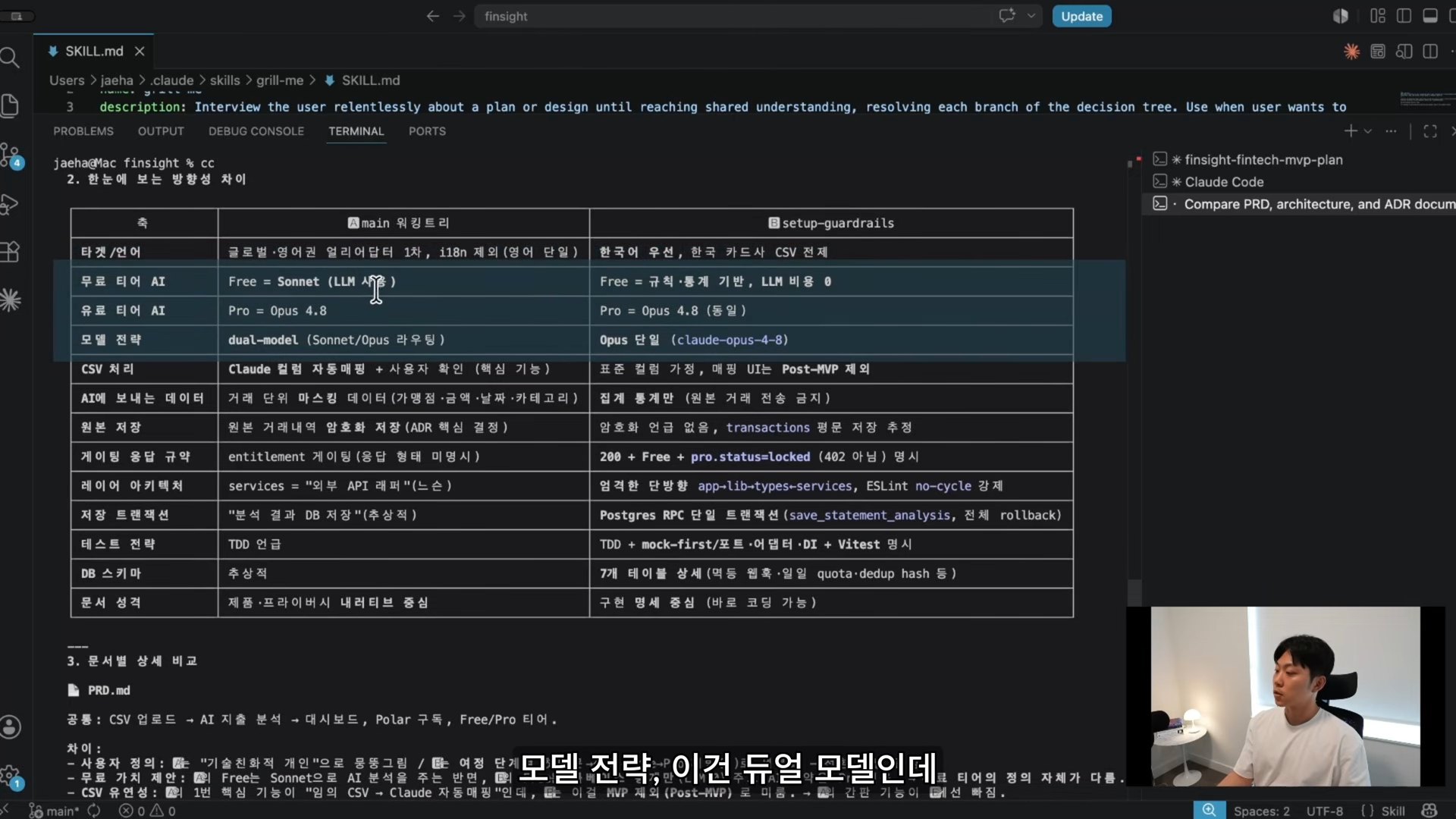
A comparison table setting the plan from grill-me (main worktree) beside the design he had written earlier (setup-guardrails), item by item
The plan from grill-me (left column) next to the design he had written by hand earlier (right column)

He set it beside the design he had written by hand earlier and judged that the grill-me plan was “비전 내러티브가 더 풍부하지만 구현 디테일은 비어 있다” (richer in vision narrative, but empty on implementation detail). His verdict: it's good for producing a product requirements document (PRD), but turning that into an actual design takes a different skill.

Reference 02Sage, who runs a private-house rental for foreign guests · GPTers, a Korean AI community

Questioned before adding scroll effects, a rental site owner swapped a flashy landing page for quiet motion on three detail pages

Before adding scroll effects to the website of a private-house rental in Seoul, Sage added one sentence to the end of the request they had been using. The first round brought six questions, and Sage wrote that they were “전부 제가 안 정하고 있던 것들” (all things I hadn't been deciding). The terms were hard to follow, so Sage asked for the questions again in plain words, and five came back. Once the answers were in, the plan had changed like this.

Under the original requestAfter answering the questions
WhereA flashy first screen (landing page)Three house detail pages
HowMotion that holds the screen in placeMotion that scrolls past without holding
With whatA specialized libraryBuilt-in browser features only

As the reason for the change, Sage wrote “첫 화면은 이미 괜찮았고, 예약 결정은 하우스 페이지에서 일어나기 때문” (the first screen was already fine, and booking decisions happen on the house pages). The answers left one principle: “절제한다. 화면을 붙잡아두지 않는다.” (Hold back. Don't pin the screen in place.) Sage wrote, “/grill-me 한 줄이 그 결정권을 저에게 돌려줬습니다” (one line of /grill-me handed that decision back to me).

The one sentence Sage added to the end of the request

수정 작업하기 전에 결정해야 할 것을 /grill-me를 써서 물어봐

If the questions are hard to follow, reply with something like "Explain it simply, then ask me again," and it asks again in plain words.


The finished rental website, 'A Private House in Seoul'. The name sits over a photo of a wall and pine trees, followed below by the introduction 'Not a hotel. A home.'
The finished website. Source: Sage's post on GPTers

Reference 03Theo, developer tools CEO and YouTuber · t3.gg

Asked to get on the same page about Theo's project, it read the repo before asking anything and flagged a badly stale project guide

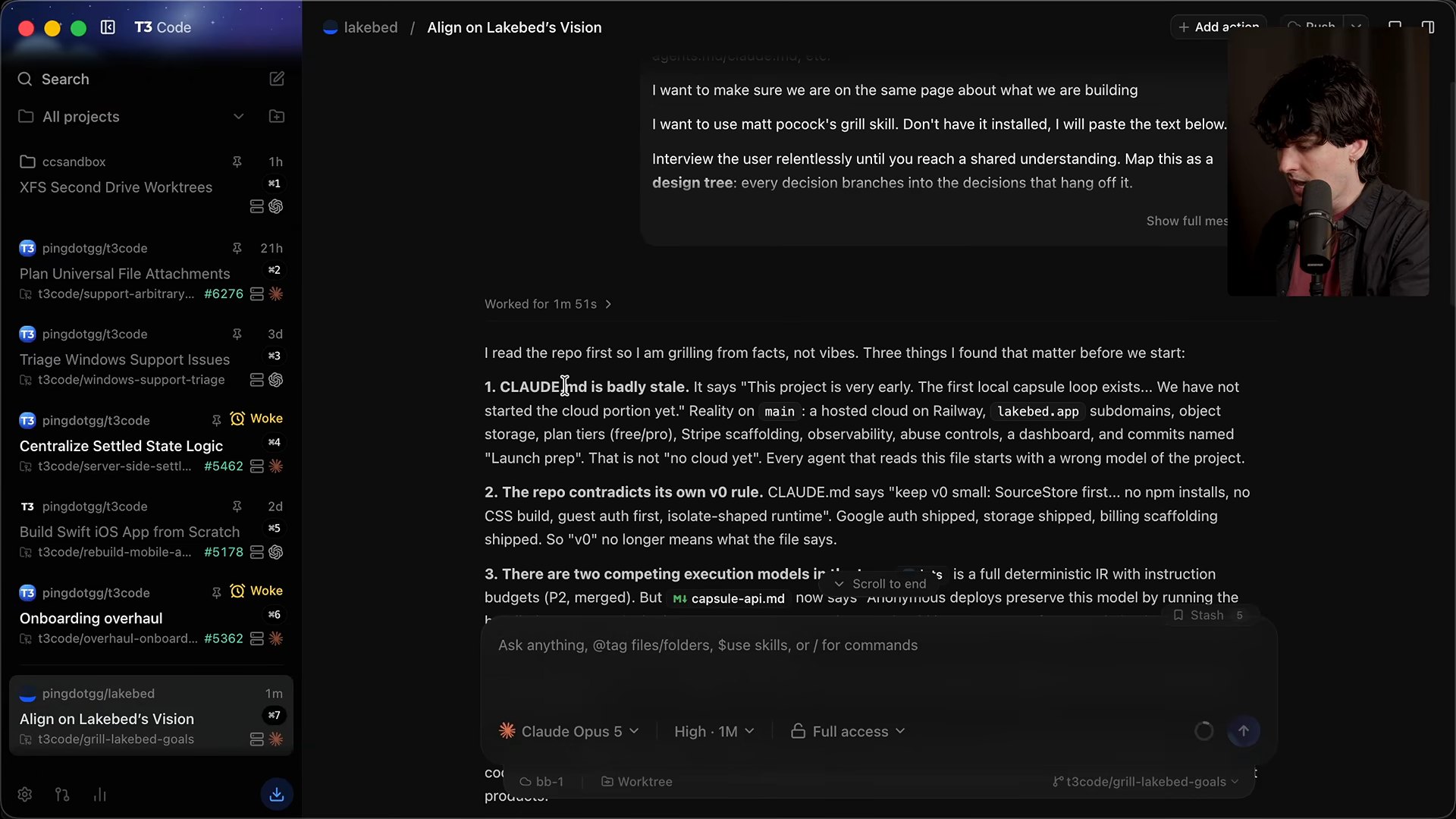
To line up with the AI on the goals of his project Lakebed, Theo didn't install the skill. He pasted in the grilling text and handed the job to Claude Opus 5. The AI spent 1 minute 51 seconds reading the repo first, said “I read the repo first so I am grilling from facts, not vibes.” and opened with three findings: the guide file agents read (CLAUDE.md) was badly stale, the repo contradicted its own v0 rule, and it had two competing ways of running things. Theo said, “I'm already realizing that I need to clean up this project.”

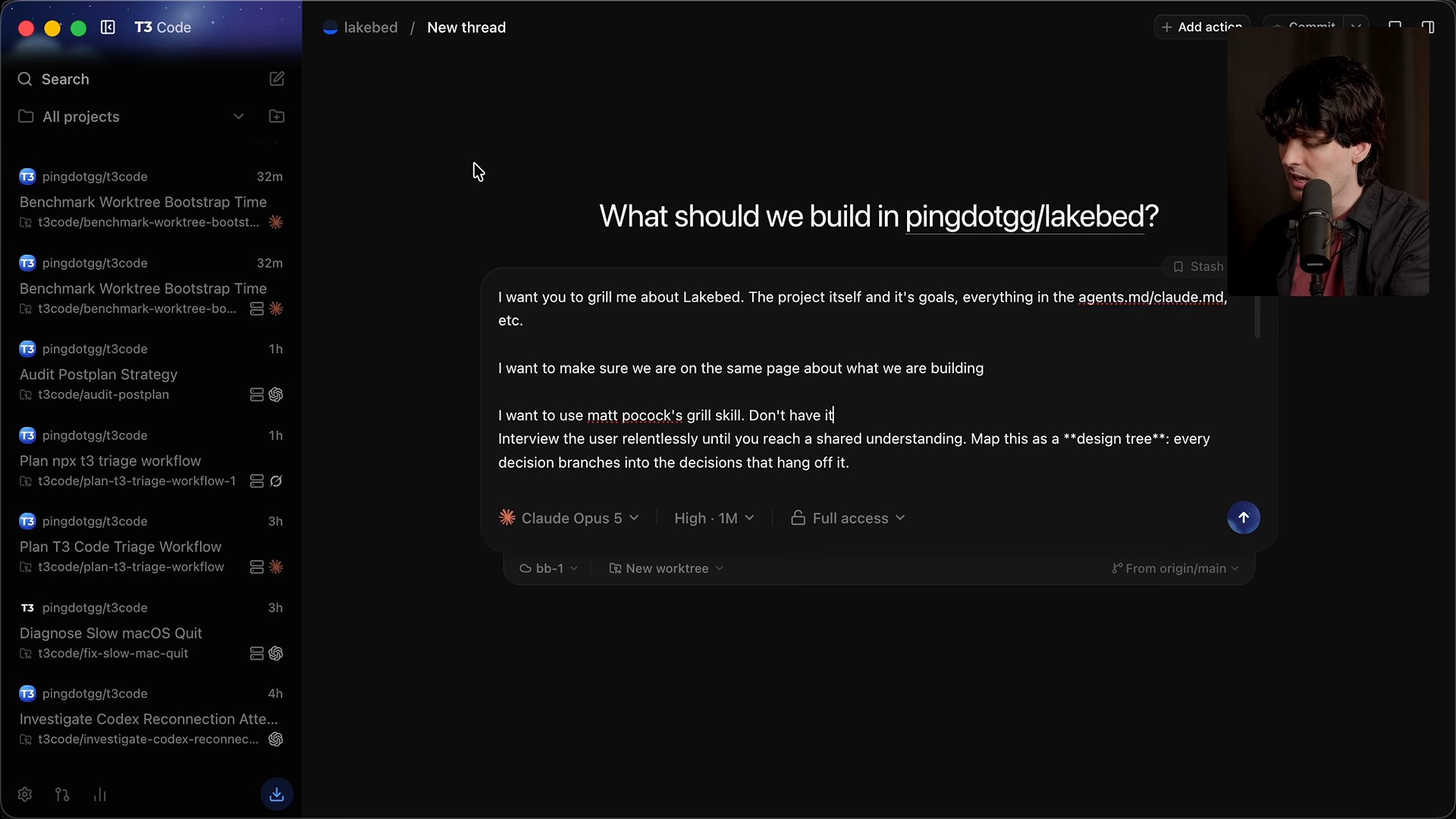
Theo's request (with the grilling text pasted after it)

I want you to grill me about Lakebed. The project itself and it's goals, everything in the agents.md/claude.md, etc. I want to make sure we are on the same page about what we are building

Put your own project's name in place of Lakebed.

The T3 Code screen. Under 'Worked for 1m 51s', 'I read the repo first so I am grilling from facts, not vibes.' and three findings, starting with '1. CLAUDE.md is badly stale.'
Claude Opus 5 · three things it found in the repo before asking anything
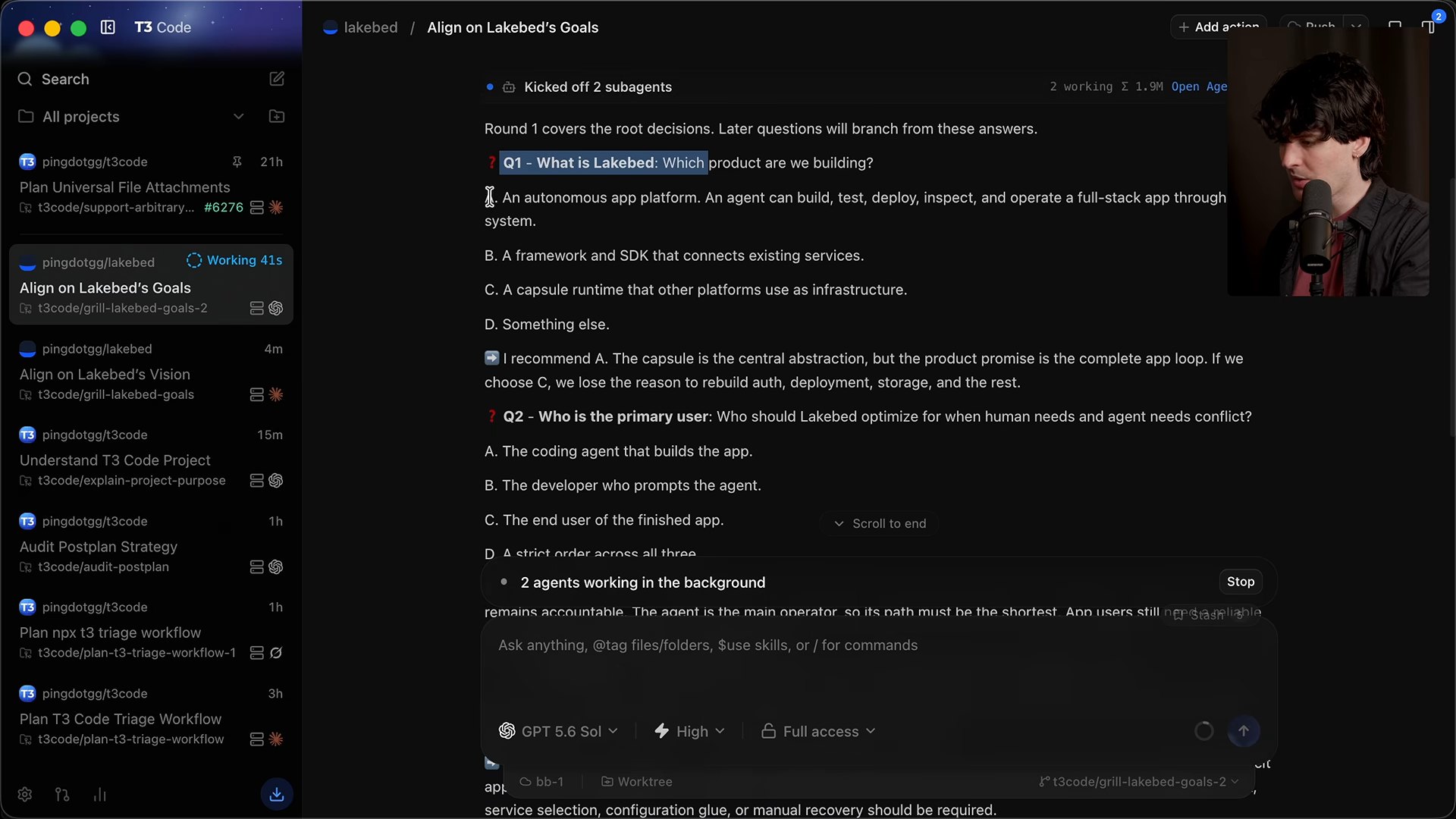
The same job given to GPT 5.6 Sol. Under 'Round 1 covers the root decisions.', Q1 'What is Lakebed' with options A to D and 'I recommend A.'
GPT 5.6 Sol · options A to D and a recommended answer for each first-round question
The T3 Code screen showing the three things grill-me found in the repo

Reference 04Povilas Korop, a developer YouTuber · AI Coding Daily

On the same client brief, Claude Code's plan mode asked 4 questions and grill-me asked 13, and the plan grew from 55 lines to 146

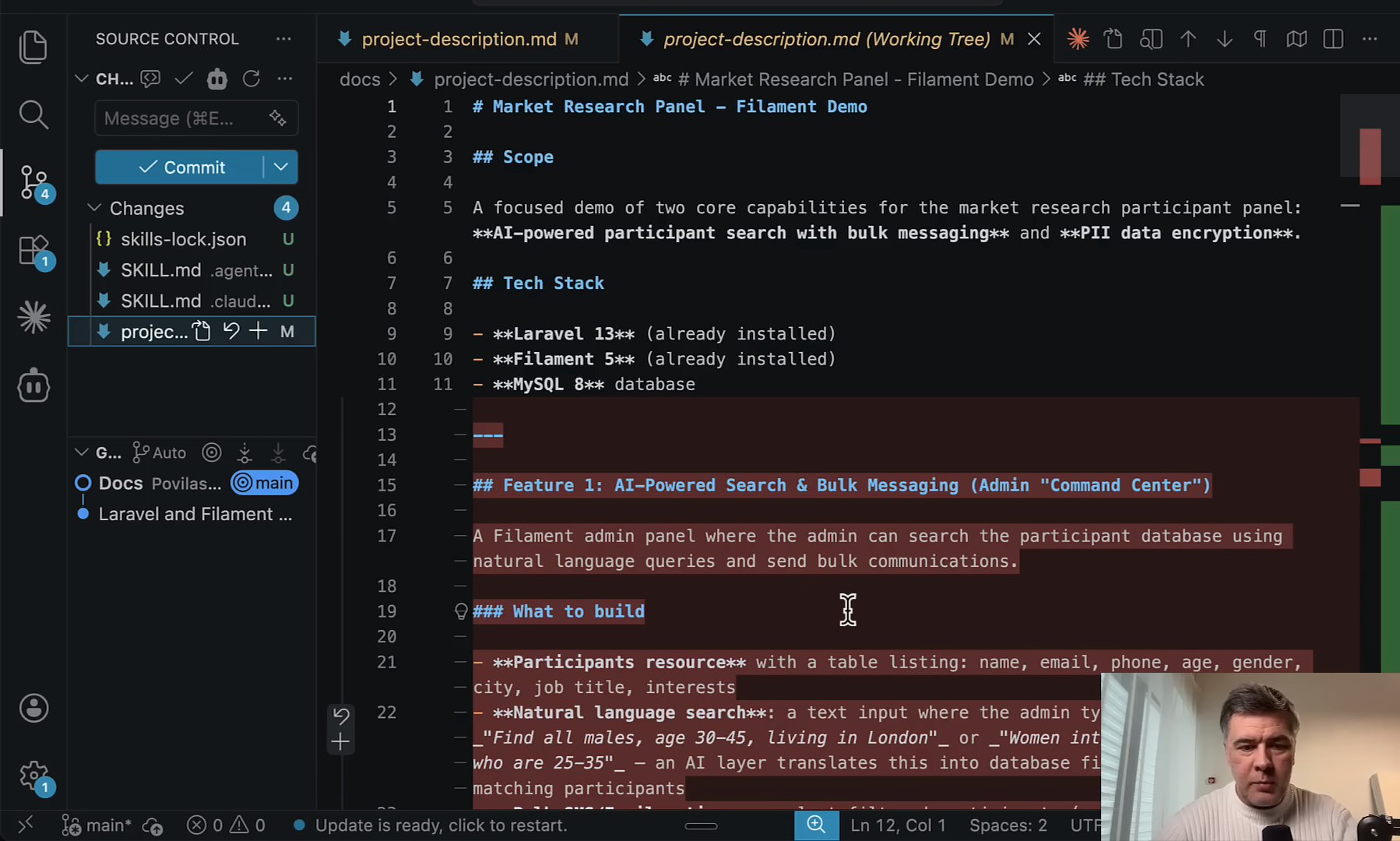
Povilas put the description of a market research panel app (Laravel, Filament) into a demo repo and had several approaches plan it. Given the same description, Claude Code's plan mode asked 4 questions, Codex's plan mode 3, and the Superpowers plugin 8. grill-me asked 13. The plan doc grew from 55 lines to 146, but he said “it's not even about the length. It's about the quality of details that are much more ready to start building.”

In August he ran the comparison again, this time on the brief from a real Upwork job he had worked on a few months earlier. Plan mode assumed Filament 4, while grill-me dug further and named Filament 5. But since the update that groups questions into rounds, the first round arrived as nine questions at once, and on his small laptop screen he had to scroll up and down to get through them.

VS Code showing what changed in the plan doc

What people who used it say

What worked

  • “I've noticed that with this workflow, it does exactly what I wanted 90% of the time, and reviewing the code it generates is a lot easier.”

    On using grill-me to plan in Codex.

    u/Impossible-Suit6078 · Redditreddit.com
  • “Even with a well-defined PRD, it reshaped things in a much better way through short, focused questions.”

    Said from the product side rather than as a developer.

    u/Charming_Cookie_5320 · Redditreddit.com
  • “the extra step to make sure that there's no miscommunnication between the agent and me has actually improved the code and behaviour i've received from my cli agents a ton.”

    They noted they have no ties to the skill's maker.

    u/Herfstvalt · Redditreddit.com
  • “you may end up in a grill me session for seven hours like I was. But holy shit, did I have one hell of a plan coming out of the end of it.”

    u/clckwrxz · Redditreddit.com

What fell short

  • “Building something with @mattpocockuk's grill me skill, and to say I'm at my wit's end would be an understatement / How many more do you have for me bro?????”

    The attached screenshot showed question 139.

    thesobercoder · Xx.com
  • “One answer leads to three more questions, and before I know it I'm deep into implementation details when all I wanted was an MVP.”

    u/GradeOdd3588 · Redditreddit.com
  • “Not gonna lie, getting 10+ questions at once is unbearable.”

    From an issue asking for the old version back, after a July update started grouping questions into rounds. It drew 35 thumbs-up.

    hendrixfreire · GitHubgithub.com
  • “When GPT runs out of questions, it begins implementing directly. I have to stop it and then redirect it with `/to-prd`.”

    It starts building without asking, so they have to stop it and steer it to a separate skill.

    ovsw · GitHubgithub.com

How to start

grill-me is a one-line file that calls the grilling skill installed with it, so installing grill-me alone does nothing. Install both. Its maker recommends turning plan mode off. Plan mode pushes the AI to hand over a plan quickly, which works against grill-me's whole point of keeping the questions coming.

  1. 1

    Install both skills in the folder where you use Claude Code or Codex

    There's deliberately no cap on the number of questions. If there's a lot to decide, it can run to hundreds of questions, so start by handing it something small.

    Install command

    npx skills add mattpocock/skills --skill grill-me --skill grilling

  2. 2

    In a new conversation, put /grill-me in front of a job that still has decisions to make

    In Codex, call it with $grill-me. If you don't know the answer to a question, it's fine to say so.

    The request Alex Lieberman (Morning Brew cofounder) uses to start his day

    /grill-me about my todo list for the day

    He said he gets questions like "If the day blows up at noon and you only ship one of these four, which one is it?"

  3. 3

    Don't just accept the recommended answers. Send your own

    Its maker names the most common failure as sending 'agree' to 40 questions and walking away, having only nodded along to a plan the AI wrote. If you'd rather get one question at a time, add 'When grilling, ask one question at a time.' to CLAUDE.md.

What you need

  • A coding agent like Claude Code or Codex
  • Node.js (to run the npx install command)

Share this reference

Did you find this reference helpful?

Get curated references delivered to your inbox weekly