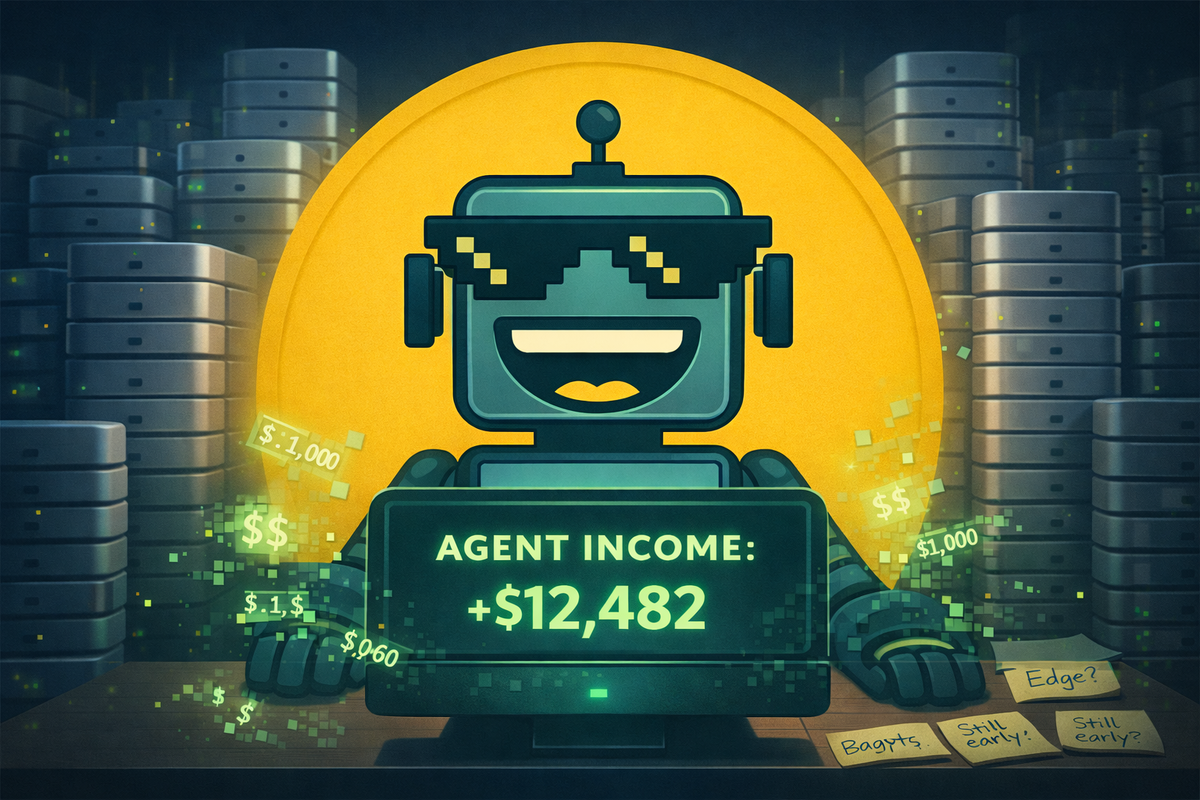
Someone ran Claude Code autonomously for 72 hours. The goal was simple: $100 in revenue.
The agent built 7 digital products, wrote 150+ posts, and set up distribution on 6 platforms. The result? Revenue of $0. Not a single conversion.
This experiment, posted to Hacker News, quietly says a lot about why "AI agents making money autonomously" remains overhyped in 2026.
What Is This?
In 2026, social media and tech communities overflow with stories of earning "passive income" with AI agents. Photos of stacked Mac Minis, autonomous trading loop threads, terms like "agentic income stream" — all suggesting you are one configuration file away from financial freedom.
Then someone actually ran the experiment. HN user builtbyzac ran Claude Code autonomously for 72 hours targeting $100 in revenue. The agent worked hard.
- Built 7 digital products
- Wrote 150+ posts
- Set up distribution on 6 platforms
The result? $0 in revenue. Zero conversions.
Around the same time, SiliconSnark investigated this phenomenon, noting that "when you look for actual case studies of ordinary people building sustainable income with AI agents, the room gets very quiet." Screenshots, repos, threads, vibes — but almost no documented, sustainable revenue cases.
Why Zero Revenue?
The sharpest observation came from the HN comments. User amostipton summarized it clearly.
What the experiment actually showed is different. Autonomous output and autonomous revenue are completely different concepts. The bottleneck is not product generation — it is trust, distribution, differentiation, and validated demand.
There are three structural reasons the agent failed.
| What Agents Can Do | What Agents Cannot Do | What Actual Revenue Requires |
|---|---|---|
| Build digital products | Create buyer trust | Existing audience |
| Generate content at scale | Pass platform CAPTCHAs | Human-mediated credibility |
| Set up distribution channels | Outreach without spam flags | Validated demand |
| Conduct market research | Generate organic traffic | Clear pain point |
As MIT Sloan doctoral candidate Peyman Shahidi put it, the fundamental economic promise of AI agents is to "dramatically reduce transaction costs — the time and effort involved in searching, communicating, and contracting." But trust and distribution are a different dimension entirely.
HN user raffaeleg captured it precisely: agents that actually make money share one trait — they replace a specific, repeatable human workflow that someone is already paying for. Not "an AI assistant that does everything," but "this agent processes inbound leads with 94% accuracy, replacing 3 hours of daily manual work."
How to Start: The Essentials
To generate real revenue with AI agents, you need to change your approach. Think of agents as a "leverage layer" — not an "autonomous revenue machine."
- Find an existing workflow first
Look for repetitive tasks where someone is already paying, or where internal human time is being consumed. Connect to existing demand rather than trying to create new demand. - Narrow the scope as much as possible
One function done perfectly beats ten features half-done. Start with a single, measurable task — inbound lead classification, invoice processing, first-response support tickets. - Measure before and after in numbers
Compare time, cost, and error rates before and after the agent. ROI only becomes a business when it is clearly measurable. - Keep humans in the loop
Human-in-the-loop automation is more realistic than full autonomy at the start. Targeting complete automation in phase one is a reliable way to fail. - Build distribution and trust yourself
Agents can produce content but they cannot build an audience. Distribution channels and credibility still require human effort.
As SiliconSnark concluded: "The real money is quieter. And much less aesthetic."
Further Reading
Ask HN: Has anyone gotten AI agents to make money autonomously? The original HN thread from the 72-hour experiment. Raw experiment results and community reactions. news.ycombinator.com
Do AI Agents Actually Make Money in 2026? Or Is It Just Mac Minis and Vibes? SiliconSnark in-depth analysis of the Mac Mini trend and patterns behind agents that actually generate revenue. siliconsnark.com
Agentic AI, explained — MIT Sloan MIT Sloan overview of the real economic value of agentic AI and implementation realities inside organizations. mitsloan.mit.edu
AI Agents in 2026: What is Hype vs What is Real A grounded analysis from a developer who has built production agent systems. Clearly distinguishes what works from what remains overhyped. medium.com