You’re using AI coding well, but the budget runs out halfway through the month
In some organizations, output metrics such as merged PRs increased after adopting AI coding tools. But admin dashboards accumulate different charges for each user and model, and it becomes difficult to explain who spent how much on which work. When the only options are “keep allowing it” or “block everything,” you can easily lose useful productivity signals too.
A more practical answer is to first make usage visible, find the least expensive model that meets real-work quality standards, then add friction in the order of alerts, switching, and exception approval. Uber introduced per-user limits and dashboards for AI coding tools. Separately, it adjusted default models by task, moved some work to lower-cost and open-weight models, and gave employees spending information. It said total AI spending remained broadly stable even as adoption increased.
This case does not mean every developer should be forced onto the cheapest model to cut costs. What matters is the order in which you decide which productivity numbers to trust and where to begin changing models.
Microsoft’s 24% is not return on cost
In Microsoft’s early 2026 study, engineers who adopted Claude Code or Copilot CLI had 24.0% more merged PRs per engineer-day than a synthetic control group over the following 115 days. The Bayesian 95% interval was 14.5–33.7%.
It is a notable increase, but it needs careful interpretation. This was not a randomized experiment, and it measures the adoption effect of the two CLI tools combined, not Claude Code alone. More merged PRs also do not directly mean better code quality, customer value, or labor costs saved.
Right after the observation period ended, Microsoft announced an internal policy to discontinue Claude Code licenses for most engineers and move them to Copilot CLI. But the paper did not disclose how many licenses were discontinued or say that cost was the sole or decisive reason.
That is as far as the public evidence lets us go. It is confirmed that Microsoft decided to switch tools, but there is no verified basis for generalizing that “it turned off licenses for more than 5,000 people because of cost” or that “AI coding costs have already surpassed labor costs.”
Uber changed the default path, not just the cap
Uber was reported to have already reached its annual overall AI budget limit in April 2026. For agentic coding tools such as Cursor and Claude Code, it set a monthly limit of $1,500 per employee per tool, along with personal usage dashboards and an approval process for exceeding the limit.
Separately, the measure Uber described in official materials as supporting stable spending was adjusting default models by task. It moved some work to cheaper and open-weight models and gave employees spending information. According to its official second-quarter materials, the cost per token had fallen in recent months, while total AI spending stayed broadly stable even as tool adoption increased.
However, Uber did not disclose usage growth rates, savings, or quality changes by task. It is also unknown how much per-user caps contributed to stable spending. “Stable spending” is a useful operating signal, but it should not be read as a controlled experiment showing quality was maintained.
| Observed signal | Conclusion you should not jump to | Value to check next |
|---|---|---|
| 24% increase in merged PRs | 24% increase in return on investment | Cost per approved output, defects, rework |
| Annual overall AI budget exhausted early | AI coding tools are an economic failure | Usage growth, cost by task, time displaced |
| Total AI spending is stable | Cost savings succeeded with no quality loss | Pass rate by model, rollbacks, task completion rate |
Not the cheapest model, but the cheapest model that clears the quality bar
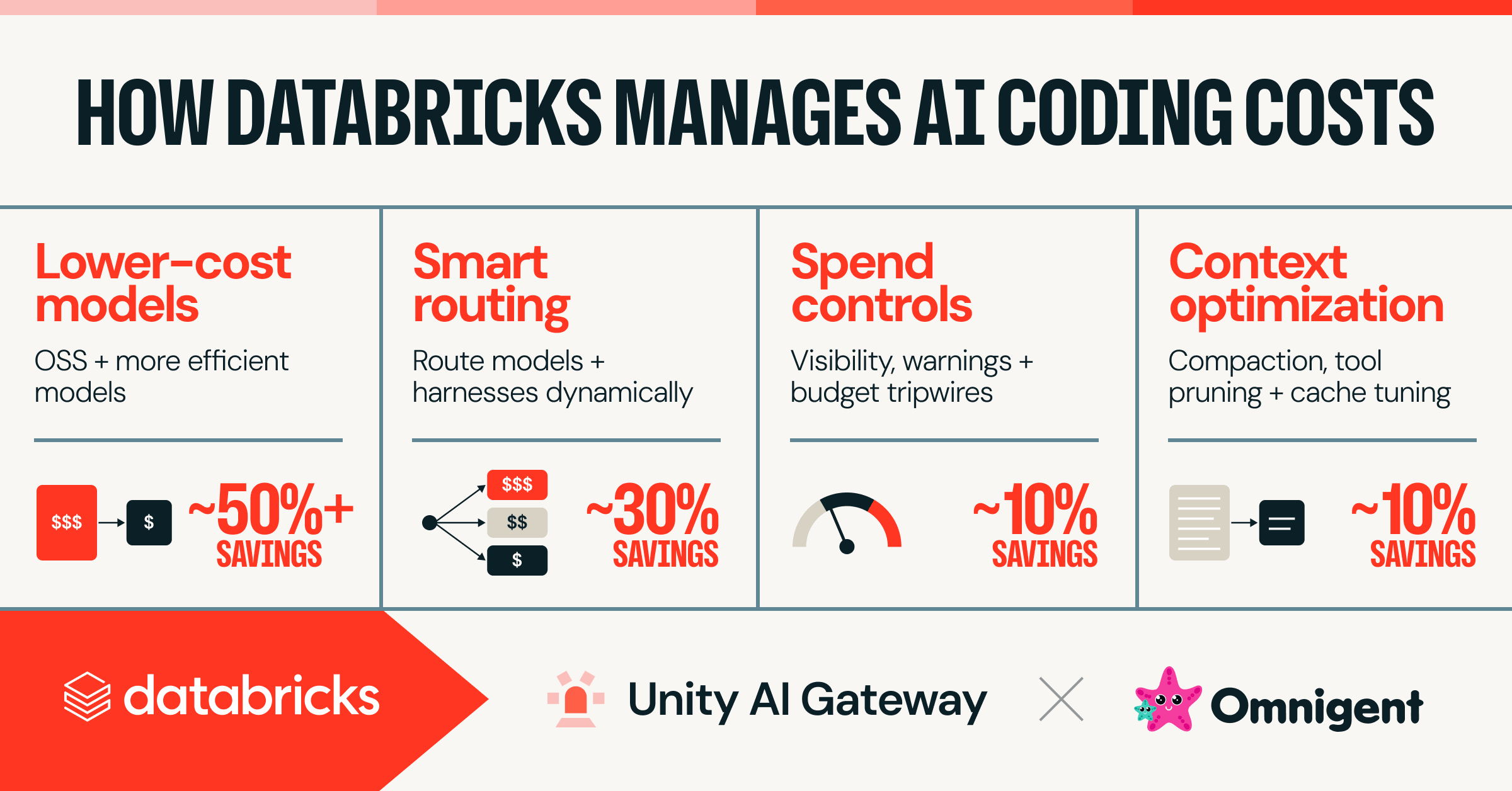
The standard proposed by Databricks is not to apply the lowest-cost model across the board either. Because public coding benchmarks may not adequately represent actual internal work, its approach is to build an evaluation set from recurring internal tasks and choose the most cost-efficient model among those that meet the required quality.
In Databricks’ internal results, Smart Router reduced average cost per task by more than 30% while delivering quality broadly similar to the most expensive model in the comparison. Work that reduced unnecessary reasoning calls and adjusted context compression and cache settings reportedly cut generated tokens and associated costs by about 50%.
Those figures should not be copied directly into a budget. They are internal results that do not disclose the tasks, period, sample, quality metric, or original cost. What to take from them is not the savings rate, but a structure for separately testing task-level evaluation, routing, and harness optimization.
Today, use the last four weeks of records to change just one model
Before buying a new cost-management system, bring admin dashboards, billing records, and PR and CI records into one sheet. If you use Claude Enterprise, the admin console lets you review costs by group, user, and model, as well as Claude Code usage metrics. You can also set admin alerts at 75% and 90% of the organization spending limit.
- Put costs into the same unit.
Group the last four weeks of records by user, team, tool, and model, and include subscription fees and usage-based overage costs. If user identifiers differ across tools, connect them first using employee or team IDs. - Place outcomes and quality next to cost.
Link merged PRs or approved task counts, then list CI pass rates, rework, and rollbacks alongside them. If you block the biggest spenders first, you cannot distinguish people handling difficult work from people wasting usage. - Choose three to five recurring tasks.
Choose tasks with comparable inputs and success conditions, such as adding simple tests, editing documentation, or fixing small bugs. Apply the same tests and quality standards to the current default model and lower-cost candidate models. - Lower the default model only for tasks that pass.
Change the default path only for tasks where the lower-cost model meets the same quality bar, and retain an exception path that moves up to a higher-tier model for complex refactoring and ambiguous incident analysis. - Increase friction gradually, starting with alerts.
Set policy in the order of current-spend visibility, budget alerts, user confirmation, admin approval, switching to a lower-cost model, and temporary suspension. Claude Enterprise’s 75% and 90% alerts are warning features and should be distinguished from a feature that automatically switches to a lower-cost model. - Recalculate cost per task after the change.
Check whether cost per approved output has fallen. If increased defects and rework offset the savings, restore the default model or narrow the set of tasks it applies to.
Success criteria for the first review
It is enough to be able to compare model-level quality pass rates and cost per approved output for at least one recurring task, with the default model, alert thresholds, and owner for exception approvals documented. Calculating an organization-wide savings rate comes next.
If you want to dig deeper
Managing AI Coding Costs at Scale explains how internal evaluation, model routing, harness optimization, and staged spending gates can be connected in sequence. databricks.com
Adoption and Impact of Command-Line AI Coding Agents lets you check in the original paper how Microsoft’s 24% figure was calculated, including the population, period, and method. arxiv.org
Uber Q2 2026 Prepared Remarks lets you review the cost changes Uber reported after shifting to lower-cost and open-weight models and providing spending information. investor.uber.com