Google reviewed it twice. Anthropic reviewed it. The FFmpeg open-source community pored over it for 23 years, tens of thousands of times. Nobody found it.
An AI security agent found all 21 — in two days, at a compute cost of $1,000.
The mainstream take: AI = hacking tool
Scroll through any cybersecurity news feed and it's almost all one direction: AI-powered spear-phishing, AI-generated malware, AI-driven social engineering. On May 11, 2026, Google's Threat Intelligence Group confirmed the first in-the-wild use of an AI-developed zero-day exploit in an actual cyberattack. The narrative of AI as a security threat was cementing itself.
Enterprise security teams share this view. One of their top concerns: AI agents accessing internal systems incorrectly or getting hijacked by attackers. That concern is valid.
What this article is about
AI works as both an attack tool and a defense tool — that's the reality. The attack direction has been covered extensively. Today, let's look at the defense side.
The numbers tell the opposite story
In June 2026, security startup depthfirst published findings that stopped the industry in its tracks. They deployed their autonomous AI agent against FFmpeg's codebase and discovered 21 zero-days at a compute cost of just $1,000. FFmpeg is the world's most widely deployed media processing library — used by YouTube, Netflix, Zoom, VLC, and probably your app if it handles video uploads or conversion.
For context: Anthropic's Mythos model ran similar-scope research at a cost of around $10,000. depthfirst did it for one-tenth of that. AI pipelines specialized for WordPress vulnerability discovery reportedly run at $20 per finding. This is becoming the new price floor for AI-driven vulnerability research.
It's not just depthfirst. Google's Big Sleep, AISLE, and TrendAI's ÆSIR — multiple independent AI systems are now producing CVE-grade findings in production software. Autonomous vulnerability discovery has crossed from research to commercial capability.
How a 23-year-old bug survived — and how AI found it
The most striking find is CVE-2026-39214. A stack buffer overflow in FFmpeg's service-description-table (SDT) parser — introduced in 2003 and never caught despite 23 years of code reviews and fuzzing campaigns.
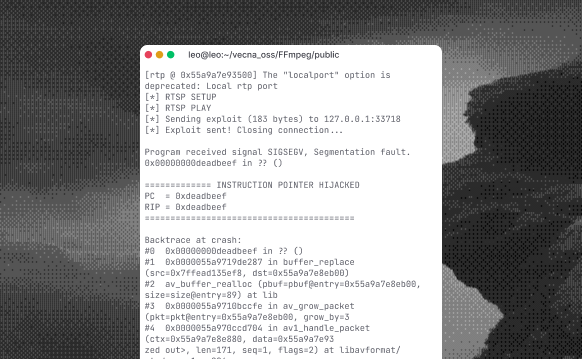
The most severe is DFVULN-127. A heap buffer overflow in the AV1 RTP depacketizer that lets an attacker achieve unauthenticated remote code execution with a single 183-byte packet. The victim just needs to run ffmpeg -i rtsp://attacker/stream.
How the AI agent found these is worth noting. Not simple static analysis — the agent ran threat modeling → attack surface mapping → data flow tracing → reproducible PoC generation in sequence. The key: every finding came with an actual working PoC input, not a vague static-analysis warning.
| Traditional Security Audit | AI Autonomous Agent | |
|---|---|---|
| Cost | Six-figure consulting | $1,000–$10,000 |
| Timeline | Months | Days to weeks |
| Coverage | Selected code paths | Full 1.5M+ line codebase |
| PoC generation | Optional, manual | Automatic for every finding |
| Parallel hypothesis testing | Not possible | Many concurrent threads |
The real problem: patching hasn't caught up
Here's the twist: cheaper discovery isn't inherently bad — it's an opportunity for defenders too. The real problem is discovery speed has accelerated while patch deployment speed hasn't changed.
When discovery gets cheaper, it gets cheaper for attackers too. Research that used to require a six-figure consulting engagement or a year of APT group time can now be done with commercial AI tools and a weekend. Attackers can weaponize AI findings in hours, while enterprise patch cycles still average 60 days.
The Cloud Security Alliance calls this the "Inverted Bottleneck." Discovery is no longer the constraint — triage, patching, deployment, and retesting are now the bottleneck. Discovery gets automated; human capacity to process the results stays flat.
Risk level: Network-reachable FFmpeg
Any service that accepts external URLs and processes them through FFmpeg (upload endpoints, stream conversion, podcast processing) should assess its exposure immediately. DFVULN-127 is unauthenticated remote code execution territory.
What teams using FFmpeg should do right now
- Full inventory sweep: where is FFmpeg hiding?
Check beyond system packages — app directories, container images, Python wheels, Electron bundles. Version strings alone aren't enough; validate build configurations and runtime paths. - Reachability check: does external input reach it?
Any path that accepts external URLs is the highest priority. Public upload services, RTSP/RTMP stream processing, live ingest, and CCTV feeds are in scope. Internal-only pipelines carry lower risk. - Sandbox: isolate media processing workers
Run FFmpeg workers with non-root execution, read-only filesystems, network egress restrictions, and protocol allowlists in isolated containers. Don't hardcode secrets inside. - URL control: restrict external resources
If FFmpeg needs to fetch network resources, put a controlled downloader in front that blocks private IPs, enforces DNS policy, limits redirects, and caps file sizes. - Patch subscription: shorten your release tracking cycle
CVE-2026-39210 through CVE-2026-39218 are already fixed upstream. Subscribe to FFmpeg's official security channel and bring patch deployment cycles down from 60 days to under two weeks.
Want to go deeper?
21 Zero-Days in FFmpeg depthfirst's original research — full vulnerability list, CVE numbers, DFVULN tracking IDs, and PoC details depthfirst.com
AI Agent Finds 21 FFmpeg Zero-Days, What Defenders Should Do Next Practical defender guide — reachability triage, sandbox architecture, immediate action plan penligent.ai
CSA Research Note: AI Autonomous Vulnerability Discovery Economics Economic analysis — cost benchmarks, inverted bottleneck concept, threat actor implications labs.cloudsecurityalliance.org
An AI agent found 21 zero-days in FFmpeg for $1,000 The Next Web coverage — industry implications, context alongside Chrome 149's 429 patches thenextweb.com
Autonomous AI Vulnerability Discovery Is No Longer a Research Demo Current state — comparing Google Big Sleep, AISLE, and TrendAI ÆSIR techgines.com
AI Agent Finds 21 FFmpeg Zero-Days Including Unauthenticated RCE Technical detail — DFVULN-127 RCE mechanism and vulnerability class breakdown dailysecurityreview.com