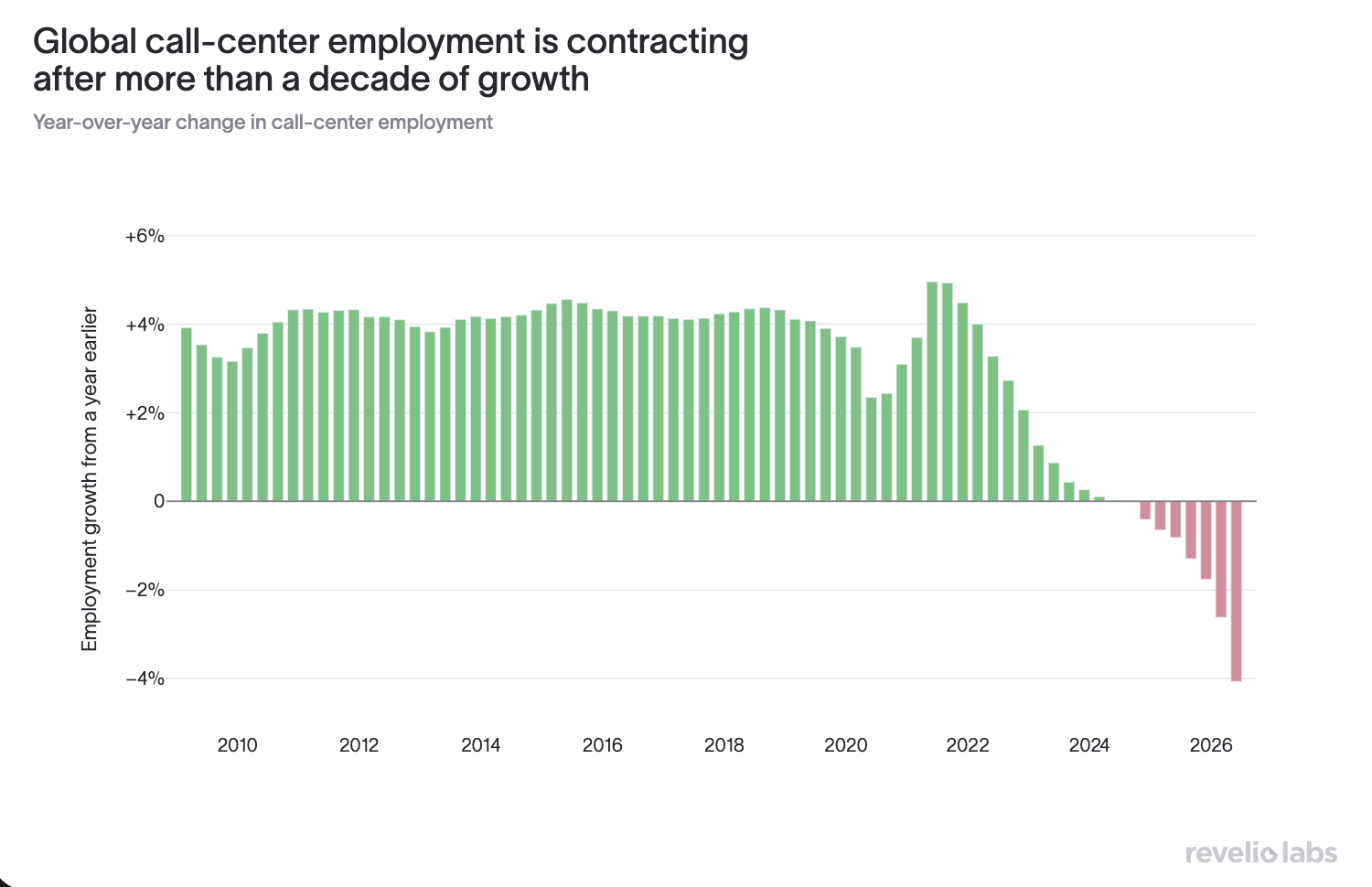
Caelan Wilkie-Rogers, an economic analyst at Revelio Labs, examined data on the global call center workforce. In 12 middle-income countries, fewer people were leaving call centers, but the number joining fell faster and dropped below the number leaving. [[cite:S1]]
Global call center employment is down 5.3% from its December 2023 peak
According to Revelio's count, global call center employment was 5.3% below its December 2023 peak. Researchers compared employment at the end of each quarter since 2009 with the same quarter a year earlier. Of 70 observations, employment fell in eight. All eight declines occurred in the most recent eight consecutive quarters. [[cite:S1]]
The global decline does not mean the same thing happened in every country. According to the original analysis, declines began at different times depending on income level, and call center employment was still growing in China and Nigeria. The workforce flows behind the global change require a separate look. [[cite:S1]]
In 12 middle-income countries, arrivals fell from 25.1 to 17.2 per 100 call center workers
Revelio also examined call center workforce flows in 12 middle-income countries. Since November 2022, the number of new arrivals per 100 existing workers fell from 25.1 to 17.2. The figures below cover flows in these 12 countries and are not directly comparable with the global employment decline above. [[cite:S1]]
| 12 middle-income countries | Earlier | Later |
|---|---|---|
| Arrivals per 100 existing call center workers | 25.1 | 17.2 |
| Departures per 100 existing call center workers | 22.3 | 18.5 |
The published analysis does not identify the 12 countries, the number of people covered, or the exact periods over which arrivals and departures were measured. The figures therefore cannot be attributed to hiring decisions in a particular country or workplace. The decline in arrivals is a change observed in the aggregated data. [[cite:S1]]
Departures also fell, from 22.3 to 18.5 per 100 workers, but arrivals fell below them
In the same 12 countries, departures per 100 call center workers also fell, from 22.3 to 18.5. But arrivals fell faster, from 25.1 to 17.2, eventually dropping below departures. Employment declined even though departures did not rise. [[cite:S1]]
These departure figures do not distinguish between people who left voluntarily and those who were laid off. 福多朗, a call center floor manager in Japan, also pointed out that a lower departure rate alone does not mean layoffs did not occur. He wrote that his workplace increasingly left gaps caused by employee leave unfilled by additional staff, but his experience is not evidence of hiring trends across the 12 countries or of AI's impact. [[cite:S4]]
The fact that arrivals and departures both fell does not explain why companies reduced hiring. The original analysis also offers a correction after the post-COVID hiring surge and cost cutting in response to high interest rates as possible explanations. [[cite:S1]]
Over the past year, software and data and technical support jobs grew in the same countries, while call center jobs declined
Revelio compared call center employment with employment in other office and administrative roles across the same 12 middle-income countries. It tracked changes using November 2022 employment in each occupation as a baseline of 100. Over the past year, call centers were the only one of the four occupations compared to lose workers; the other three gained workers. [[cite:S1]]
| Occupation | Employment change over the past year |
|---|---|
| Software and data | +8.9% |
| Customer success and customer relations | +7.2% |
| Technical support | +2.6% |
| Call center | Declined |
The author interpreted the difference between call centers and other office roles as suggestive of a role for AI. However, the author said it was not possible to observe which companies had replaced people with chatbots. The analysis was not an experiment comparing companies that adopted AI with those that did not. Differences in employment by occupation alone therefore cannot establish that AI reduced call center hiring. [[cite:S1]]
Revelio, which published the analysis, sells workforce data and related products. Corporate talent development specialist Ravinder Tulsiani also pointed out that the data do not establish a causal effect of AI. [[cite:S3]]
Of those whose new jobs were observed within 12 months of leaving call centers, 10.8% moved into growing technical support, customer success, software and data roles
Where did people who left call centers go as employment grew in other occupations? Revelio examined the first new jobs observed within 12 months for people who left call centers in the same 12 countries. Of this group, 10.8% moved into technical support, customer success, software and data roles, where employment was growing. Another 49.7% moved into other customer service, sales, office and human resources roles. [[cite:S1]]
These percentages cover people whose first new job was observed within 12 months, not everyone who left a call center. The original analysis did not disclose how many people had no job move observed during that period. The figures therefore cannot show how many of all departing workers found a new job. [[cite:S1]]
In the same countries, median wage changes for people who moved out of call centers while retaining their seniority also varied by occupation. Wages rose 11.4% for those moving into technical support, 7.1% for those moving into customer success and 12.7% for those moving into software and data. These are wage changes for job movers who met those conditions, not a comparison of wage levels for everyone in each occupation. [[cite:S1]]
Tulsiani argues that company-level career movement data are needed to determine whether reduced entry-level hiring harms a company's future supply of skilled workers. The published analysis also does not explain its sample adjustments or statistical uncertainty, so the precision of the observed differences cannot be assessed. [[cite:S3]]
Arrivals at call centers fell faster, and employment grew in other occupations. But among departing workers whose new jobs were observed, 10.8% moved into those growing roles.
For a closer look
Global call center employment analysis Revelio Labs' original analysis of employment changes, arrivals, departures and occupational moves. reveliolabs.com
Slower hiring and the skilled talent pipeline A critique of the analysis's causal claims and a discussion of company-level career data. rtulsiani.com
A call center floor manager's perspective Views on interpreting departure rates and staffing practices observed on the job. note.com