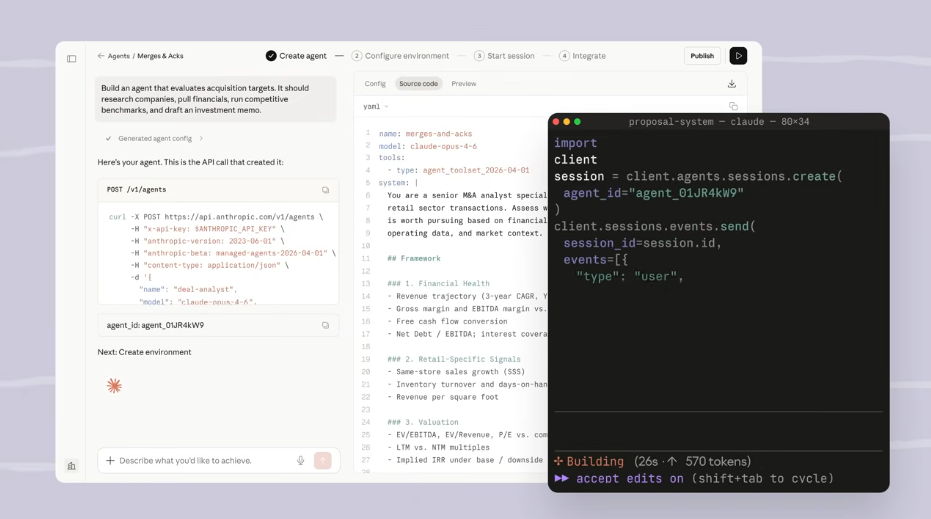
Ever built an AI agent? Getting to a demo is the easy part — the moment you try to ship it to production, things get ugly fast. Container sandboxing, credential management, failure recovery, state management… The actual agent logic ends up being maybe 20% of the work. The other 80% is infrastructure grunt work. On April 8, 2026, Anthropic launched Claude Managed Agents in public beta — a direct answer to this problem.
What it solves: Anthropic handles all the infrastructure needed to run AI agents in production — sandboxing, state management, failure recovery.
Core architecture: It separates the "Brain" from the "Hands," so the model, harness, and containers scale and recover independently.
Business impact: Agent deployment goes from months to days. Notion, Sentry, and Rakuten are already running it in production.
What Is It?
Claude Managed Agents is a hosted agent runtime. In plain terms: you define what your agent does — tasks, tools, guardrails, system prompt — and Anthropic handles everything else.
Before, shipping a production agent meant building all of this yourself:
- Isolated container setup
You had to build a sandbox so the agent could run code without touching production systems. - Credential management + permission scoping
You needed a system to safely inject API keys and OAuth tokens with tight scope limits. - Checkpointing + failure recovery
If the agent died mid-run, you needed a way to resume from its last known state. - Agent loop + long-running session management
You needed an orchestration layer that could maintain coherence even when context exceeded the model's window. - Observability + monitoring
You had to build a dashboard to see what the agent was doing and where errors happened.
None of that is the agent itself — it's all scaffolding. Managed Agents takes the whole thing off your plate.
What Changes?
The core architectural shift is the separation of "Brain" and "Hands." In the old setup, everything lived in one container — model inference, tool execution, state management. If one thing died, everything died. Managed Agents tears that apart completely.
| DIY Agent (Before) | Claude Managed Agents | |
|---|---|---|
| Architecture | Monolithic (model + tools + state in one container) | Brain/Hands split (independent scaling) |
| Container failure | Full restart required | New container auto-spins up |
| Harness updates | Manual refactoring when model changes | Anthropic auto-optimizes |
| Security model | Relies on token scoping | Generated code can't touch credentials |
| Deployment time | Weeks to months | Days |
| TTFT (P50) | Baseline | ~60% reduction |
The security model is particularly impressive. The old approach was "minimize token permissions" — Managed Agents goes further: code generated by the agent simply can't access credentials in the first place. Git tokens get injected into a local remote at container init; MCP and OAuth tokens live in a separate vault and are called through a proxy. The attack surface is eliminated, not just reduced.
Anthropic's internal tests showed TTFT (Time to First Token) dropping roughly 60% at P50 and over 90% at P95. And when you define success criteria using the "outcomes" feature, task completion rates improved by up to 10 percentage points over standard prompting.
Notion is already using it to automate client onboarding, and Sentry and Rakuten have it running in production too. At a WIRED demo, Notion PM Eric Liu handed a task list to a Managed Agent and monitored it in real time through the Claude Platform dashboard — watching exactly which tools it called at each step.
Getting Started
- Get your API key
Any Claude Platform API key gets you access — no separate application needed. Just addanthropic-beta: managed-agents-2026-04-01to your request headers. - Define your agent
POST to/v1/agentsto create an agent. Specify the model, system prompt, and tools (bash, file_editor, web_search, etc.) as JSON. - Configure the environment
Define the container environment your agent will run in — required packages, network access scope, MCP server connections. - Start a session and send events
Create a session, send a message to the agent, and you're done. Anthropic's orchestration layer handles the rest. - Monitor
The Claude Platform dashboard shows you tool usage, the agent's decision-making process, and error logs in real time.
Deep Dive Resources
Agent framework comparison Curious how Managed Agents stacks up against LangGraph, CrewAI, and similar tools? The key question is whether you need multi-model orchestration. If you're going Claude-only, Managed Agents replaces a significant chunk of middleware.
Anthropic's platform strategy Anthropic's ARR tripled from $9B in late 2025 to $30B in March 2026, mostly driven by Claude Platform. Managed Agents is the next move in what looks like a deliberate dependency-moat strategy.
Claude Mythos synergy Claude Mythos — unveiled the day before Managed Agents — automatically found thousands of cybersecurity vulnerabilities. The Managed Agents + Mythos combination could set a new bar for automated security auditing.