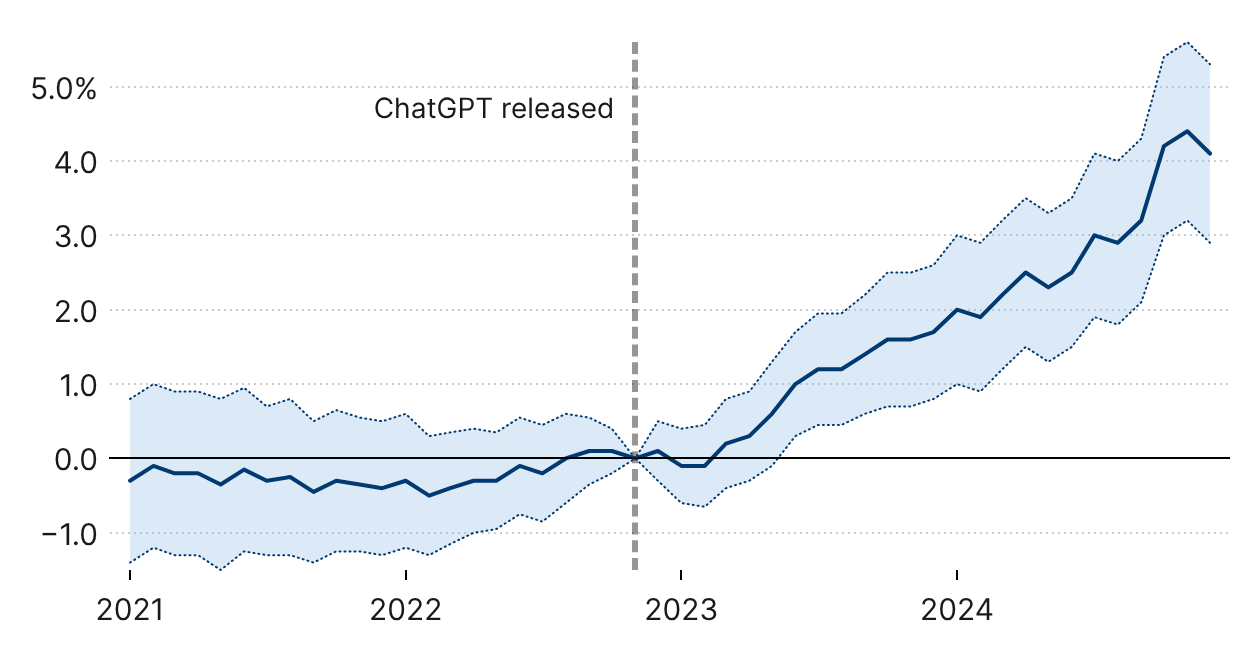

In Denmark, 93% of employees at workplaces that encouraged AI use and provided both enterprise chatbots and training had tried a chatbot at work. But the administrative records examined by researchers showed no clear wage change associated with chatbot use. Other changes appeared in the time employees saved and the new tasks they took on.
Danish researchers matched surveys of 25,000 workers in 11 AI-exposed occupations with national wage and working-hour records
Anders Humlum of the University of Chicago and Emilie Vestergaard of the University of Copenhagen worked with Statistics Denmark to select 11 occupations exposed to AI. They included software developers, marketers, accountants, and teachers. From a 2024 survey, the researchers obtained about 25,000 valid responses that could be linked to administrative records. The respondents worked at 7,000 workplaces.
The researchers compared chatbot users with nonusers in the same occupation who were similar in age, gender, experience, and other respects. They also compared workplaces that supported chatbot use with those that did not. Both comparisons examined monthly changes before and after ChatGPT launched in November 2022, and checked whether trends had already differed before the launch.
Employees reported their own chatbot use in the survey. Wages, working hours, and occupations were checked against administrative records through December 2024. The study covers 11 occupations in Denmark and roughly two years after ChatGPT's launch, so it does not show the effects of tools that appeared later.
Two years after ChatGPT's launch, wages and working hours had not changed distinctly for AI users compared with similar nonusers
Employees' experience with chatbots varied widely depending on the support their workplaces provided. At workplaces that took no action, 41% of employees had tried a chatbot at work. At workplaces that encouraged use and provided an enterprise chatbot and training, 93% had tried one. Among employees at the latter workplaces, 28% used one daily and 19% said they saved more than an hour a day.
| Workplace support | Employees who had tried a chatbot at work |
|---|---|
| No specific measures | 41% |
| Encouragement, enterprise chatbot, and training | 93% |
When researchers compared chatbot users with similar nonusers in the same occupation before and after ChatGPT's launch, however, they found no statistically clear difference in changes in wages or working hours. The confidence intervals around the estimates ruled out average effects larger than 2%. That does not mean the change was exactly zero; it means the data did not reveal a large average effect.
In the workplace comparison, effects larger than 2% on headcount, total payroll, and hiring composition were also ruled out for workplaces that encouraged chatbot use compared with those that did not. Looking separately at daily users and people who saved more than an hour a day also revealed no clear effect on individual wages or working hours. Widespread experience with chatbots and a change in average wages were separate outcomes.
Employees' answers pointed in a similar direction to the administrative records. Among chatbot users, 97.7% said chatbots had not affected their income. That figure reflects employees' perceptions; the wage comparison above was an analysis of administrative records.
AI saved users about 3% of their working hours, and 85% of those who saved time said they spent it on other work
Unchanged wages did not mean employees felt chatbots were of no help. In the survey, chatbot users reported saving an average of about 3% of their working hours. By occupation, the figures were 6.1% for marketing, 5.6% for software development, and 0.7% for teachers. All were self-reported.
Among employees who said they saved time, 84.7% said they spent it on other work. Another 7.2% said they used it for breaks, and 5.8% for leisure. A person could divide the time among several uses, so saying they spent it on other work does not mean they worked without breaks.
Time savings were measured by asking employees about changes they perceived. The authors also noted that employees might have overestimated the help chatbots provided. Even with that caveat, the survey shows a clear pattern: employees who felt they had saved time said they spent it mainly on other work, while the study found no clear difference in average wage changes during the period.
AI changed tasks before pay: 10% of teachers who had never used a chatbot also took on work responding to students' AI use
In the survey, employees also described new tasks that had emerged alongside chatbots. Marketers cited directing AI and repeatedly refining its output to create marketing copy, social media posts, and product descriptions. Developers described adjusting AI coding assistants by providing feedback and project-specific examples, while legal staff described creating policies and guidelines for AI use in their organizations.
New tasks did not arise only for employees who used chatbots themselves. About 4% of employees who had never tried one also said chatbots had created new work for them. Among teachers who had never used a chatbot, 10% said they had taken on work monitoring and responding to students' AI use. Teachers' examples of new tasks included identifying homework written by AI.
The changes in tasks here come from employees' survey responses, while the wage changes come from a comparison using administrative records. Taken together, the findings show that changes employees experienced and changes observed in pay did not emerge at the same pace during the study period. The authors are academic researchers, not sellers of a product. The study was released as a working paper, and a research institute with which the authors are affiliated said the summary may describe work in progress that has not been peer reviewed.
National records showed a change in occupational mobility: AI users moved more often into IT support and office roles, but the authors could not determine which came first
Another change the researchers found in administrative records concerned moves between occupations. They took each employee's occupation in December 2024 and traced how long the person had worked in that occupation previously. Chatbot users had spent about 4% more time in that occupation, measured in full-time equivalents, than similar nonusers. This suggests that more users had recently moved into the occupation.
Occupations into which users moved more often included IT support and office roles. There was no excess movement into occupations requiring licenses, such as teaching and accounting. Among chatbot users who changed occupations, income growth from November 2022 to December 2024 was 12 percentage points higher than among other Danish workers employed at both dates. Because that comparison group was not limited to nonusers who changed occupations, the 12 percentage points cannot be treated as an effect of chatbot use.
The researchers left open both the possibility that chatbots helped people change occupations and the possibility that people who had already moved found chatbots more useful as they adapted to new roles. Checking movement trends before ChatGPT's launch cannot rule out the second possibility. The authors also suggested that too few users had changed occupations to move average income for users as a whole.
Much attention has focused on how much time chatbots save, but Denmark's early records brought changes in tasks and occupational mobility into view before changes in pay.
Go deeper
Still waters, rapid currents The study's authors explain AI adoption in workplaces and changes in work and the labor market. brookings.edu
Still Waters, Rapid Currents: Research paper A closer look at the methods used to compare survey and administrative data, and the findings on time use and occupational mobility. squarespace.com
The Short-Term Effects of Large Language Models on Unemployment and Earnings A study comparing earnings and unemployment by occupations' exposure to AI rather than actual use. arxiv.org