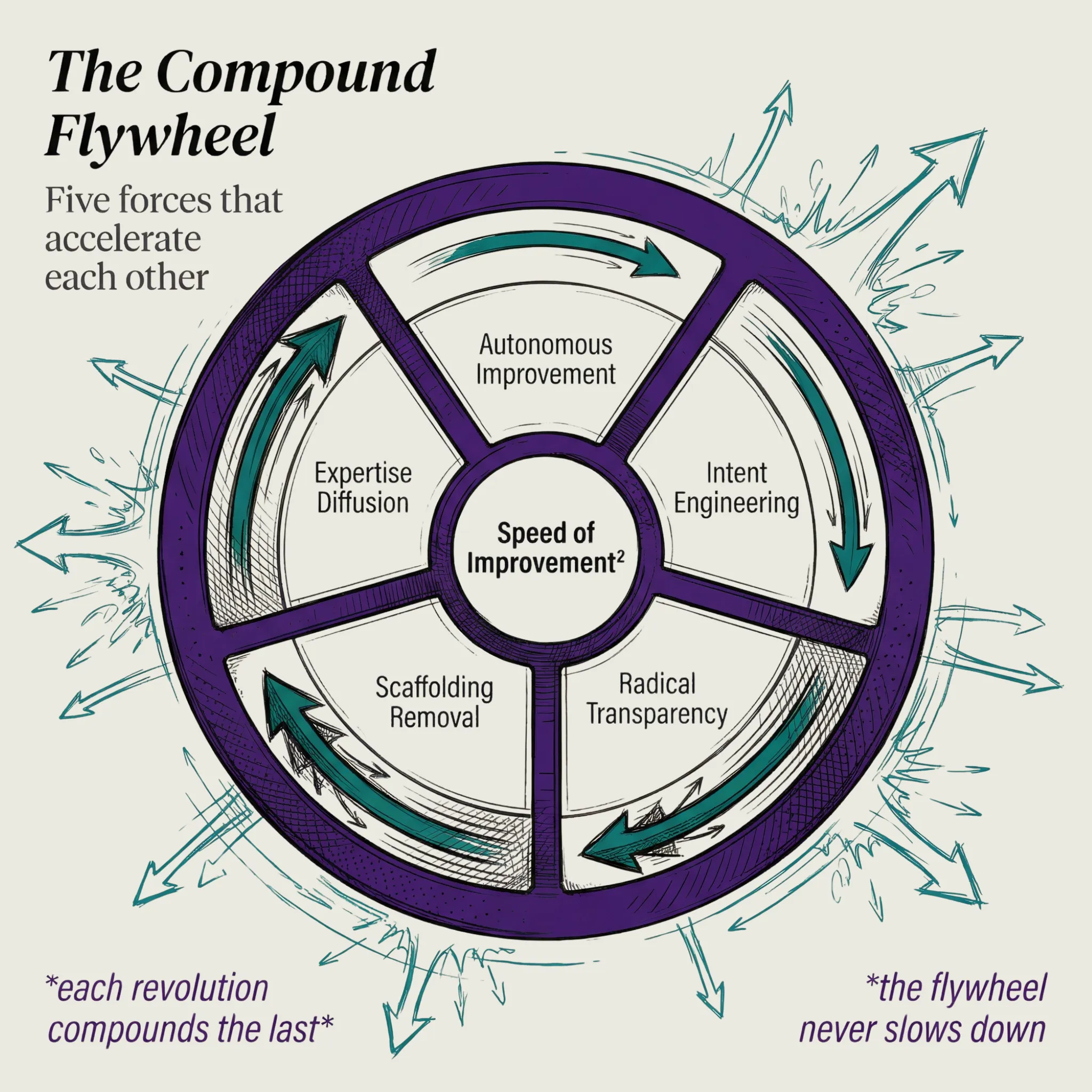
Most of us have played with an AI tool or two. But the question — "how do we actually embed this into our organization?" — still doesn't have a clean answer. Security expert and AI infrastructure designer Daniel Miessler put together what he calls the five most important AI ideas as of April 2026. The key thing isn't just each idea on its own — it's that they amplify each other.
What Is It?
Miessler's framework isn't a trend list. It's five interlocking ideas — understand one and you start to see why the other four are necessary.
What Changes?
Put these five ideas next to the typical AI approach and the gap becomes obvious. Most organizations are still stuck on the left.
| Area | Old Approach | The 5-Idea Framework |
|---|---|---|
| How You Improve | Manual tuning and review by humans | Define goal → agent runs → autonomous improvement loop |
| Goal-Setting | Vague language like "good results" | 8–12 word testable ideal-state criteria |
| Operational Visibility | Vibes and spreadsheets | AI-powered full logging — cost, quality, and process made visible |
| How Work Is Understood | "Hard work only experts can do" | 75–99% is scaffolding, replaceable by AI |
| Knowledge Management | Tacit knowledge locked in experts' heads | Extracted into skills, SOPs, context files → infinitely replicable |
| Competitive Advantage | Linear growth — scales with headcount | Compounding growth — the rate of improvement itself improves |
The most striking row is the last one. Here's Miessler's core claim:
The organizations that adopt this cycle first will compound their advantage until the rest can't catch up.1
In a world where manual tuning that used to take months happens overnight, starting six months late doesn't cost you six months — it costs you orders of magnitude. This pattern started in ML research, but it applies to security programs, consulting deliverables, content pipelines, hiring processes — anything where you can define an ideal end state. That's the real reach of the Autoresearch model.
Getting Started
At your next project kickoff, break your goal into 8–12 word pass/fail criteria. Instead of "a good landing page," try "core value proposition communicated within 5 seconds on the first screen." Without that kind of specificity, you can't run an autonomous improvement loop.
Look back at this week's work and split it into two buckets: time requiring actual thinking, and time spent on setup, formatting, and report-writing. For most people, the second bucket will be over 70%. Package that second bucket into an AI agent skill first — that's where you'll see immediate results.
Run a debriefing session with your key experts and document their tacit knowledge as SOPs, context files, and skills. Once extracted, every AI instance can use it immediately. Document the methodology in a single PROGRAM.md — Karpathy-style — and it becomes a self-improvable asset.
Like MindStudio's marketing optimization agent, pick a single metric — conversion rate, click-through rate, whatever — and run the full cycle at small scale: define goal → agent runs → log → auto-improve. Once the loop completes one full turn, expanding to the next area feels natural.
Deep Dive Resources
The full original post. Detailed explanations of each idea, what they mean in practice, and why they amplify each other — worth reading straight through.
The actual implementation of the autonomous improvement loop. Drop an idea into PROGRAM.md and the AI runs experiments and optimizations on its own. Give it a try.
A business-perspective look at how fast Autoresearch actually produces results, and how AI labs are putting it to work. Good grounding before you build your own loop.
A practical guide to applying the Autoresearch pattern in marketing. Covers metric definition, API connections, and how to get an agent running copy and ad experiments automatically.
The full argument behind the 75–99% scaffolding claim. Breaks down which roles have the highest scaffolding ratio, and why it's so hard for people to admit.