1 in 2 US healthcare leaders has already deployed generative AI in production. That number was 25% in 2023 — it's doubled in just two years. The question is no longer "should we adopt AI?" It's "how do we scale it?"
What Is It?
This comes from a McKinsey Q4 2025 survey of 150 leaders across US insurers, clinical organizations, and health tech companies. Three findings stand out.
First, Gen AI has shifted from "experiment" to "core capability." 50% of respondents are already in implementation, and over 80% have deployed their first use case to real users. For the first time ever, zero respondents said they weren't doing anything with Gen AI.
Second, agentic AI has emerged as the next wave. We're not talking about chatbots that respond to prompts — these are autonomous AI agents that plan independently, coordinate across multiple systems, and handle complex workflows end-to-end. 19% are already implementing it, 51% are running PoCs, and just 1% say they have no plans at all.
Third, it's starting to pay off. 82% of organizations that have implemented Gen AI expect a positive ROI, and 45% are already measuring returns in hard numbers. Most are reporting 2–4x returns on initial investment.
Deloitte's research tells the same story. 61 out of 100 health tech executives surveyed are already building or implementing agentic AI, or have budget secured — and 85% plan to increase investment over the next 2–3 years. 98% expect cost savings of at least 10%.
What Changes?
Traditional healthcare AI was a support tool that "shows information to doctors." Agentic AI is evolving into a system that "judges and acts on its own."
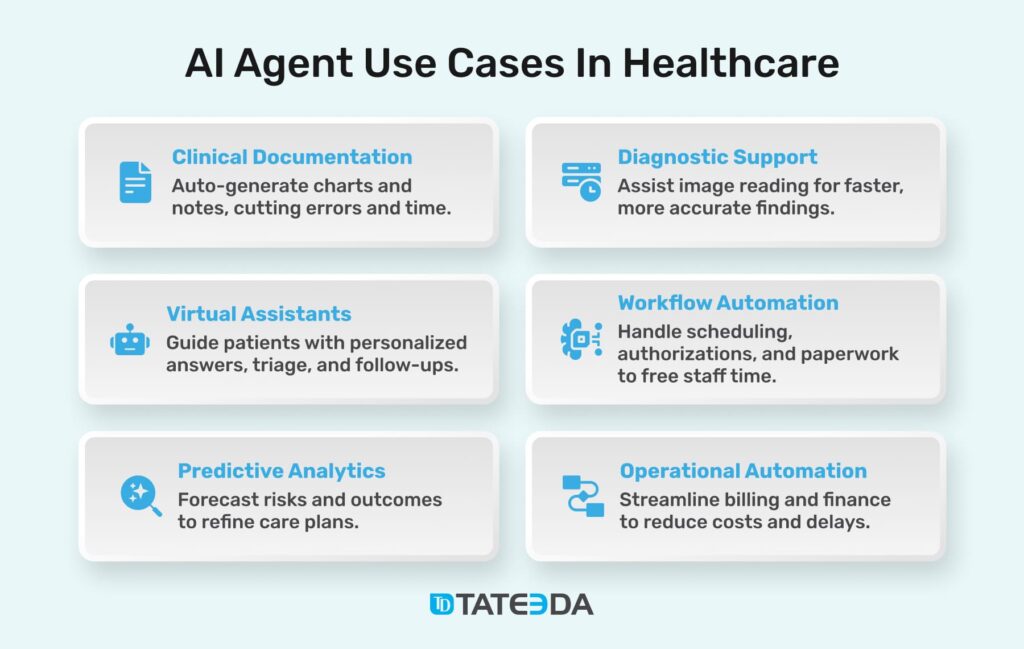
| Area | Old Way | With Agentic AI |
|---|---|---|
| Clinical Notes | Doctors manually typing and charting | AI listens to conversations and auto-generates notes and prescription drafts (Epic AI Charting) |
| Prior Authorization | Days to weeks via fax and phone | AI agent handles real-time code verification and auto-submission (MUSC: 40% fully automated) |
| Patient Communication | Call center queues, one-way notifications | AI automatically handles test result explanations, medication reminders, and post-discharge monitoring |
| Clinical Decision-Making | Doctors searching the EHR manually | AI synthesizes patient records and proactively flags risk signals |
Real-world examples are already piling up.
BCG projects 2026 as the year AI agents start compressing drug development timelines from years to months. Synthesizing patient data, genetic information, and wearable device data to predict conditions like Alzheimer's or kidney disease years before symptoms appear is already becoming reality.
South Korea isn't sitting this out. Seoul National University Hospital has launched a Healthcare AI Research Institute to lead the country's medical AI push, and experts say Epic-level clinical AI systems are now achievable domestically.
Getting Started
Here's the AI adoption roadmap McKinsey and Deloitte lay out for healthcare organizations.
- Start with quick wins
Patient intake digitization combined with ambient scribes for clinical documentation is the most battle-tested starting point. Tools like Epic AI Charting and Abridge are already running in 200+ organizations. - Build your data integration infrastructure
Connecting EHR, insurance claims, and CRM data into a unified system is what makes agentic AI actually work. Stanford Health Care uses ChatEHR to synthesize patient records and automatically deliver tailored clinical evidence at the point of care. - Design governance and guardrails first
In the McKinsey survey, 43% named "risk and safety" as their top barrier — tied with "integration complexity." Make sure AI decision paths are traceable and that humans hold final approval authority. - Focus on domain-level end-to-end workflows
McKinsey research shows that organizations bundling an entire domain (like the full insurance claims process) into an agent system significantly outperform those using point solutions. In the Deloitte survey, 82% of early adopters chose multi-agent systems. - Measure ROI in hard numbers
"Looks promising" won't survive budget season. McKinsey reports that the share of organizations tracking quantitative ROI hit an all-time high of 45% — and they're reporting 2–4x returns on investment.