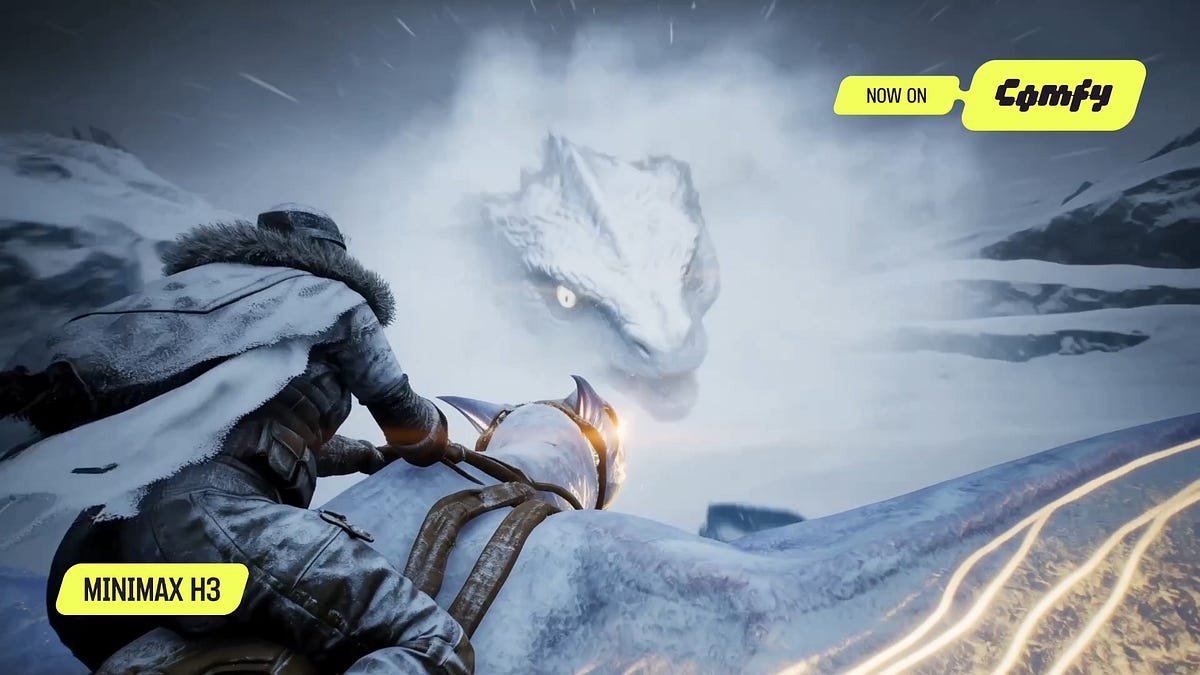
ComfyUI announced day-0 support. An open-weight video model that runs on an RTX 3060 — that felt like good news.
Then I opened the actual license text, and there it was: Korea, sitting right in the "excluded territories" list.
Open weights sounded great
MiniMax released H3 on August 3 — a 33-billion-parameter dense transformer. It reads text, images, video, and audio as a single context, and generates the picture and stereo audio (32kHz) in the same pass. Up to 2K resolution, 4-15 second clips, and motion transfer that copies a reference video's camera work and performance onto a different subject.
ComfyUI shipped native support the same day. One PR merged four dedicated nodes (EmptyMiniMaxH3LatentAV, MiniMaxH3ImageToVideo, and others), plus six official workflow templates for text-to-video, image-to-video, and reference-to-video.
The most impressive part was the memory optimization. Of the 33 billion parameters, about 13 billion sit in modulation weights — MiniMax swapped that whole branch for a lookup table instead of computing it, and layered int8 convolution quantization on top. Total memory footprint dropped from 123.6GB to 42.5GB, a 66% reduction. That's what makes local inference possible on a single RTX 3060. For a second, it looked like commercial-grade video AI had just landed on consumer PCs.
Then Korea wasn't on the list
Open the MiniMax H3 Community License Agreement and the definitions section says this: "Applicable Territory" means worldwide, excluding the "Excluded Territories." And the Excluded Territories are the European Union, the United Kingdom, the Republic of Korea, and the United States. Downloading the open weights and running them locally is, by the license's own terms, not authorized in any of those four places.
The reasons differ by region. According to MiniMax's own Q&A document, the US restriction traces back to ongoing copyright litigation the company is involved in, while the EU, UK, and Korea are cited for regulatory uncertainty around video-generation AI specifically — likeness, copyright, and content-safety rules that haven't fully settled yet. The document frames this as "not yet," not "not ever."
What's notable is that the API is exempt. Because MiniMax operates the hosting infrastructure directly and can enforce safeguards against misuse, the API is available worldwide with no territorial restriction. The limitation applies to exactly one thing: downloading the weights and running them on your own server or PC.
Heads up
If you genuinely need local deployment in Korea, the license spells out the process: email api@minimax.io with the subject line "MiniMax H3 licensing - authorization request," describe your deployment scenario, and get separate written authorization first.
Running on an RTX 3060 is half true
The "runs on an RTX 3060" demo from comfy.org refers specifically to the pruned, quantized (int8/nvfp4) build, capped at 768p. Getting the full 2K output you'd expect requires an additional upscaling stage called H3-Regenerate-2K — and that module is API-only for now, with no public weights. So a purely local setup can't actually reproduce the full 2K pipeline.
Want lossless (BF16) quality locally instead? That's a different story. Published benchmarks show it takes two RTX 5090s and a roughly 384GB host to run it, at about 9.3 minutes for a single 1344×768, five-second clip. There's a real gap between "runs locally" and "runs comfortably on your laptop."
| Local open weights | API (hosted) | |
|---|---|---|
| Usable in Korea | No (license violation) | Yes |
| Resolution | 768p (quantized build) | Up to 2K |
| Hardware needed | RTX 3060 to dual RTX 5090 | None (cloud) |
| Cost structure | Upfront hardware | Pay per use |
So what can you actually do right now
- Try the API first
No territorial restriction — start with the three API workflow templates (T2V/I2V/R2V) in ComfyUI. - Apply for a license before going local
Email api@minimax.io with your deployment scenario and get approval first — not download first. - Check the revenue threshold before commercial use
Organizations earning over $20M a year in revenue need separate authorization even inside the Applicable Territory. - Pick a checkpoint that fits your VRAM
BF16 (highest quality, largest), INT8 (balanced), NVFP4 (lightest) — start with INT8 or NVFP4 if VRAM is tight. - Keep an eye on the license
MiniMax states it's continuously reassessing the territorial scope — worth checking back periodically.
Want to dig deeper?
MiniMax-H3 model card Full official specs — parameters, resolution, license. huggingface.co
The license text itself Read the Excluded Territories clause and commercial terms directly. huggingface.co
ComfyUI's official announcement The memory-optimization techniques and a getting-started guide. blog.comfy.org
Hardware requirements review GPU-by-GPU benchmarks and real deployment costs. kingy.ai
Guide to the 42.5GB weight set Which files to download and why. atlascloud.ai
Competitive analysis vs. ByteDance What the open-weight strategy means for the market. scmp.com