Intel dropped 6% in a single day. AMD fell 5%. Markets tend to smell things before we do.
What Jensen Huang announced was not a data center GPU. It was a laptop chip — one that runs 120B-parameter AI models locally, no cloud required. When he said "we are reinventing the PC for the first time in 40 years," maybe this time it was not a metaphor.
Beyond the specs — what can it actually do?
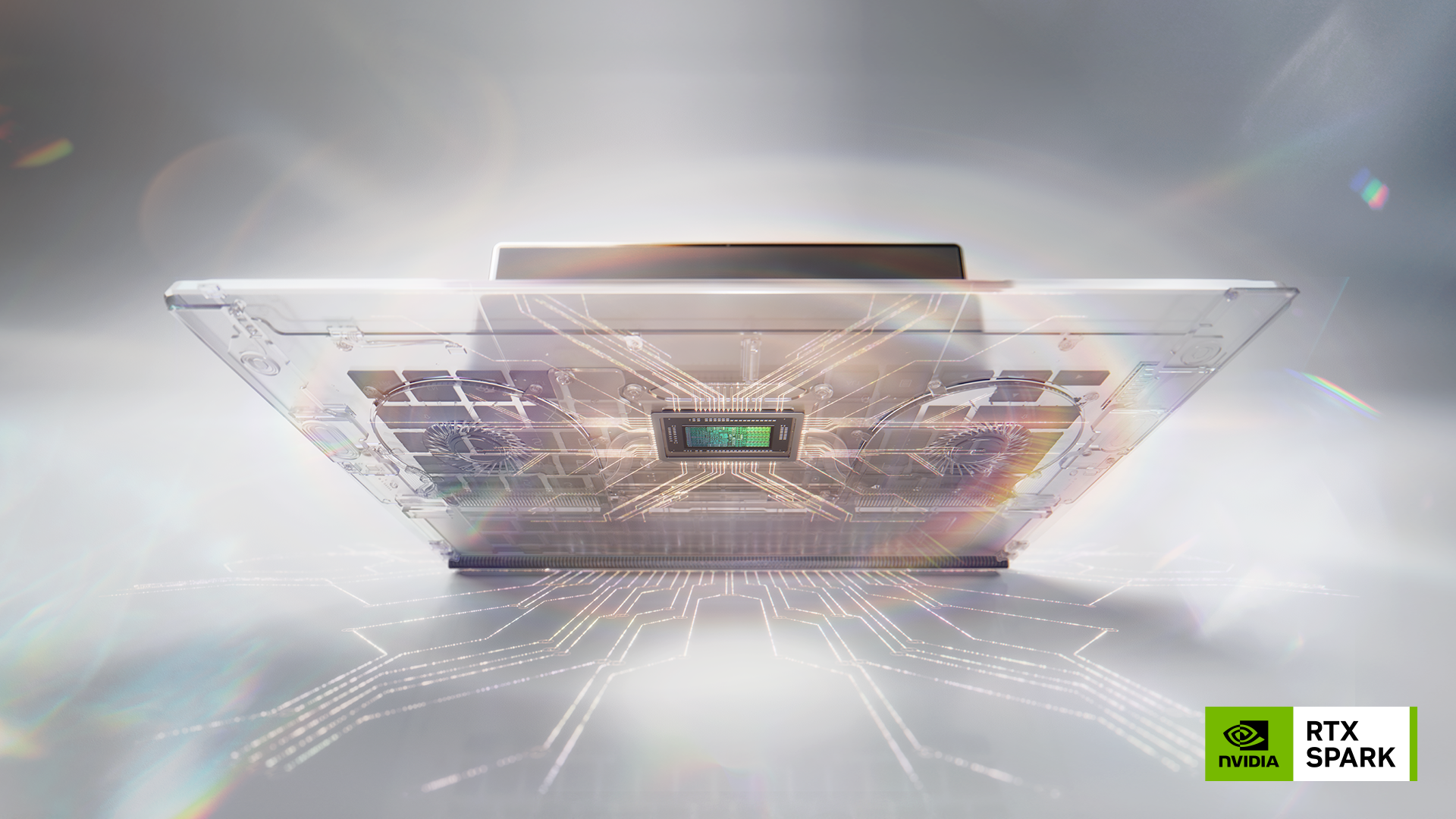
RTX Spark is a superchip pairing a 20-core Grace CPU (Arm) with a Blackwell RTX GPU (6,144 CUDA cores) via NVLink-C2C. 14mm thin, ~1.4kg, 128GB unified memory, 1 petaflop FP4 AI performance in a laptop.
The specs are not the story, though. The real story is that it runs 120B-parameter LLMs with 1-million-token context at interactive speed, locally — GPT-4-class models, on your laptop, offline, at 1,000+ tokens per second.
- Cross-app workflow automation
"Draft next week client report" — works across Excel, Word, and email without manual steps. Multi-step reasoning across Windows apps, entirely on-device. - Semantic search across local files
"Find Client A budget mentions from last year Q3 meeting notes" — natural language search across all local files, no internet needed. - Local image, video, and code generation
ComfyUI, Blender, Adobe Premiere Pro run natively on RTX Spark. Cloud rendering subscriptions start looking optional. - Sandboxed agent execution
NVIDIA OpenShell isolates agent execution locally. Internal documents never leave the device.
Satya Nadella goal: "unmetered intelligence to every desk"
Microsoft co-developed this from day one — signaling a shift from recurring cloud AI subscriptions to a one-time hardware purchase model.
The cloud payback math — 4 months to break even
This is the number that actually matters for business owners and developers: how much are you paying in cloud AI today, and when does RTX Spark pay for itself?
According to MindStudio analysis, a developer team running steady AI inference 8 hours a day hits the cloud-cost breakeven in 75–88 working days — roughly 4 months. Amortized over 3 years, that is about $1,000/year in hardware cost.
There is also the latency angle. Local inference is 10–50x faster than round-tripping to a cloud API. When agents reason through multiple steps, each cloud hop adds latency — on-device, it disappears.
| Cloud AI API | RTX Spark Local | |
|---|---|---|
| Cost model | Pay-per-token (unlimited accumulation) | One-time hardware purchase |
| Response speed | Network round-trip included | 10–50x faster |
| Data privacy | Sent to external servers | Fully local processing |
| Offline use | Requires internet | Works offline |
| Frontier models | Latest models available | 120B-class (GPT-4 level) |
| Bursty workloads | Cloud wins here | Best for steady high-volume work |
To be clear: this is not "move everything local." For absolute frontier models or occasional spikes, cloud still wins on flexibility. But for always-on, privacy-sensitive, or high-throughput steady workloads, RTX Spark is a compelling switch.
Why Intel dropped 6% — it is not a CPU war, it is a stack war
Markets reacted with Intel -6%, AMD -5% — not because "Nvidia launched another chip," but because of what it implies.
"For 40 years, you launched apps. Click. Type. With RTX Spark and Windows, you ask — and the PC does the work."
— Jensen Huang, NVIDIA CEO (GTC Taipei 2026)
Nvidia already dominates data center AI with H100/B200, and sold roughly $20B in Vera server CPUs. Add RTX Spark to consumer PCs and you get Nvidia silicon running AI compute across the full stack: data center → desktop → laptop.
There are real risks. Nvidia first ARM Windows attempt ended with a $900M Microsoft write-off in 2013. Qualcomm Snapdragon X is already carving out Arm Windows territory. But this time, Microsoft was co-developer from day one, there is a real market need for local AI agent hardware, and 30+ laptop models, 10+ desktop designs, and 100+ software partners are already committed.
AI PC prep checklist for this fall
RTX Spark laptops land fall 2026 from ASUS, Dell, HP, Lenovo, Microsoft Surface, and MSI. Here is what to check before buying.
- Audit your cloud AI bills
Pull the last 3 months of OpenAI, Anthropic, or Google AI invoices. Spending more than $100/month? The RTX Spark ROI math gets compelling fast. - Map your workload types
Document analysis, code generation, and internal data processing are where local inference wins. For frontier-model tasks or occasional spikes, keep the cloud. - Check your privacy requirements
Healthcare, legal, or finance orgs: NVIDIA OpenShell local isolation eliminates compliance risk from sending sensitive data to external APIs. - Verify software compatibility upfront
RTX Spark is Arm architecture. Make sure your daily-driver tools support Windows on Arm natively before committing to a purchase. - Start practicing with Ollama now
While you wait, run Ollama + Llama 3.1 70B on your current GPU. Get comfortable with local AI agent workflows so you hit the ground running at launch.
ARM compatibility heads-up
RTX Spark is not x86 — it is Arm architecture. Most major apps are already supported, but legacy or specialized software may need emulation. Always verify your critical tools against NVIDIA partner compatibility list before purchasing.
Want to go deeper?
NVIDIA RTX Spark Official Product Page Full list of 30+ partner devices, software ecosystem, specs. nvidia.com
NVIDIA Newsroom — RTX Spark Official Announcement Jensen Huang and Satya Nadella original statements, AI agent security feature details. nvidianews.nvidia.com
MindStudio — RTX Spark Local AI Inference Analysis In-depth cloud vs. local cost comparison, industry-specific use cases. mindstudio.ai
IndexBox — Nvidia RTX Spark Market Analysis Intel/AMD competitive dynamics, stock price reactions, risk factors. indexbox.io
TechCrunch — Nvidia chases $200B CPU market The original AI agent PC ecosystem breakdown. techcrunch.com
ZDNet Korea — NVIDIA enters PC processor market Intel/AMD competition analysis, Qualcomm positioning. zdnet.co.kr