Mercor researchers gave month-end close tasks for fictional companies to US certified public accountants and AI. In some tasks completed by an accountant and AI working together, the AI produced the correct number during the work, but a different number appeared in the final submission.
12 US certified public accountants and AI took on four month-end close tasks for fictional companies
Mercor researchers compared the performance of 12 certified public accountants practicing in the US with Claude Opus 5. The accountants had an average of 5.4 years of experience. Six worked in public accounting and the other six in corporate accounting. Four participants had previously worked on Mercor AI data projects.
The tasks covered a nonprofit’s budget and shared-cost allocation, adjustments to hotel room revenue and commissions, event revenue analysis, and lease accounting for three companies. Participants found the necessary numbers in the fictional companies’ files, made calculations according to each company’s rules, and submitted results tables. In the hotel task, for example, some stays at the end of December had been billed on January 3 and were missing from December revenue. Participants needed to find and correct the missing revenue, but the paper did not say who got this item right under each experimental condition.
The researchers randomly assigned each participant an order for the four tasks and selected two on which they would use Claude Cowork. Participants completed the other two without AI. Separately, Claude Opus 5 completed all four tasks on its own. Accountants were given up to three hours per task. They were paid for three hours regardless of the time taken, with a bonus for each grading criterion met.
The tasks were simplified versions of the existing APEX-Accounting benchmark, designed to reduce the estimated time people would need to complete them. Mercor created the benchmark and also provides AI training data and evaluation services. That means the company published research related to its own evaluation.
AI scored perfectly in all 20 solo runs; four of 24 runs with accountants fell short
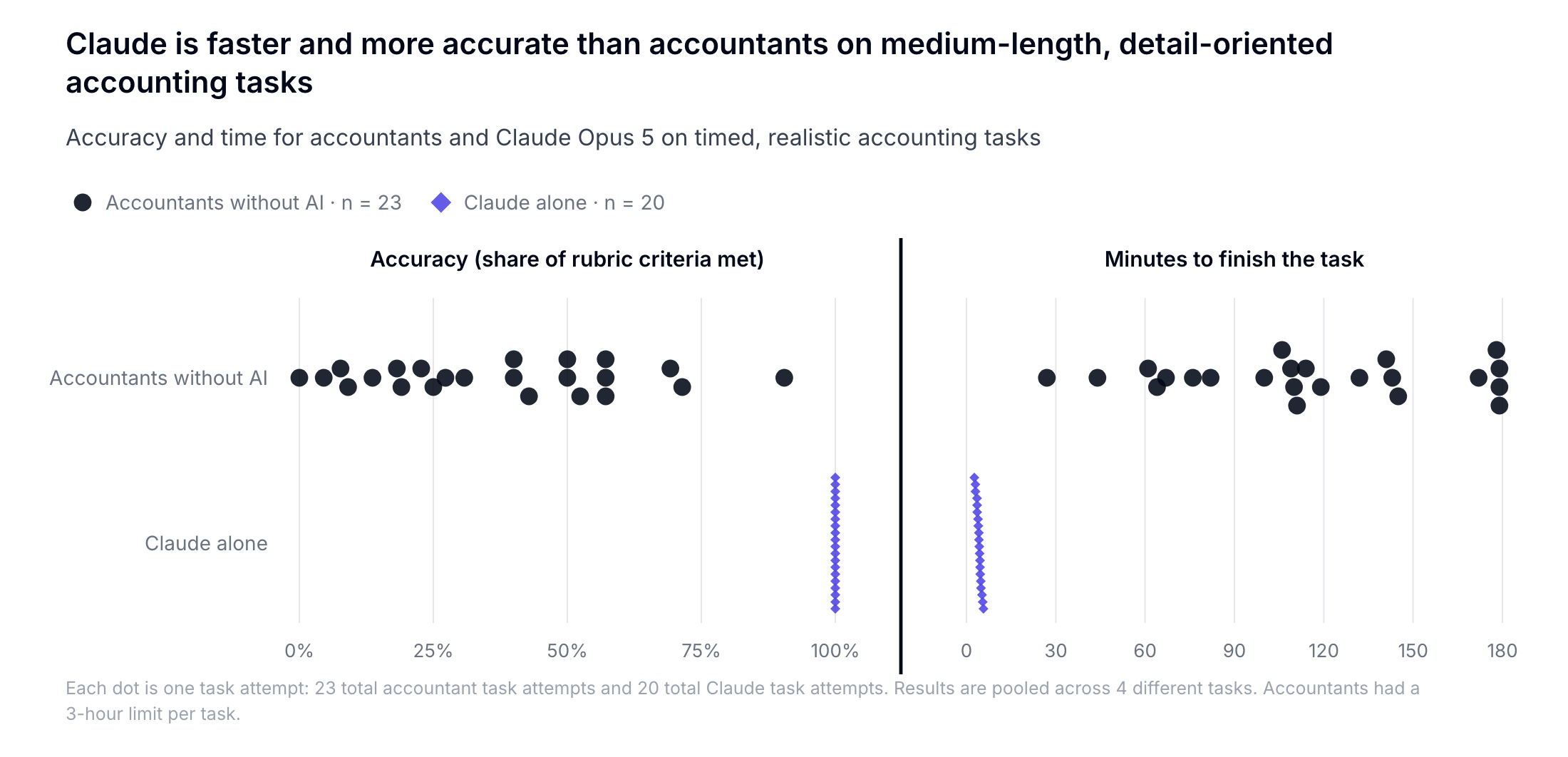
Across 23 submissions completed by accountants alone, an average of about 37% of grading criteria were met. Claude Opus 5 met 100% of the criteria in all 20 solo runs. Of the 24 submissions completed by accountants working with Claude, 20 received perfect scores and four fell short.
| How the task was completed | Submissions | Result |
|---|---|---|
| Accountant alone | 23 | About 37% of grading criteria met on average |
| Claude Opus 5 alone | 20 | 100% of grading criteria met in all 20 runs |
| Accountant and Claude together | 24 | 20 perfect scores, four below perfect |
The scores show how many of the grading criteria set for the four tasks were met. An LLM judge scored 13 to 22 criteria written by an accountant for each task. The researchers reported 98% agreement between the LLM’s grading and the task author’s grading across eight submissions the author assessed directly.
The collaborative and AI-only runs used different environments. The accountants used Claude Cowork, while the AI-only runs used an API agent with tools. AI working alone had already achieved perfect scores, leaving no room for an accountant’s help to raise them. The researchers said they shifted their focus to a comparison with automation instead of studying AI’s originally intended effect as a work assistant. These results alone do not establish that human involvement caused the scores to differ.
In three of the four imperfect collaborations, AI produced the right answer but it did not make the final submission
The researchers examined the records of the four tasks completed by accountants and Claude that did not receive perfect scores. In three, Claude produced the correct number during the work. In all three, however, that number was absent from the final submission.
This observation reveals a process that final scores alone cannot show. Even when AI had produced the correct number needed for a task, the answer submitted could change as work continued with the accountant. There were only three observed cases, however, and the researchers’ published account does not include the numbers or the original conversations. The work records do not establish why each answer changed.
The study also involved 12 accountants and four simplified tasks. Whether the score difference between AI working alone and collaboration was statistically significant could not be determined from the published study. The 20 perfect AI-only runs should also be read as results observed in this experiment.
AI changed its correct answer twice; an accountant overwrote it once
The three cases in which the correct answer did not remain in the final submission followed different paths. Twice, Claude initially produced the correct number, then changed it to another number, and the accountant followed the revised answer. In the remaining case, the accountant overwrote Claude’s initial correct answer. The paper describes how the answers changed in these three cases but does not disclose the specific numbers or conversations.
Tasks completed by accountants and Claude together took about 15 times as long as tasks completed by Claude alone. In a post-task response, one participant said it was difficult to check AI answers and sources against the original data to confirm that the data had been extracted correctly. This was one participant’s experience; the experiment did not establish that review caused the difference in time.
Certified public accountant Blake Oliver also interpreted the need for a person to read and approve AI output as a possible limit on speed. He also pointed out that when AI should stop work and ask questions remains unresolved. This, too, is an expert’s interpretation. The study did not separately compare review time or the reasons answers were changed.
Even when AI gets the answer right, the final answer can change as it works with an accountant
In these tasks, accountants received files and instructions for fictional companies and produced results tables, either alone or with AI. They did not have access to client conversations, accumulated work context, or help from colleagues that might be available in actual work. The paper’s authors explained that the tasks tested abilities favorable to models, such as following detailed instructions and searching files, and that missing one item could lead to a chain of failures across several grading criteria.
Participants’ assessments were divided. Seven of the 12 said the tasks were realistic, while five said they were unrealistic. In a follow-up, the two who called them very unrealistic objected to the absence of colleagues rather than to the Excel tasks themselves. These were participants’ views expressed after the experiment.
The original APEX-Accounting leaderboard operated by Mercor says that even frontier agents cannot yet reliably complete a close. The four tasks in this study were simplified from that benchmark, so scores from the two evaluations cannot be compared directly. Still, the three cases found in the collaboration records show that producing a correct answer once and keeping it as the submitted answer are different questions.
Beyond whether AI can produce the right answer, the study also raises the question of what happens to that answer in the final submission as AI works with an accountant.
Go deeper
Research paper comparing accountants and AI on the tasks Explore the experimental design, grading methods, and cases in which answers changed during collaboration. cdn.sanity.io
APEX-Accounting leaderboard An introduction to the accounting benchmark on which the simplified tasks in this study were based. mercor.com
A CPA’s interpretation of the experiment Blake Oliver writes about the review process and when AI should ask questions. blakeoliver.com