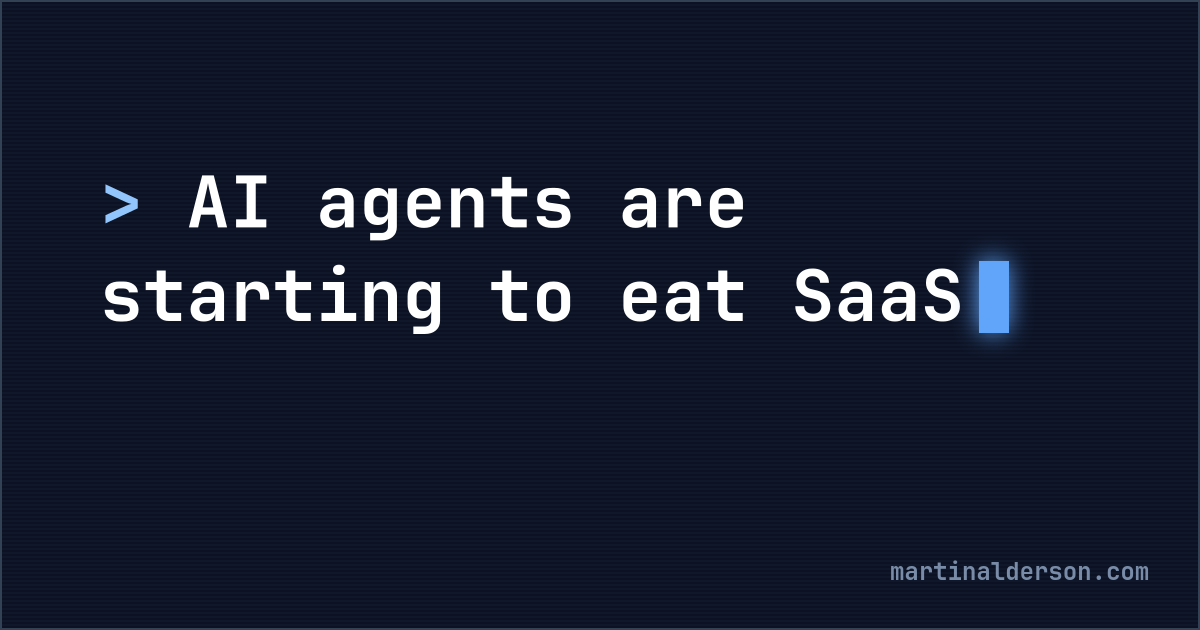
In late 2025, a blog post by Martin Alderson hit the top of Hacker News. Title: "AI agents are starting to eat SaaS." 412 points, 386 comments. But what dominated the top of the comments wasn't agreement.
benzible, CTO of a vertical SaaS company, earned the most upvotes. His opening line: "The thesis doesn't match my experience."
What is this?
Early 2026 saw the rise of the term SaaSpocalypse — the fear that AI agents would let companies build their own tools and cancel SaaS subscriptions. Enterprise software stocks including Salesforce, ServiceNow, and Adobe lost roughly $300 billion in a single day.
The core logic: if AI agents can autonomously execute workflows, companies can reduce per-seat SaaS licenses or build internally — undermining the entire SaaS revenue model. Klarna replacing Salesforce CRM with an internal AI system is frequently cited.
But developers in the HN thread who actually run B2B SaaS products pushed back hard.
Why Is the Ground Reality Different?
Counterargument 1: "Our end users run Excel"
benzible's core rebuttal: "The threat model assumes customers can build their own tools. Our end users can't. Their current system is Excel."
Even large enterprises aren't doing much better. Two major companies tried to clone his product internally — one gave up, the other's users call it garbage. Not a single subscriber was lost.
SkyPuncher (another SaaS founder): "Sales teams hear 'we'll just build it internally' or 'we'll throw it into an LLM' all the time. But 99% of our product is (1) extremely hard and non-obvious things, (2) endless routine work, (3) an SLA that works even when the dev is on PTO."
Stories of "vibe-coding a CRM in a few hours" make the rounds, but real enterprise software is built around compliance infrastructure, security, audit trails, dozens of integrations, and reliability guarantees. Generating code is entirely different from running it safely for years.
Counterargument 2: "The bottleneck is knowing what to build, not building it"
benzible's second key point: "Agents are a multiplier on existing velocity, not an equalizer. A lot of the value in our product is in decisions users don't even know we made for them. Domain expertise plus a tight feedback loop with users can't be replicated by an internal dev in an afternoon."
SaaS CFO Ben Murray agrees: "Vibe-coded things aren't on proper IT infrastructure. They're not secure." The open-source alternative argument also varies widely by domain — it works for developer tools but deep vertical SaaS for non-developers won't attract OSS contributors, because the domain knowledge alone takes months to acquire.
Counterargument 3: "Core systems are safe — periphery is what's being replaced"
What's actually happening is not core platform replacement. Cohesity famously used AI agents to automate device deprovisioning in two days, pausing a ServiceNow purchase review — but ServiceNow fired back that the vibe-coded tool "can't be said to function from compliance, integration, and auditability standpoints." Enterprises are replacing high-cost human workflows around the core system of record, not the core itself.
| Area | AI Agent Displacement Risk | SaaS Defense | Verdict |
|---|---|---|---|
| Simple CRUD dashboards | High | Low | High displacement risk |
| Internal automation add-ons | High | Low | High displacement risk |
| Horizontal generic CRM | Partial | Data moat | Medium risk |
| Vertical domain SaaS | Low | Domain expertise | Defensible |
| System of record (ERP/CRM) | Low | Switching costs | Near-term safe |
| Payment/security infra | Very low | Reliability/regulation | Safe |
What to do now
If you run a SaaS business
- Honestly audit your defensibility
If your core value is purely UI convenience, you're exposed. Identify which of domain expertise, accumulated data, regulatory moat, or switching costs is your real moat. - Run an NRR stress test
If AI reduces headcount at your customers, what happens to seat-based NRR? Model that scenario today. - Double down on your data moat
If your product gets smarter as customer data accumulates, make that central to your sales narrative. AI agents without that data are far less valuable. - Revisit pricing models
If 100% of revenue is seat-based, explore outcome-based or consumption-based alternatives. This shift is already underway in the market.
If you're an enterprise IT leader
- Classify your SaaS portfolio by risk
Separate systems of record from peripheral workflow automation tools. The latter are the first AI displacement targets. - Honestly assess internal AI capabilities
Replacing SaaS via vibe coding requires ops, security, and compliance capabilities. Check first whether your org actually has them. - Pilot AI agents at the periphery first
Replacing core systems is high-risk. Apply AI agents to repetitive internal automation workflows first and build institutional knowledge.
Go deeper
AI agents are starting to eat SaaS The original post that sparked the debate — analyzing how falling software build costs may reshape SaaS demand. martinalderson.com
The SaaSpocalypse: AI Agents, Vibe Coding, and the Changing Economics of SaaS A CFO framework for NRR stress-testing, margin pressure, and defensibility diagnostics. thesaascfo.com
Will AI agents replace SaaS? Key insights for 2025 Enterprise AI agent adoption trends and SaaS coexistence scenarios with McKinsey and Klarna case studies. glean.com