If a manuscript gets an “AI 100%” result, can you take it down immediately?
Suppose a manuscript awaiting publication or a piece of brand content receives a high score from an AI detector. Publishing it as is may seem likely to undermine trust, while pulling it immediately may unfairly cast suspicion on the author. What an editorial lead needs is not a more decisive number, but a fair way to establish who made it and through what process.
Two events in publishing in 2026 make this distinction clear. The novel 《Shy Girl》 was flagged by Pangram as roughly 78% AI-generated, then had its publication canceled following online allegations and a publisher investigation. Based on the reporting available, however, we cannot say that score alone caused the cancellation. In contrast, an outside party raised a claim that the winning Commonwealth Short Story Prize entry was 100% AI-generated according to Pangram, yet the foundation upheld the award. A key difference was that the foundation did not use AI tools in its investigation and instead reviewed the creative process and related materials.
100% is a decision value for a particular manuscript, not universal accuracy
The claim that a detector is useful is different from the claim that its result alone can determine an author. An independent study highlighted by the University of Chicago’s Becker Friedman Institute compared 1,992 human-written originals with corresponding texts produced by four generative models across six genres. For medium- and long-form texts in this controlled English-language dataset, Pangram showed false-positive and false-negative rates close to zero, meeting the study’s policy threshold of no more than a 0.5% false-positive rate.
That is strong performance, but its scope is clear. These were results for the selected models and detector version at the time, English-language genres, and specified lengths. It does not establish the “percentage written by AI” in a mixed manuscript edited repeatedly by people, nor does it mean the system will always be 100% accurate across every language and future model. A 78% or 100% result on a manuscript should not be read as quantitative proof that AI wrote 78% or 100% of its sentences.
Use scores as signals to begin an investigation. If they are to support a sanction, document at minimum the detector and version, the text range examined, the threshold, and whether the language and genre fall within the validated scope.
What preserved the award was the creative process, not a rerun of the detector
The Commonwealth Foundation did not use AI detection tools during its investigation. Outside parties claimed that the winning story 《The Serpent in the Grove》 had been labeled 100% AI-generated by Pangram, but this was not a test conducted by the foundation; it was a result made public by an external user and Pangram.
The foundation said it did not use AI tools in the investigation because of artistic ownership and consent concerns around unpublished work. Instead, over roughly a month, it spoke with the writer about the creative process and reviewed drafts, timestamped documents, and notes. It concluded that the work had not been written by AI and retained the award. More than 7,800 people entered the competition, and each winning work was read by at least seven people.
The lesson is not that “all detectors are wrong.” A classifier that looks only at text output and an investigation that reconstructs the creative process answer different questions. A detector looks for statistical signals in style, whereas drafts and editorial records show how ideas developed into sentences and who approved changes.
| What is being checked | When looking only at a detection score | When also reviewing process evidence |
|---|---|---|
| What you can know | How closely the text matches detection patterns | Draft development, stages where AI was involved, and human editorial accountability |
| Remaining risk | False positives and overinterpreting percentages | Missing records or possible after-the-fact manipulation |
| Appropriate use | Screening manuscripts that need further review | Decisions on disclosure, revision, or withdrawal, and review of appeals |
The center of this debate is “authorship,” not copyright
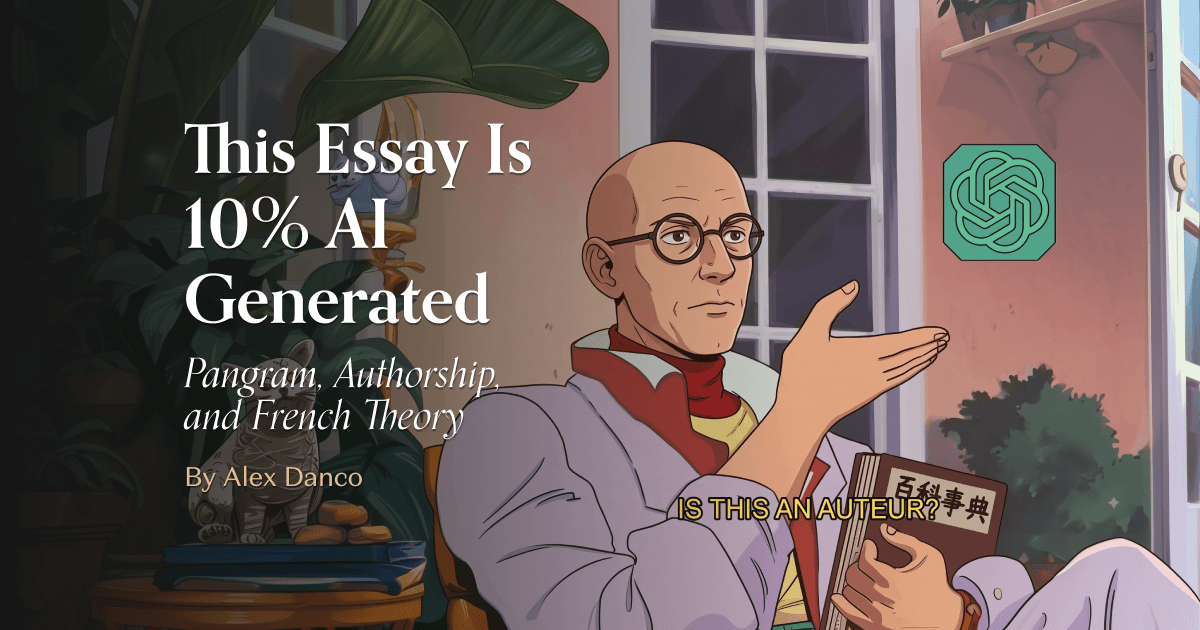
The terms to distinguish here are copyright and authorship. Drawing on Barthes and Foucault, a16z’s Alex Danco interprets the category “AI-generated” as functioning like a new authorship category that assigns meaning and responsibility to text. The issue is closer not to copyright, a legal right, but to authorship and the “author-function”: who puts this work forward under their own name and takes responsibility for its outcome.
That is why asking only “What percentage did AI write?” obscures the real work. Idea development, research, translation, drafting, grammar correction, and final wording carry different degrees of responsibility. A more useful explanation for readers is not an estimated percentage, but the stages where AI was involved and the person responsible for the final judgment.
Create an investigation record from one manuscript today
Before adding another detector, first lay out the production record for one recent manuscript. You can start if you have access to document version history, notes from the author and editor, and records of AI use.
- Separate the stages of AI use.
For ideas, research, translation, drafting, proofreading, and final wording, state whether each is allowed, requires disclosure, or is prohibited. Do not bundle them into a single line such as “AI use allowed.” - Connect people to evidence.
Record the author, editor, and final approver, along with where drafts, timestamps, and editorial comments are stored. If records do not exist, do not manufacture a conclusion; mark it “unable to verify.” - Preserve the conditions of the detection result.
Do not copy only the score. Record the tool and version, submitted scope, threshold, and test date. For an unpublished manuscript, first confirm the authority to upload it to an external service and its confidentiality. - Review the explanation and the record together.
Compare the author’s and editor’s explanations against draft changes, then decide whether to disclose, revise, or withdraw according to pre-established criteria. Another reviewer should be able to reconstruct the decision process from the same materials. - Describe stages of involvement and accountable people instead of percentages.
For example: “AI was used for idea organization and grammar correction, and editor B reviewed and approved the final wording.” Check legal disclosure obligations separately based on content type and distribution region.
Content ID: ______
Stages where AI was involved: ______
Process evidence reviewed: ______
Author / editor / final approver: ______
Detection conditions and result: ______
Decision on disclosure, revision, or withdrawal and rationale: ______
Success does not mean driving the detection score to 0%. It means applying the same investigation criteria even if the score changes, and being able to explain the basis for the final decision from a single record.
Labels and Content Credentials do not replace accountability either
Technical provenance markers are supporting evidence, not certificates of truth. C2PA Content Credentials record a work’s origin and change history in a tamper-evident form, but do not independently prove that the content is factual or trustworthy. Nor should a missing credential immediately be treated as proof that something is fake.
Article 50 of the EU AI Act likewise does not require the same label for every piece of AI-assisted content. AI-generated or manipulated text intended to inform the public on matters of public interest has a disclosure obligation, but the regulation provides an exception where a human has reviewed it or exercised editorial control and a natural or legal person bears editorial responsibility. Deepfake images, audio, and video are subject to separate disclosure requirements. Whether it applies depends on purpose, format, and distribution region, so individual cases require legal review.
Try changing the editorial-policy question. Do not stop at “Is this manuscript AI?” Ask instead: “At which stage was AI involved, what process evidence exists, and who is accountable for the final result?” A detector may signal the first question, but the remaining answers come from organizational records and procedures.
If you want to dig deeper
2026 Commonwealth Short Story Prize Update explains why the foundation did not use AI tools in its investigation and what process materials it actually reviewed. commonwealthfoundation.com
Artificial Writing and Automated Detection is useful for checking the samples, genres, generative models, and false-positive and false-negative criteria used to assess Pangram’s performance. bfi.uchicago.edu
C2PA and Content Credentials Explainer provides the official specification explanation for distinguishing what Content Credentials do and do not prove. spec.c2pa.org