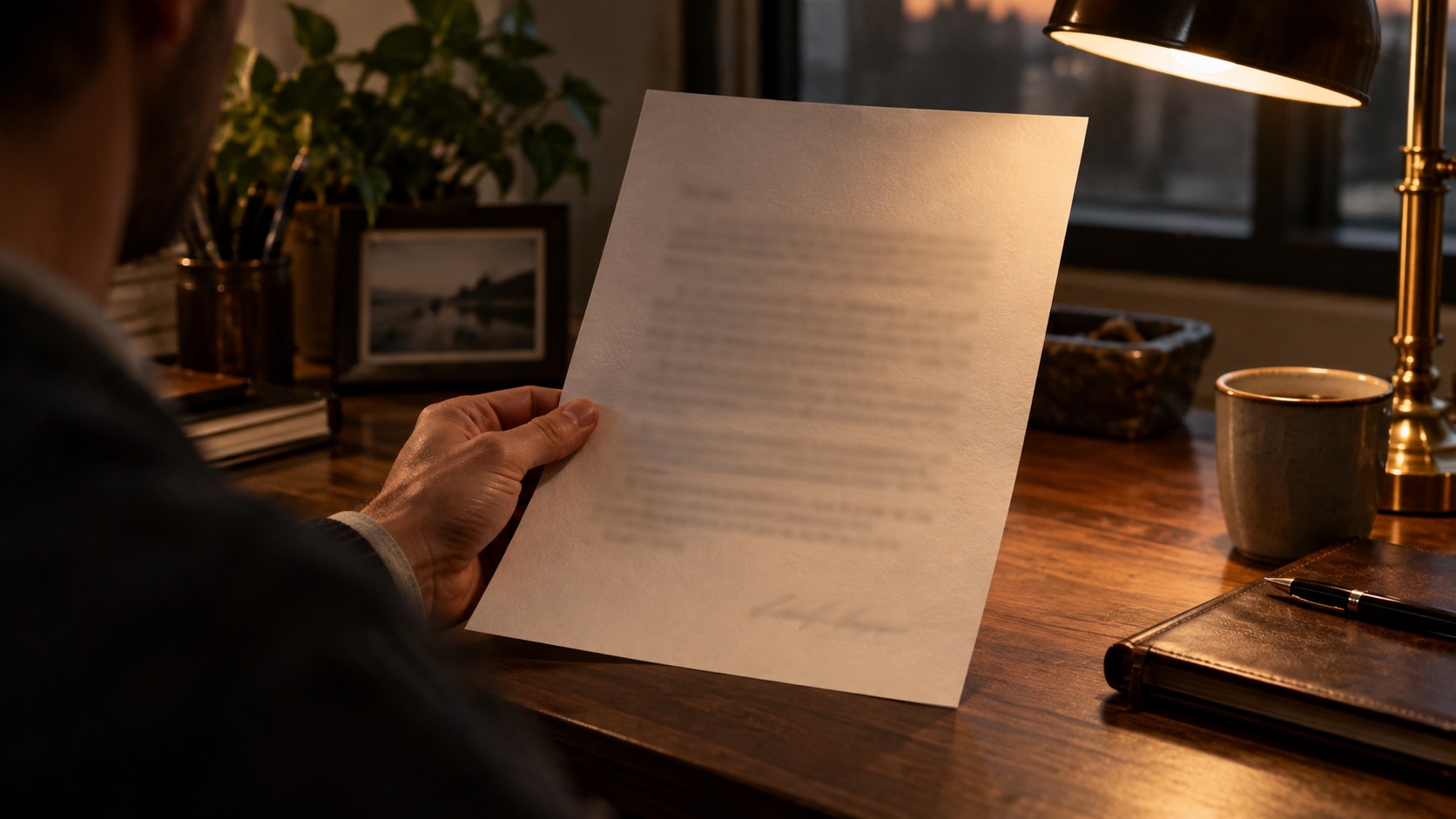
A manager who has done hiring reads an applicant's cover letter. At the bottom is one extra sentence: this letter was written by generative AI. A second manager gets the identical cover letter, except that the sentence says a career coach wrote it. The copy a third manager receives has no such sentence at all.
This was an experiment by Oliver Schilke and Martin Reimann of the University of Arizona, who randomly split 85 managers with hiring experience into three groups. The applicant was the same person, applying for the same job, with the same cover letter. The only thing that changed was that one sentence.
Saying a coach wrote the letter didn't lower trust at all
Here are the trust scores the managers gave the applicant.
| The one sentence attached to the cover letter | Trust in the applicant | Compared with the letter that had no sentence |
|---|---|---|
| No sentence attached | 4.40 | Baseline |
| Written by a career coach | 4.32 | No significant difference (p = 0.81, d = 0.06) |
| Written by generative AI | 2.91 | Clear difference (p < 0.001, d = 1.42) |
The researchers added the career coach sentence to check whether trust dropped simply because the applicant had handed the work to someone else. The results ruled that out. The gap in trust between the letter credited to a coach and the letter with no sentence was not statistically meaningful. Willingness to hire the applicant followed the same order.
So what lowered trust was not the fact that the applicant didn't write the letter. The letter credited to a coach scored the same as the one with no sentence, and the only one that lost points was the letter credited to AI.
That experiment had 85 participants. The researchers ran the same comparison again with more people. They showed 195 undergraduates a professor's welcome message for the first week of the semester and split them the same way. Students whose message said assignments would be graded by generative AI rated their trust in the professor at 2.48. Those whose message said a graduate teaching assistant would grade them gave 2.87, and those whose message didn't mention a grader gave 2.96. Here, too, the gap between the teaching assistant version and the no-mention version was not significant. An experiment that showed the same ad to 345 investors produced the same order.
The researchers tried six ways of disclosing AI use, and all six scored below saying nothing
So would a better way of saying it fix the problem? The researchers ran another experiment to find out. They took the cover letter experiment, dropped the career coach sentence, and attached six different sentences disclosing AI use instead.
- A general statement Simply says AI was used.
- A human reviewed and revised it Signals that a person holds final responsibility.
- Used only for proofreading Keeps AI's role to a minimum.
- Explains why Describes the intent behind using AI.
- May contain errors Warns up front about the limits of AI output.
- Stresses transparency Presents the act of disclosing as a virtue in itself.
All six sentences produced lower trust than the cover letter with no sentence. Every p value was below 0.02. Willingness to hire followed the same order.
Would it be different if disclosure were required by rule? They ran it again to see. Participants read one of two news articles, one saying the state government planned to make disclosure of AI use mandatory and one saying it planned to leave disclosure voluntary, and then rated the same designer. Whichever article they read, the designer who disclosed using AI still got lower trust.
"Thirteen experiments consistently demonstrate that actors who disclose their AI usage are trusted less than those who do not."
— Schilke & Reimann, Organizational Behavior and Human Decision Processes (2025)
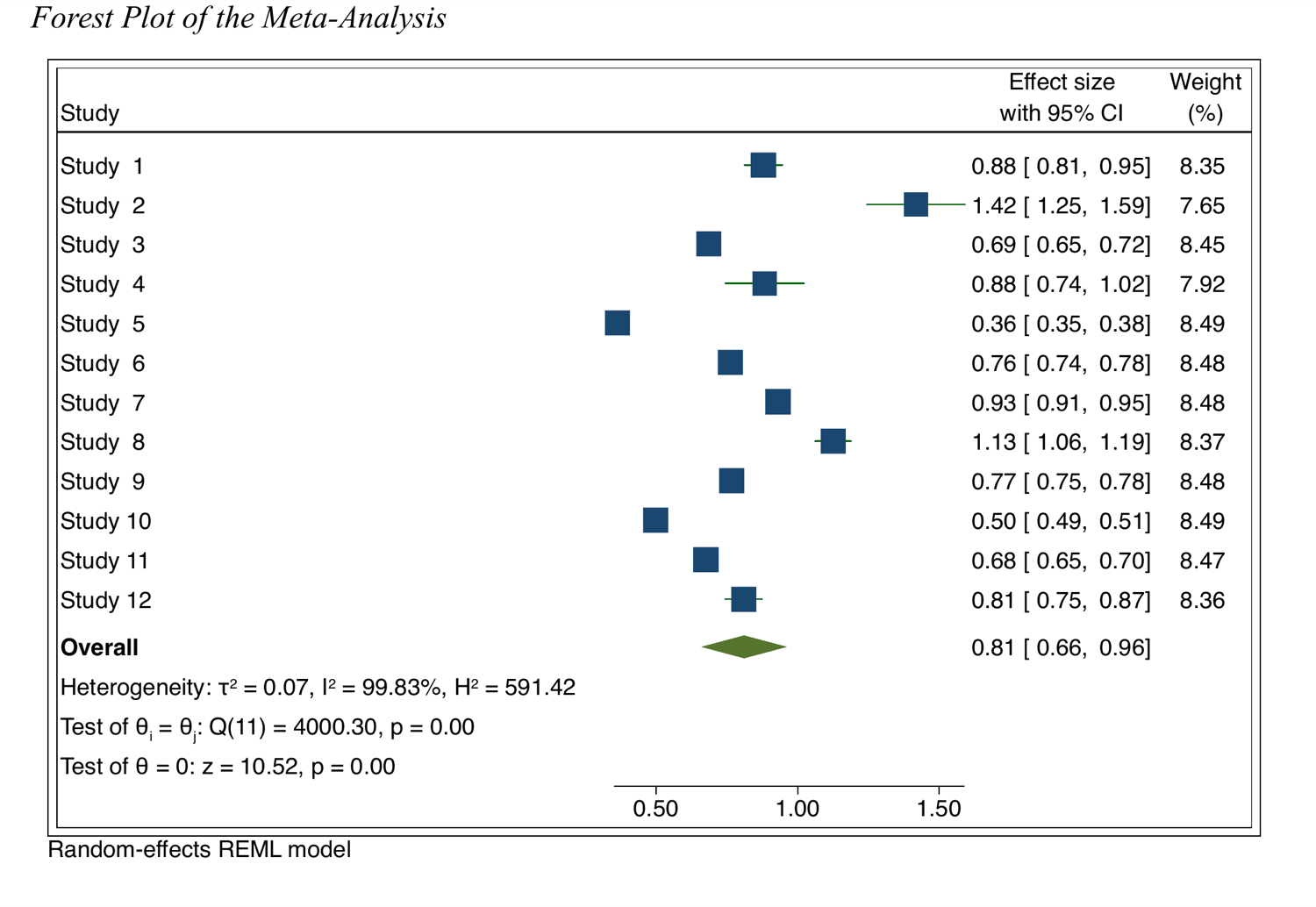
The number of experiments isn't the only reason to take this paper seriously. All thirteen were preregistered on OSF before any data was collected, and the paper's table links each experiment to its registration. Sample sizes were calculated in advance, and no data was dropped after the fact. The materials, analysis syntax, and even the manipulation checks are public. The meta-analysis that pools all thirteen covers 4,093 people.
In 2026, 94% of US knowledge workers already use AI at work
Everything so far comes from experiments in which the researchers controlled the conditions. In June 2026, Atlassian's Teamwork Lab put the same question to US knowledge workers in a workplace setting.
In a separate survey of 1,006 people, 94% said they had used AI at work in the past month, and roughly 80% said they don't hide it from their managers and peers. Then, in a controlled experiment with 961 people, participants saw the same email summarizing a business proposal, attributed to the same hypothetical colleague, with only one line changed: the note on how the work was done. People who saw the version noting AI use were 24 percentage points less likely to say they would recommend that colleague to a senior leader for a high-visibility project.
Atlassian also measured how much the wording could soften the penalty. Compared with an email saying AI "saved me time," an email framing AI use as "supporting the team and client" raised the share who credited the colleague's effort from 45% to 56%, and the share who would recommend them from 43% to 51%. Both versions still scored below the email that didn't mention AI at all.
Atlassian sells AI products, and these results have not been published as a paper.
There is one place where the two overlap. Atlassian reported that in companies that actively celebrate AI use, disclosing it carried almost no penalty, and Schilke and Reimann likewise found experimentally that the drop in trust gets smaller when the people around you treat AI use as normal. The two studies arrived at the same result.
The advisor who kept quiet about AI scored highest, and the one who got caught scored lowest
The last experiment was about tax advice. In it, 195 participants consulted a tax advisor named Charles over chat about their refund. They were split three ways: some saw a chat in which the advisor said himself that he had used AI, some saw a chat in which a third party revealed that he had used AI, and some saw a chat with no mention of it at all.
These three scores come from the same experiment on the same scale. When the advisor disclosed AI use himself, he scored lower than when AI wasn't mentioned, and when a third party exposed it, he scored lower still than when he disclosed it. All three gaps were statistically clear.
So what this research offers is not advice on what to do. It shows what happens to the score when you do each thing. Not saying you used AI gets the highest score. That score lasts only as long as nobody finds out. After thirteen experiments, one question is still open. If 94% of workers already use AI, how long can it stay something that costs you when you admit it and costs you more when you get caught?