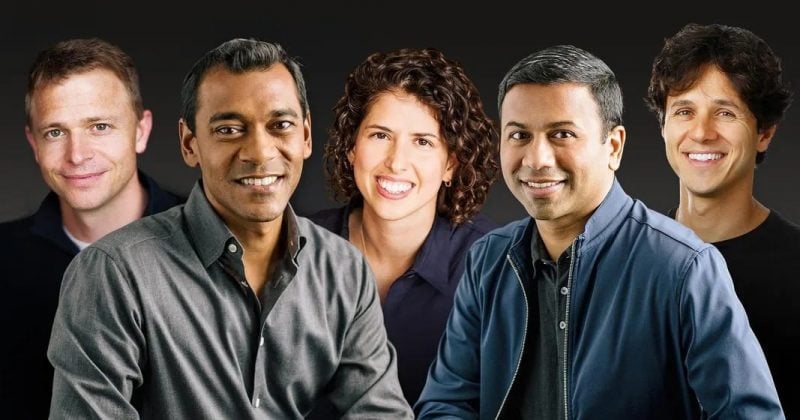
Benchmark kept its fund size locked at one number for over 20 years. $425 million.
The early backer of eBay, Twitter, and Uber just broke that ceiling and raised $2 billion.
$1.25 billion of that is going into Benchmark's first-ever growth fund.
There was a reason it stayed small for 20 years
Benchmark is a strange firm by Silicon Valley standards. Every partner holds equal equity — no "senior partner," no "junior associate." It typically runs on just 4 to 6 general partners, targets roughly 20% ownership in every deal, and has stayed brutally selective the whole way.
That small size was the point. Partner Bill Gurley once said in an interview that as funds get bigger, they lose interest in a $7.5 million check — and with it, the craft of finding companies early. His long-standing rule: venture is a game where one 1,000x return can offset eight failures, so you focus on what could go right, not the odds of failure.
That discipline is how Benchmark caught Uber, Twitter, eBay, and Snap early. For over 20 years, its funds hovered right around $425 million.
| Benchmark's traditional fund | New growth fund | |
|---|---|---|
| Size | $425M | $1.25B |
| Target stage | Seed–Series B | Growth/late-stage |
| Check size | Small and concentrated | $50M–$100M+ |
This time, it couldn't hold the line
Two things forced the change. First, Benchmark simply couldn't get into capital-intensive AI startups. Foundation model rounds run into the hundreds of millions to billions — a $425M fund can't even show up.
Second, it suddenly had the ammunition. Cerebras, the AI chipmaker Benchmark led the Series A for back in 2016, went public in May 2026. At the IPO price, $3.25 billion flowed back to Benchmark — roughly a 12x return.
One Benchmark LP put the math bluntly.
"A $425 million fund just doesn't math anymore. If you owned 15% at Series A, you need growth-stage capital to hold that stake through a $5 billion pre-IPO round."
— Benchmark LP
One portfolio story shows exactly what "losing the stake you can't defend" looks like. Manus, an AI agent startup Benchmark backed early, crossed $100 million in annual recurring revenue just eight months after launch — the fastest anyone had done it at the time. Meta tried to buy the company for roughly $2 billion, but in April 2026 Chinese regulators blocked the deal over export-control and national-security concerns. A great early stake means nothing if you can't follow it through the later rounds and the exit.
The partnership itself has turned over too. Sarah Tavel, Benchmark's first female GP, stepped back to venture partner in 2025. Victor Lazarte left to start his own fund. In their place: Everett Randle, poached from Kleiner Perkins, and Jack Altman — OpenAI CEO Sam Altman's brother.
Why does a bigger crossover fund matter to founders?
This isn't just a Benchmark story. From 2022 through Q1 2026, AI's share of global venture funding jumped from 30% to 81%, and mega-rounds over $100M now account for 73% of all AI investment value.
That concentration shows up directly in valuations. At Series A, AI startups price 38% higher than non-AI companies — and by Series E and later, that gap widens to 193%. A $10 million seed check landing a $40–45 million valuation isn't unusual anymore.
Heads up
When early-stage-only firms like Benchmark start writing late-stage checks, it means more investors show up at your term sheet table. It also means valuations riding on an "AI premium" can snap back hard into a down round the moment growth slows.
If you're raising right now, check this
- Map the new crossover funds
Traditional early-stage firms are launching late-stage vehicles like Benchmark's growth fund. If you're prepping a Series B or C, update your investor list. - Run the dilution math first
Model out pro-rata rights and option pool top-ups before you even open the round, not after a term sheet lands. - Diligence the actual partner
Don't just check the fund's brand — check who's actually running your deal and how likely they are to stick around. Benchmark itself has churned three partners in two years. - Don't get drunk on the AI premium
Positioning as AI can inflate your valuation, but it also raises the growth bar you'll need to clear next round. Be honest about what you can defend. - Build leverage with capital-efficiency numbers
Gross margin, CAC payback period, NRR — line these up in advance so you can prove you can grow without burning like an AI lab.
Want to go deeper?
TechCrunch's original report The first story on Benchmark's $2B raise techcrunch.com
Bill Gurley's MiB interview Benchmark's small-fund philosophy, straight from a partner ritholtz.com
China blocks the Meta-Manus deal The geopolitical risk behind one Benchmark portfolio company cnbc.com
AI mega-round funding trends Data on how global VC capital keeps concentrating into AI qubit.capital
The venture return gap AI is opening up Coverage of the widening IRR gap between AI and non-AI funds mt.co.kr
A closer look at Benchmark's $2B raise More detail on the structure behind both funds cryptobriefing.com