AI bills are rising, but it’s unclear which work was worth the cost
AI spending can be scattered across usage-based model APIs, separately contracted AI SaaS, and cloud bills. You may know the month-end total, yet still struggle to explain which tasks needed expensive models and which expenses actually led to results.
That is why the key takeaway from Databricks’ recent funding news is not just its high valuation. As it raised large-scale capital, the company put forward a product narrative that shifts from “more tokens” to “cost relative to outcomes.” Still, the causal relationship between investor enthusiasm and demand for cost control should be read separately.
$15 billion signals investment interest, not proof of “savings demand”
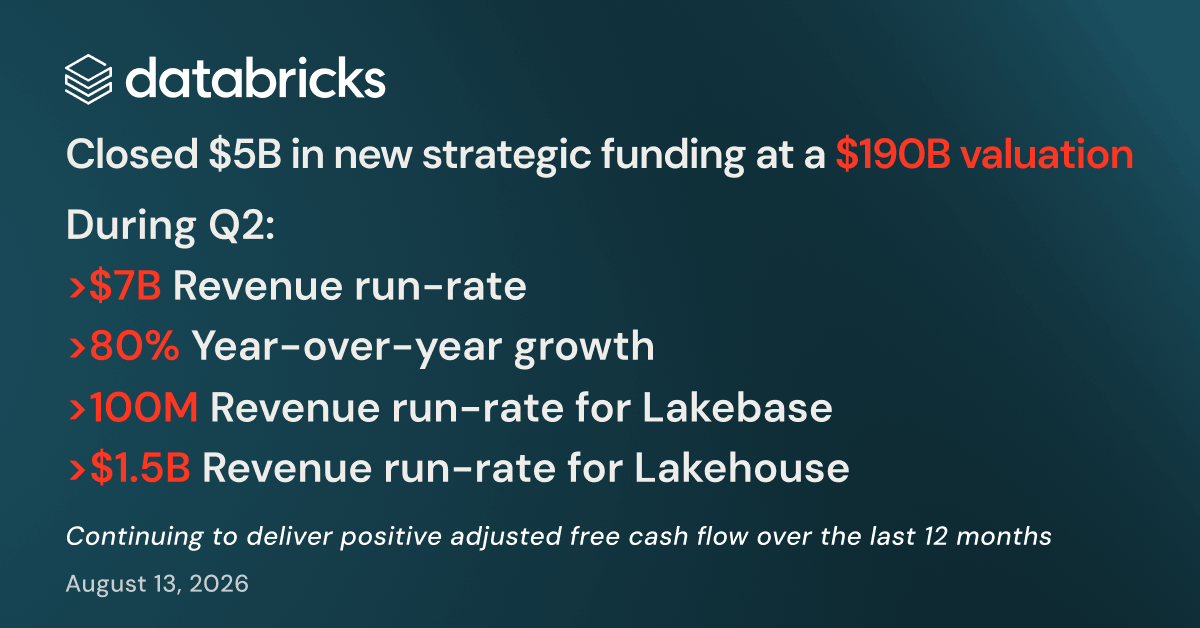
Databricks originally planned to raise about $1 billion, but according to CEO Ali Ghodsi, the investor group the company considered expressed $15 billion in interest. It ultimately raised $5 billion in August 2026 at a $190 billion valuation. Here, $15 billion is the level of interest reported by the company, not committed subscriptions or cash received.
There were also business metrics supporting investor demand. Databricks said its Q2 2026 revenue run rate exceeded $7 billion, with growth above 80% year over year. It also had more than 1,000 customers spending over $1 million annually and reported positive adjusted free cash flow over the trailing 12 months. A revenue run rate annualizes performance at a particular point in time, however, and adjusted free cash flow is not the same as GAAP net income. These are also figures announced by a private company, which is a limitation.
Three things need to be considered separately.
- Confirmed facts: investment interest equal to 15 times the target amount and a $5 billion fundraise
- The company’s market assessment: the claim that enterprises are moving from an all-in focus on the highest-priced models toward optimizing cost relative to outcomes
- What is unconfirmed: a causal link showing that individual investors invested because of demand to reduce AI costs
So rather than concluding that “investors bought AI savings,” it is more accurate to say that Databricks has positioned cost control as a core sales argument for enterprise AI infrastructure.
The strategy sells “cost per outcome” instead of the “best model”
Databricks calls this change “a shift from tokenmaxxing to valuemaxxing.” Rather than attaching the most expensive, highest-performing model to every task, the idea is to select models suited to each task’s difficulty and required quality to get more business value from the same budget. This is not an independently measured finding about the overall market; it is Databricks’ market assessment and product positioning.
In practice, comparing model unit prices alone does not deliver valuemaxxing. If switching to a cheaper model reduces approval rates and increases rework, total costs can actually rise. The right comparison unit is not “price per million tokens,” but cost per approved outcome.
Unity Gateway is presented as the control layer for putting this judgment into practice. According to the official documentation, it can centrally route requests to models and MCP services, enforce Unity Catalog permissions, and track usage such as request count, tokens, and latency. You can assign costs by adding team or project tags to requests, and set rate limits and budgets.
The important point is that a gateway itself does not automatically reduce costs. The organization must first decide which outcomes to protect, which model to switch to when costs exceed a limit, and which tasks to stop.
Today, unpack just one task from the past month of AI spending
Before buying a new platform, gather the last month’s SaaS contracts, cloud bills, and model API records in one place. Deloitte recommends treating AI costs as a finance issue that considers strategic value, usage drivers, total cost of ownership, and outcomes together—not merely token unit prices.
- Regroup spending by task.
For every line item on a bill, add the application, task, department, owner, and purpose of use. Also record the current model and vendor, along with input/output unit prices or the contract’s billing unit. For AI SaaS that does not reveal usage, ask the provider for model-level usage and billing terms, and leave it marked “unknown” until you receive an answer. - Add costs beyond tokens.
To monthly model costs, add the SaaS, cloud, data processing, and professional-services costs allocated to that task. Then add review and rework hours multiplied by the hourly labor cost to calculate monthly TCO by task. If shared contract costs were allocated, also document the allocation basis, such as request count, seats, or usage time. If historical data is unavailable, do not fabricate estimates; mark it “unknown” and begin measuring this month. - Put task outcomes on the same row.
For customer inquiry drafts, record the agent approval rate and rework rate; for document processing, record actual outputs such as completed items and error rate. Calculate approved outcomes as “monthly requests × approval rate,” and cost per approved outcome as “monthly TCO ÷ number of approved outcomes.” A model that lowers costs but worsens outcomes is not a savings candidate. - Choose one next decision.
Classify each task as keep, compare with a lower-cost model, set a usage limit, or stop. If there is no performance metric or a core TCO item is “unknown,” securing the missing measurement criteria and cost data comes before expanding usage.
Task: Customer inquiry drafts
Owner: Customer support team
Current model · vendor: ______
Monthly requests: 40,000
Average input · output: 1,500 · 350 tokens
Input · output unit price or contract billing unit: ______ / unknown
Monthly model cost: ______
Allocated AI SaaS cost: ______
Allocated cloud · data processing cost: ______
Allocated professional services cost: ______
Review · rework time: ______ hours
Hourly labor cost: ______
Review · rework labor cost: hours × hourly labor cost = ______
Monthly TCO: all direct costs + review · rework labor cost = ______
Agent approval rate: 72%
Approved outcomes: 40,000 × 72% = 28,800
Cost per approved outcome: monthly TCO ÷ 28,800 = ______
Rework rate: 28%
Unknown items and person responsible for obtaining them: ______
Next decision: Compare the same inquiries with a lower-cost model
The first deliverable is not a report saying “we reduced AI costs by X percent.” A single list that connects each use case to monthly TCO, number of approved outcomes, cost per outcome, owner, and next decision is enough. Do not treat blank fields as zero; leave them as “unknown” and assign someone to obtain the data. That is how you distinguish tasks that need expensive models from tasks that use them out of habit.
It is not too late to consider a gateway after your models multiply
If you use one model on a small scale, you can start with billing tags and a monthly usage review. Conversely, if multiple teams use multiple models and vendors and need to apply access permissions, cost attribution, and limits under the same rules, there is a reason to consider a central control layer such as Unity Gateway.
| Current situation | What to do first | Gateway decision |
|---|---|---|
| One team uses one model | Connect billing tags and outcome metrics | Recordkeeping comes before adoption |
| Multiple teams use multiple models | Define common tags, permissions, and limits | Consider central routing as a candidate |
| Costs are visible, but quality is not | Measure approval rate, errors, and rework | Hold off on routing automation |
If you are considering Databricks, first confirm that you meet requirements such as a Databricks workspace and Unity Catalog. Then check whether service, team, and project tags remain in usage records and whether you can view request counts and total tokens by model. You should also review separate charges for usage tracking, required administrator permissions, and supported regions. The budget feature can separately configure alerts and blocking usage, but it uses near-real-time estimates and therefore does not guarantee an absolute spending cap. You should also verify in the current documentation whether external-model costs and provisioned throughput are included in the tracking scope.
What a $190 billion valuation does—and does not—signal
Based on official announcements, Databricks’ valuation rose roughly 3.1 times, from $62 billion in December 2024 to $190 billion in August 2026. It is safer to exclude the $134 billion round reportedly mentioned in prior timelines for December 2025 because it cannot be verified through official materials.
| Point in time | Announced amount raised | Valuation |
|---|---|---|
| December 2024 | $10 billion Series J | $62 billion |
| August 2026 | $5 billion | $190 billion |
This comparison uses nominal valuations from private rounds at different points in time. It is neither an investment-return comparison that accounts for share terms and dilution nor a measurement of whether Unity Gateway reduced customer costs. The signal we can confirm goes only this far: there was strong investment demand for data and AI infrastructure businesses, and Databricks placed a layer for managing cost, usage, and model selection at the center of that growth narrative.
The question for our organization should be more specific than “Should we invest in Databricks?” Which task currently uses the most expensive model, and are we recording outcomes that justify its price? Once you can answer that question, you can choose cost-control tools properly too.
If you want to dig deeper
Databricks wanted to raise $1B, investors wanted $15B. It settled on $5B at a $190B valuation. You can review the context behind the $1 billion target and $15 billion in interest together with the CEO interview. techcrunch.com
AI token economics for CFOs A resource outlining the financial questions needed to connect AI spending with strategic value, usage, TCO, and outcomes. deloitte.com
AI governance with Unity Gateway Official documentation to use as a starting point when reviewing the current scope of support for central routing, permissions, usage tracking, and budget features. docs.databricks.com