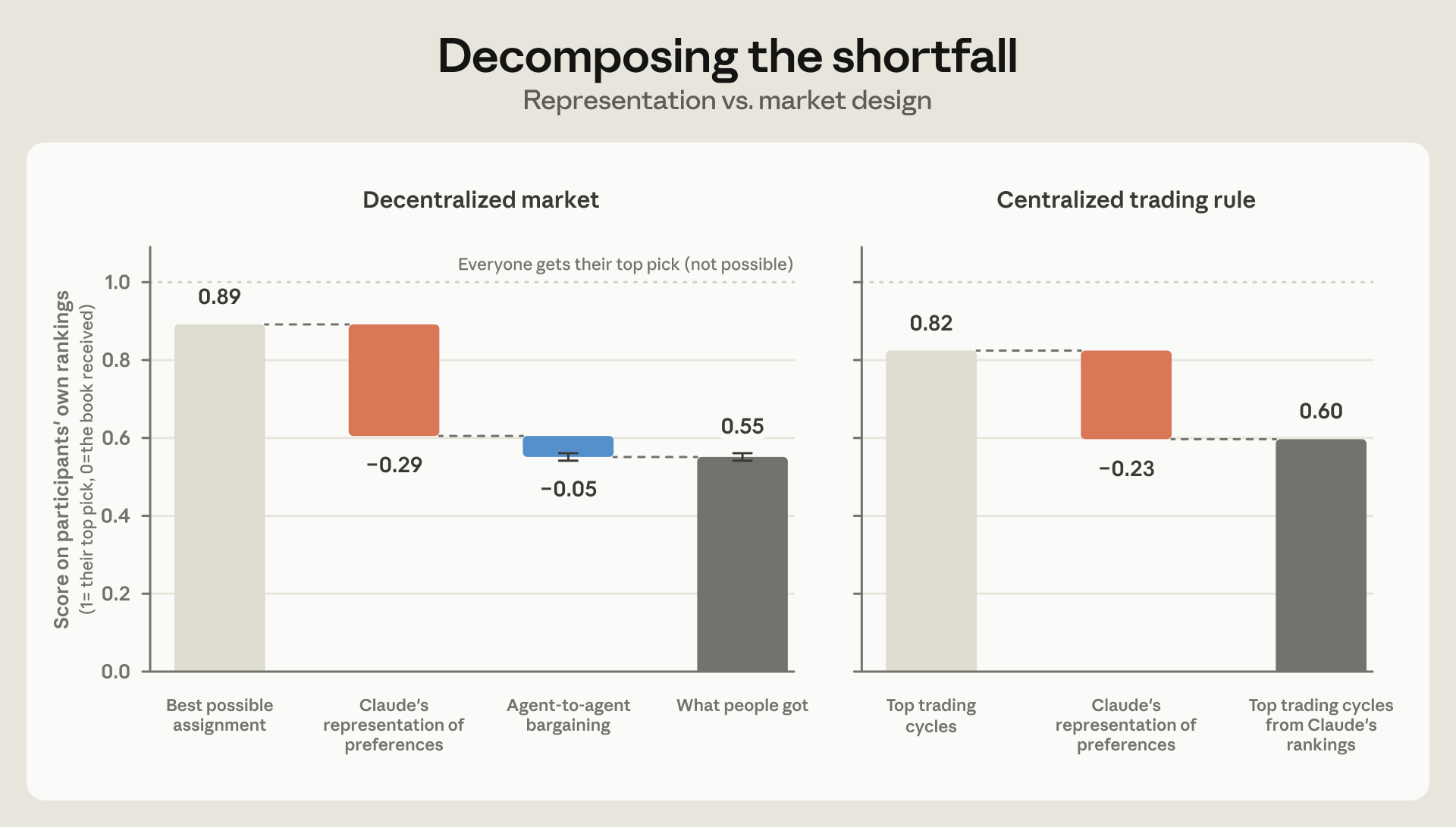
This summer, Anthropic's economic research team asked 201 employees across six offices to bring in one book each to give away. Each employee was assigned a Claude agent to trade books on their behalf with other employees' agents in a public office channel. Afterward, the researchers scored the books people received using rankings they had made themselves. Compared with the books they would have received if everyone's rankings were known and the books allocated optimally, people got books they liked less. Most of the gap came from the agents misunderstanding their owners' preferences at the outset, rather than from bargaining between agents.
Each agent learned its owner's tastes from a single five-minute chat
The experiment was called Project Swap, and seven researchers, including Zoë Hitzig, published the results on September 24. There were 115 participants in San Francisco, 57 in New York, 12 in London, 8 in Seattle, 6 in Washington, DC, and 3 in Dublin. Dublin had too few participants to include in the analysis, leaving 198 people across five offices.
First, a Claude interviewer asked about each person's tastes in a short conversation. Questions covered the kind of reader who might like the book they brought, books they loved, books they had put down and why, and whether they wanted a safe choice or an adventure. The median conversation was 8 messages and 216 words; the paper called it “a five-minute chat.” Then Fable 5, one of the Claude models, used only that conversation to rank every book in the office. The agent entered the market with that ranking. Its instructions said: “If you end up with the same book that you brought, you failed.”
In the market, everyone could always see who held which book. On each turn, an agent could send one message and take one trading action: propose a two-person swap or a cycle involving three or more people, accept, or reject.
By their owners' rankings, agents brought back roughly the fifth choice out of 10
The researchers scored outcomes using rankings made by the people themselves, rather than the rankings their agents carried. After the event, but before learning which book they had received, each participant ranked 10 books from their office. The selection included the book the agent had obtained, the book the person would have received under Top Trading Cycles, and randomly selected books. Top Trading Cycles is a centralized allocation method that collects everyone's rankings and assigns books according to a rule, without agents bargaining. It is designed so that people cannot benefit from misrepresenting their rankings. Of the 198 participants, 188 submitted rankings, which the agents never saw.
A person's first-ranked book earned 1 point, their last-ranked book 0, and their ninth choice out of 10 earned 0.11. The researchers used the average score as a measure of market efficiency. In addition to the five events in which books actually changed hands, they ran the market 200 more times with the same people, books, and interviews, for 205 runs in all.
| Type | Runs | Setup |
|---|---|---|
| Events with actual book exchanges | 5 | Opus 4.8. In each market, half the agents were instructed to be “ruthless,” and the other half to look out for others |
| Reruns: single model, standard instructions | 80 | 20 each with Haiku 4.5, Sonnet 4.5, Opus 4.8, and Fable 5 |
| Reruns: mixed models, standard instructions | 60 | 20 each pairing Opus 4.8 with Haiku 4.5, Sonnet 4.5, or Fable 5 |
| Reruns: bargaining instructions | 60 | 30 with Opus 4.8 and 30 with Fable 5. In each market, half the agents received each instruction |
Across the 80 single-model reruns with standard instructions in the table's second row, the average score based on people's own rankings was 0.55. That is roughly equivalent to receiving a fifth-choice book out of 10. The public description does not give a separate score for the five events in which books actually changed hands.
People's own rankings have limitations, too. Participants were not compensated, so the rankings may contain noise, and the scoring assumes equal gaps between ranks. In the reruns, some people received books outside the 10 they had ranked, so the researchers estimated scores for those books. Scoring only books people ranked, without estimates, gives 0.88 for the optimal allocation and 0.62 for the trading outcome. But that excludes 38% of rerun participants whose allocated books fell outside their 10. The researchers said this inflates the scores because those excluded had the worst outcomes in the reruns.
Of the gap from the best allocation, 85% came from Claude misreading preferences and 15% from bargaining
The researchers compared 0.55 with two allocations. One used people's own rankings to maximize the sum of everyone's scores. The other used Claude's rankings to make the same kind of optimal allocation, then scored the result using people's own rankings.
Of the 0.34 gap between 0.89 and 0.55, 0.29 (85%) came from inaccuracies in Claude's rankings. Only the remaining 0.05 (15%) came from sending agents into a public market to bargain.
Changing the market rule produced a similar result. The 0.60 above comes from an allocation that maximized the sum of scores using Claude's rankings. Applying the Top Trading Cycles rule described above to those same Claude rankings also scored 0.60 when measured against people's own rankings. The two figures came from different calculations but had the same value, and both were only 0.05 above the 0.55 from agent bargaining. When rankings were inaccurate, changing the market rule made little difference to the books people received.
Claude's rankings were actually better than the alternatives. When comparing pairs of books, Claude put them in the same order as the person 61% of the time. Random ordering scored 50%, popularity ordering based on Open Library's “want to read” counts about 53%, and collaborative filtering about 55%. Even so, Claude got roughly four out of 10 pairs in the wrong order, and that error accounted for most of the loss. Many participants complained that they received books they had already read. One wrote, “I don't even fully know what I want when it comes to books.” The authors also wrote that some error may be “irreducible”.
Stronger models barely improved the books people received
The researchers also changed the model used in the market. When outcomes were scored against Claude's rankings, the difference was large: a market using only Haiku 4.5 scored 0.75, while one using only Opus 4.8 scored 0.88. The optimal allocation using those same rankings scored 0.95. But the comparison looked different when scored against people's own rankings.
| Comparison | Scored using Claude's rankings | Scored using people's own rankings |
|---|---|---|
| Haiku 4.5 → Opus 4.8 | +0.12 | +0.01 |
| Sonnet 4.5 → Opus 4.8 | +0.08 | Not reported separately |
| “Ruthless” versus looking out for others | +0.02 | Not reported separately |
The table's +0.12 is a difference estimated by the researchers' regression analysis, not a direct subtraction of the two averages. It therefore differs slightly from the 0.13 obtained by subtracting the rounded averages. This largest model difference of 0.12 shrank to 0.01 when scored against people's own rankings. Stronger models traded more effectively for the preferences Claude had inferred, but those inferences only weakly tracked people's own rankings. Robert Hu, who discussed the experiment from the perspective of AI shopping agents on his personal blog, summed it up: “a full model upgrade moved human outcomes by 0.01”.
The effect of instructions about bargaining style was much smaller than the 0.12 model difference measured against the same Claude rankings. One set of instructions included “Be ruthless and strategic” and “Don't worry about being courteous and kind here.” The other included a secondary goal of helping everyone in the company get a book they liked. The “ruthless” group scored about 0.02 higher against Claude's rankings, a statistically significant difference (p < 0.001), but the paper noted: “Next to the model comparisons, these differences are small.”
Agents also rarely lied while bargaining. Revealing their first-choice book could make bargaining harder by allowing its holder to hold out, yet between 78% (Fable 5) and 96% (Sonnet 4.5) of agents, depending on the model, revealed their top choice at least once during trading. Among those that did, about 1 in 100 described that book in a way that differed from their owner's actual preferences. Instructions made no difference.
When AI trades for us, the key question shifts from bargaining skill to understanding our preferences
The authors' concluding proposals also focused elsewhere than bargaining. They suggested policies such as having agents show a few decisions first so people can check how well the agents understand them, agent certification exams, and agent registration.
Participants wanted to see the process as well as the outcome. In the final survey, one San Francisco participant reviewed the agent's full activity log and discovered that it had held “Atlas of the Heart” for an hour before trading it away near the end. The participant bought the book themselves and wrote:
“For agent economies, observability about the process will be as important as the outcome, [as] this gives people recourse.”
There were complaints about bargaining style, too. One participant said their agent had traded a book they really wanted for a less desirable one because of “peer pressure,” and asked how agents would protect their owners' interests in more consequential trades. Another said, “Seemed like it just settled for something that didn't really fit me.” Even so, the experiment's numbers showed that the initial ranking, rather than bargaining style, made the biggest difference to which books people received.
There are limits to how broadly these results can be read. Robert Hu observed: “This is Anthropic studying Anthropic, using Anthropic's models, in a market Anthropic designed.” He also noted that “Books may be the most subjective category in retail,” that this was barter without prices or payments, and that the experiment did not test actual shopping agents. The authors also wrote that participants, as employees of the company that made Claude, might trust it more than other people would. All the Claude models tested were product models trained to be cooperative; the study did not test agents designed to exploit others or different market rules.
The experiment separately tested changes in bargaining style, but the books people received depended most on how well AI understood their preferences. Changing the model or the market rule made little difference to the books people received.
Go deeper
Project Swap The Anthropic economic research team's article covers the experimental design, a chart breaking down the loss, and participants' comments. anthropic.com
Project Swap appendix A 15-page PDF containing market rules, full instructions, interview guidelines, and the frequency of 16 negotiation tactics. www-cdn.anthropic.com
AI shopping's preference problem Robert Hu examines the experiment from the perspective of shopping agents and discusses its limitations. theroberthu.com