The best ideas, apparently, live in the heads of people who aren't allowed to build them.
A designer, a PM, a support rep — they know exactly what needs to change. Then they wait weeks for engineering time. That's where good ideas quietly die.
Everyone's trying to kill the handoff
Figma's Config event in June 2026 said it all. Figma showed off a new "Code Layer" that turns a drawn design into working code with one click. The old flow was: designer draws, engineer rebuilds from scratch. Now the drawing just becomes the product.
Figma isn't the only one chasing this. YC-backed Rivet lets designers edit the production codebase directly, like a canvas, and ship straight from there. Their line is basically "what you design is what ships". They want to erase the handoff entirely.
Remix, freshly launched on Product Hunt, is going after the same problem. Its approach is different, though.
So what's Remix actually doing differently?
Remix founder Hesham Ghandour put it this way in the launch post.
The best ideas are usually in the heads of people not allowed to build them. A designer, a PM, a support rep sees exactly what should change, then waits weeks for engineering time. That wait is where most good ideas quietly die.
— Hesham Ghandour, founder of Remix
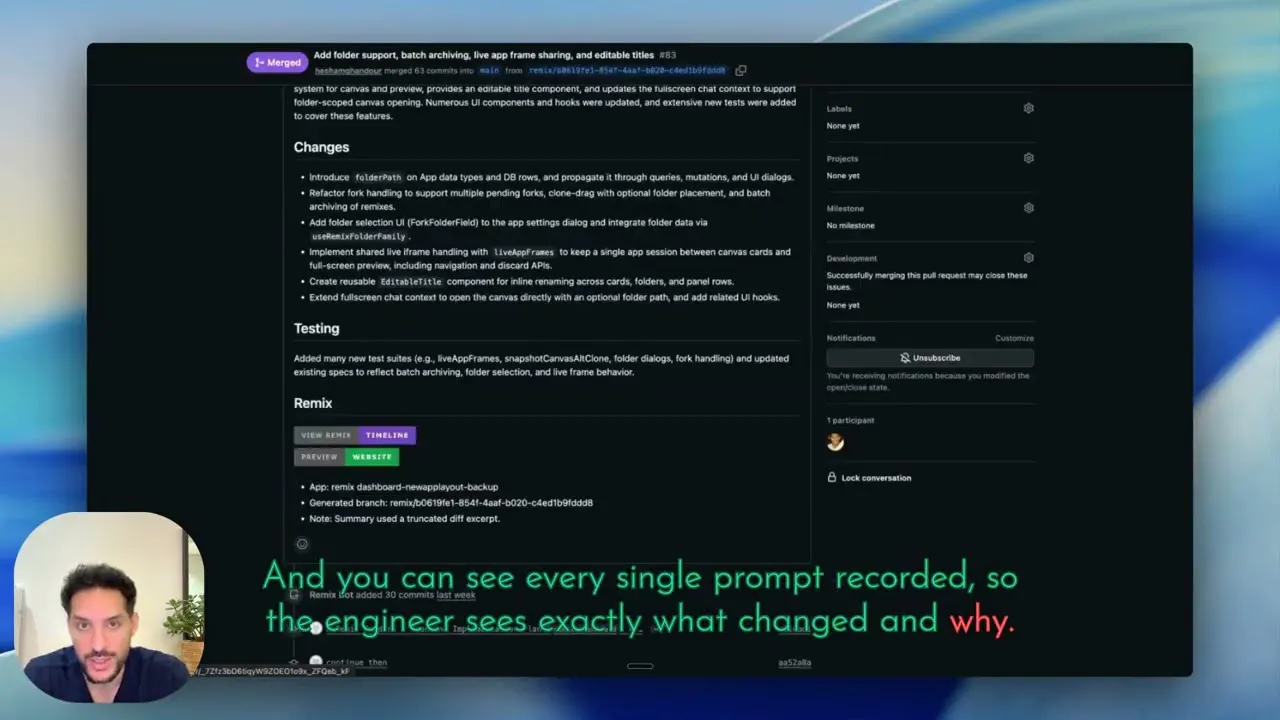
Remix's answer isn't "edit directly." It's a safe copy + AI prompting + a review gate. Each teammate gets their own sandbox copy running the real product code. Describe the change you want, and a live preview appears inside that copy — automatically checked against your design system, security, and compliance rules. If it looks good, open a PR straight to GitHub, and every prompt exchanged along the way stays on record so a reviewer can see exactly how it was built.
There's an argument floating around about why small UI fixes keep getting pushed down the backlog — AI, the theory goes, dropped the cost of that work from "someone has to focus and build it" to "someone has to review the output". Remix's whole workflow is built around exactly that shift — AI and non-engineers do the making, while review and merge approval stay firmly with engineering.
| Direct-edit (Rivet, etc.) | Sandbox + review (Remix) | |
|---|---|---|
| Where you edit | Production codebase, like a canvas | A safe copy of the real app |
| How it ships | Design it, it ships | Merges after a GitHub PR review |
| What's logged | Version history of edits | Every AI prompt, kept and visible |
| Best fit | Small teams where designers touch code | Orgs that need an engineering approval gate |
Okay, but is this actually safe?
That question showed up in the Product Hunt comments almost immediately. Clement Morel wrote that he'd want to understand exactly what the sandbox is before handing it to a support rep or a designer. Fair concern.
Ghandour's reply: "The sandbox runs the real app off the branch, what it talks to is a config decision you make, not something Remix picks for you." In other words, whether it's wired to production data or staging data is entirely up to the team.
Another commenter, InferHaven, framed it differently — "I really like this, accelerating ideas → prod while also giving the engineer greater visibility". Whether this actually works out probably comes down to how carefully each team sets that config — speed versus control.
If you want to try it
- Sign up on the Product Hunt page
Join the waitlist or early access at remix.one/product-hunt. - Connect your GitHub repo
The sandbox only makes sense if it's running your actual production codebase. - Decide the data scope first
Your team, not Remix, decides whether the sandbox talks to production or staging data. - Invite designers, PMs, and support to try a first variant
Describe the change in a prompt and a live preview appears on the copy. - Once it clears design-system and security checks, open a PR
The prompt history stays attached, so reviewers see the full context.
Worth digging into
Remix's Product Hunt launch page See the maker comments and the actual demo GIFs for yourself producthunt.com
Rivet — letting designers own the code A competing take (direct-edit) on the same category reforgers.com
The Modern Leader — the backlog is finally getting its moment A good breakdown of how AI changed the cost structure of small UI work modernleader.is
Figma's Code Layer, explained A deep-dive on Config 2026's biggest design-to-code announcement brunch.co.kr
Figma embraces code and AI Korean tech press coverage of the Config 2026 announcements digitaltoday.co.kr
Hesham Ghandour's profile Background on Remix's founder, including his Y Combinator W20 history linkedin.com