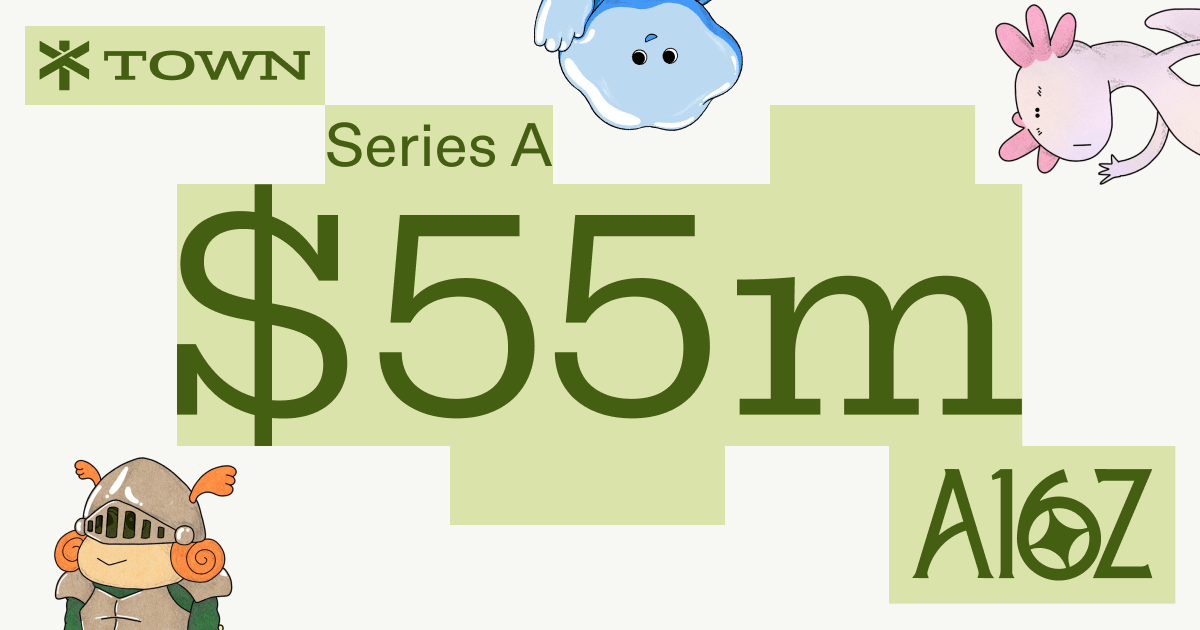
Everyone says you need great prompts to get great results from AI. a16z just bet $55M on the exact opposite — a personal AI assistant that learns your behavior without prompts. That's Town.
This is how everyone uses AI, right?
Most people's AI workflow looks the same: open a window, explain everything, get results, close it. Come back tomorrow and explain everything again. a16z put it bluntly.
"For the past few years, using AI has mostly meant staring at a blank prompt box and knowing the right thing to ask it."
— a16z
That's why "prompt engineering" became a skill. To get good output, you need to know how to ask. But here's the thing — that's backwards. Tools should adapt to you, not the other way around.
ChatGPT, Claude, Gemini — they all follow the same pattern. Session ends, memory resets. Next time you need to explain yourself again. Whether you're drafting an email, summarizing a meeting, or writing a Slack message, you always start with "here's who I am and what I'm doing."
But $55M is pointing the other direction
Town doesn't have a prompt box. Instead, it learns from the spaces where you already work — email, calendar, Slack, docs, WhatsApp, desktop, and browser. It observes what you do frequently, who you communicate with, and where bottlenecks appear. Then it acts first.
Here's what Town handles: recruiting pipeline management, schedule coordination, missed follow-up alerts, grant application processing, and communication drafting. Before you ask.
a16z's one-line take captures why this is different. Accumulated context is the product.
| Current AI tools (prompt-based) | Town (behavior-learning) | |
|---|---|---|
| Getting started | Explain context every time | Learns from existing behavior |
| Memory | Session-only (resets to zero) | Continuously accumulates |
| How it works | Responds when you ask | Proactively suggests |
| Platform scope | Within specific apps | Email · Slack · Calendar unified |
| Moat | None (easy to switch) | Context builds = irreplaceable |
In June 2026, Town closed a $55M Series A led by a16z, with Forerunner, First Round, Alt Capital, and Conviction participating.
So what actually changes when context accumulates?
The lack of moat in AI tools is a real problem right now. Switch from ChatGPT to Claude and you lose nothing. Better model? Just switch. That's the current state.
But if Town has learned six months of your email patterns, Slack conversations, and calendar behavior — that changes. That context is basically impossible to transfer to another tool. It's not the data that moves — it's the understanding of you that was built from it.
"The winner won't be whoever ships the most features. It'll be whoever earns enough trust to hold your context."
— a16z
Town's co-founder JDG (Jean-Denis Greze) is the former CTO of Plaid. Plaid connects 9,000+ fintech partners and 12,000+ financial institutions — he built infrastructure for the world's most sensitive financial data. Co-founder Tony is the former Google Product & AI lead and ex-Dropbox design lead. They met at Dropbox, where helping build productivity tools used by hundreds of millions daily gave them the foundation for Town's design.
"Personal AI assistants are going to be one of the defining consumer software categories of the next decade."
— a16z
What you can do right now
Even if Town isn't publicly available yet, you can start preparing for the shift to context-based AI today.
- List your recurring tasks
The clearer your behavioral data, the faster any AI can learn. Writing down "5 tasks I repeat every day" in Notion or your notes means faster onboarding whenever the right assistant arrives. - Start cleaning up your communication patterns
Behavior-learning AI like Town starts from your email and Slack history. The more organized your inbox and the more your calendar events have descriptions, the better it learns. - Find where you drop follow-ups
One of Town's first use cases is catching missed follow-ups. Knowing when and why you drop them helps you pre-design what you want an assistant to catch. - Max out your current AI tools' memory features
Enable memory in the AI tools you already use and build up as much context as you can. It gives you a preview of what continuity feels like — and prepares you for the shift. - Think through your data access limits now
Town needs access to email, Slack, and calendar. Deciding in advance what you'll allow, and how to separate work and personal data, means no confusion when you actually onboard.
One thing you can do right now
Next time you use AI, ask yourself: "Will this tool remember this context next week?" If the answer is no, that's where your biggest hidden cost is hiding.