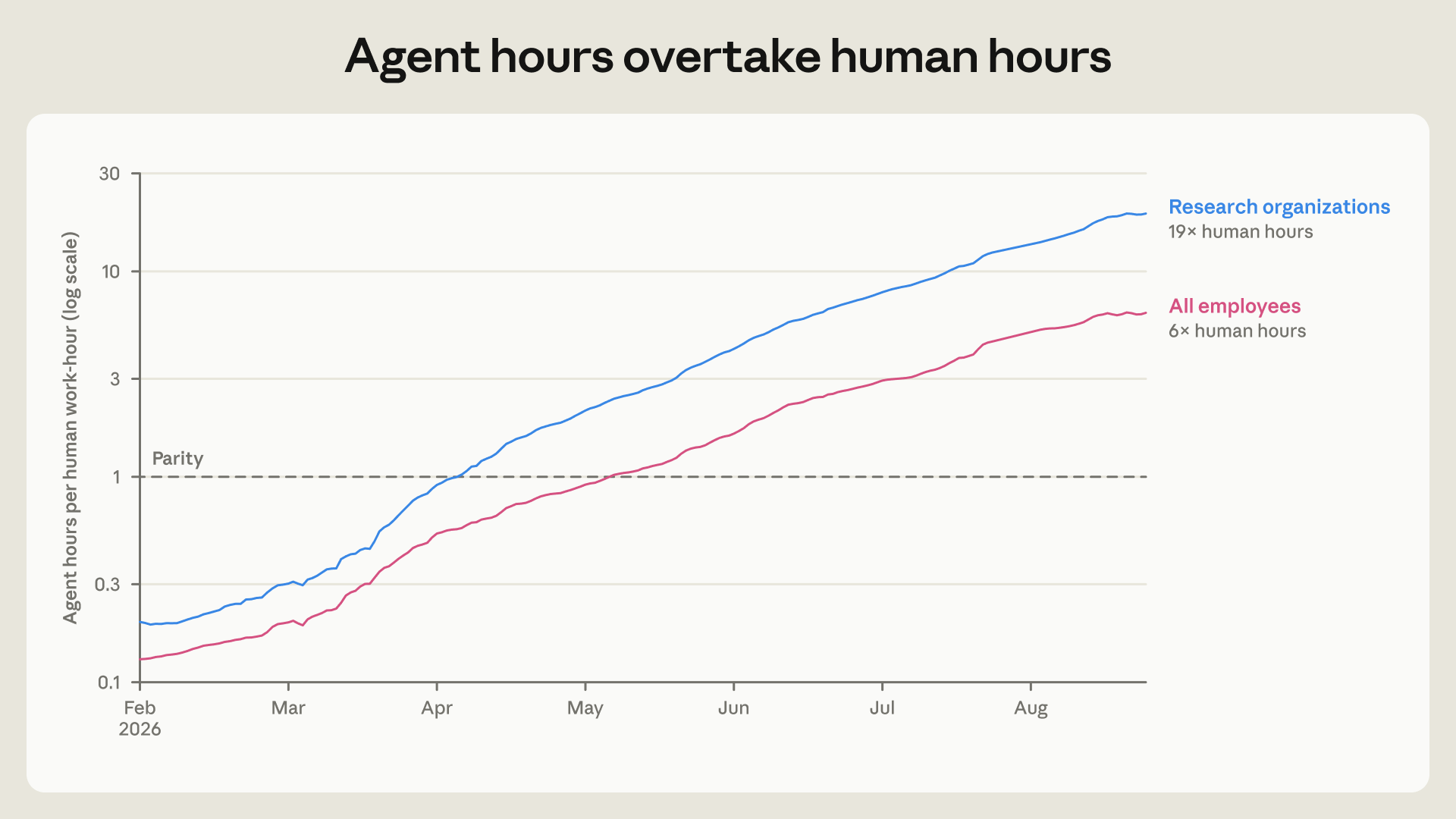
One Anthropic engineer recently described their work as “an army of Claudes, with every one asking for my attention”: a multitude of Claude agents each asking to be noticed. In August 2026, employee-directed agents at the company worked six times as many hours as its employees. Yet employees spent more time in meetings than they had a year earlier.
The sixfold figure compares active time in employee-directed interactive sessions with a 40-hour workweek for each employee
These figures come from “How employment is changing at Anthropic,” a report published on October 16, 2026, by the company’s research organization, The Anthropic Institute. The researchers analyzed HR records, agent session usage records, output measures such as commits, contracts and closed sales, employee surveys, internal Slack, calendars and hiring interview scorecards. They also interviewed 17 employees.
Counting both autonomous agents that run without employee direction and employee-directed interactive agents, agent work time first exceeded employee work time in March 2026. Five months later, in August, agent time was six times employee work time even when the measure was limited to employee-directed interactive sessions. The public explanation does not give an August ratio that also includes autonomous agents.
The sixfold figure adds up the time agents spent reasoning and using tools in interactive sessions, including the time of subagents, and compares it with the number of employees multiplied by 40 hours a week. Employee work time is an assumption of 40 hours per person per week, not a record of actual hours worked.
The researchers who wrote the report, the data they analyzed and Claude, the tool whose effects they studied, all came from Anthropic. There was no external audit. Yale social scientist Julián Posada said the report was written from the perspective of “a company that wants to sell shares.” The Guardian reported that Anthropic could go public as early as November.
For around 80% of the time employee-agent sessions were open, agents were waiting for a human response
The picture looks different when measured against the entire time those interactive sessions were open. Agents spent around 80% of that time waiting for human input. The report’s wording is “around 80% idly waiting for human input”. The sixfold figure adds up time when agents were active; the 80% is the share of open-session time when they were inactive. The two measures have different bases. Both figures can be explained if an employee runs multiple overlapping sessions and subagents, but the public explanation does not say how many sessions a person opens at once. The report also did not measure what people were doing while the agents waited.
The report also estimated how long it would take people to read everything agents produced. Converting output tokens from interactive sessions at 0.75 words per token and 250 words per minute, the reading time exceeds half of a 40-hour workweek even for nontechnical employees. The figure is titled “Reading Claude as a full-time job.” This is an estimate based on reading everything, not a measure of how much employees actually read.
One engineer compared the situation to a child asking for a juice box to be opened and another who has cut a finger and is bleeding, both demanding attention with equal urgency.
“every child brings to you concerns with an equal demand for your attention and the various [Claudes] also do that.”
Another engineer said people were “bottlenecking the agents”.
The share of employee-agent conversations spent creating instructions and review criteria rather than assigning actual work rose from 10% to 22%
The report divided employees’ interactive Claude sessions into two categories. One consists of conversations assigning actual work to agents; the other consists of conversations that enable agents to work. The report calls the latter “meta-work.” It includes creating skills for other agents, planning and reviewing for other agents, setting up pipeline dashboards and monitors, and documenting how work is done. It also includes instructions written once for agents to follow repeatedly, which the report calls standing instructions.
The 22% is meta-work’s share of the average employee’s interactive sessions, not 22% of their total working hours. It was derived by using an automated classifier to categorize a sample of 2,000 conversation summaries. In open-ended responses to an April 2026 internal survey, 20% wrote that their role had shifted from doing work directly to managing Claude, and 27% wrote that their productivity had increased. The public explanation does not say how many people responded.
The interviews show what this shift looks like. One engineer set up an “agent chief of staff” to sort agent requests. Another wrote a performance review for their team of Claudes, saying, “let’s talk about what is and is not working about our communication style.” One lawyer moved from reviewing legal questions one at a time to writing decision frameworks that customer-side agents could find and read. The lawyer called this “SEO for legal advice”.
Engineers also produced more code as they used agents. Commits per engineer were five times their level six months earlier. The researchers compared changes before and after adoption among 192 engineers who began using coding agents with changes among 74 engineers who did not use agents in the same month. The approach attempts to account for changes affecting everyone, such as company growth. Even with that comparison, the amount of code added by adopters rose after adoption. For the same engineer, in the same month and the same code folder, agent-written and human-written code had no difference in the rate at which it was later deleted or reverted. Adoption was not random, however, and the report cautioned: “More code does not necessarily mean better code or business impact.”
The report suggests that working with agents exposes problems people need to decide together, adding to meeting time
Drawing on interviews, the report suggests that chasing bugs with agents exposes organizational, systems and technical debt problems that people need to resolve together. One interviewee said, “A break from managing the agents typically looks like jumping into a meeting.”
Calendar records show that median employee meeting time rose 20% from a year earlier. The report says that figure includes the effects of the company tripling in size over the past year and a growing share of nontechnical employees, who spend more time in meetings. Meeting time for technical individual contributors (ICs) who were not managers removes some of those effects; it rose 16% year over year. The public explanation does not say how many hours meetings occupied before and after, or how many calendars were examined. There is also no causal analysis showing that agents increased meetings. The figures establish that agent use and meeting time rose during the same period; the connection between them is the report’s interpretation.
The report argues that agents need to be able to see what people have decided. In the public Slack channels of one large department, the number of human replies to human-started threads stayed flat, with agent replies added on top. Agents appeared in nearly half of active public channels. Decisions made in meetings or private messages and left unrecorded are invisible to agents. One employee had been named in a Claude merchandise document months earlier; after responsibility changed hands, agents kept bringing that employee requests for T-shirts and mugs. The report wrote: “The need to feed AI context requires observability of human work and decisions.”
Hiring interviewers also mentioned candidates’ use of AI tools three to four times as often as in 2024
The researchers used an automated classifier to sort interview scorecards for thousands of people hired since 2024 and examine what interviewers mentioned about candidates. The share mentioning a candidate’s ability to use AI tools was about 5% for technical roles and 7% for nontechnical roles in 2024. By 2026, it had tripled for technical roles and quadrupled for nontechnical roles. Interviewers mentioned autonomy and judgment more often than technical expertise.
| Measure | Before | After |
|---|---|---|
| Share of interview scorecards mentioning AI tool use (technical roles) | About 5% (2024) | 3 times the 2024 level (2026) |
| Share of interview scorecards mentioning AI tool use (nontechnical roles) | 7% (2024) | 4 times the 2024 level (2026) |
| Share of entry-level hires among technical department hires | 27% (early 2025) | 9% |
| Share of entry-level employees in technical departments | 21% (early 2025) | 14% |
Over the same period, the entry-level share of technical department hires fell from 27% in early 2025 to 9%, and the entry-level share of employees fell from 21% to 14%. In a manager survey, about one-third of ML managers and about one-fifth of software engineering managers said they were hiring less because of AI. These were managers’ own responses, however, and there was no analysis testing whether AI caused the decline in the entry-level share.
Outside researchers and developers question the “bottleneck” label and metrics such as commits, and caution against applying Anthropic’s results elsewhere
Dylan Baker of DAIR said the report’s description of people as bottlenecks for agents fundamentally misunderstands how software is made. “It’s such a social, interpersonal and human process,” he said.
On Hacker News, djoldman argued that counts of commits, queries and contracts are secondary metrics that can rise 1,000-fold with little relationship to business outcomes, while metrics for closed sales, hiring and invoices are closer to actual economic activity. “AI can make it very easy to do more and more busywork that doesn't move the needle,” he also wrote.
ytxm said the report welcomed the disappearance of entry-level work without explaining how future senior employees would be trained. The report proposed employee stock ownership and internal redeployment, among other measures, in response to these employment changes, but acknowledged that such measures do not directly address the decline in entry-level hiring.
skybrian argued that exploding revenue and a small workforce would inevitably make statistical productivity look high: “We can’t all be Anthropic.” The company tripled in size over the past year, and the report itself says much of its employment model cannot simply be replicated by other companies.
At Anthropic, as agents take on more work, people decide what to delegate, make decisions together and judge the results
Why did meetings increase as agents took on more work? According to the report’s interpretation, when work with agents exposed organizational, systems and technical debt problems that individuals could not resolve alone, people gathered in meetings. Decisions made there then needed to be recorded in public channels so agents could see them.
Baker argued that software work is a process between people, and the report’s numbers show that interpersonal work stayed the same or increased. Human-to-human replies on Slack remained flat, while meeting time rose. Agents took on the actual tasks, while people still decide what to do and whether the results are right. Anthropic employees had focused on doing work themselves. As agents took on more of the actual work, employees now focus on deciding what to delegate, making decisions together and judging the results.
Go deeper
How employment is changing at Anthropic The original report, with figure notes explaining how the sixfold figure, 80%, meta-work and meeting time were calculated. anthropic.com
Experts cast doubt on Anthropic report An article collecting outside experts’ objections, including the lack of an external audit and criticism of the word “bottleneck.” Some figures differ from the original report: for example, it puts the point when agent time exceeded human time in May rather than March. theguardian.com
Hacker News discussion Developers discuss whether output measures such as commits show business results and how to develop entry-level employees. news.ycombinator.com