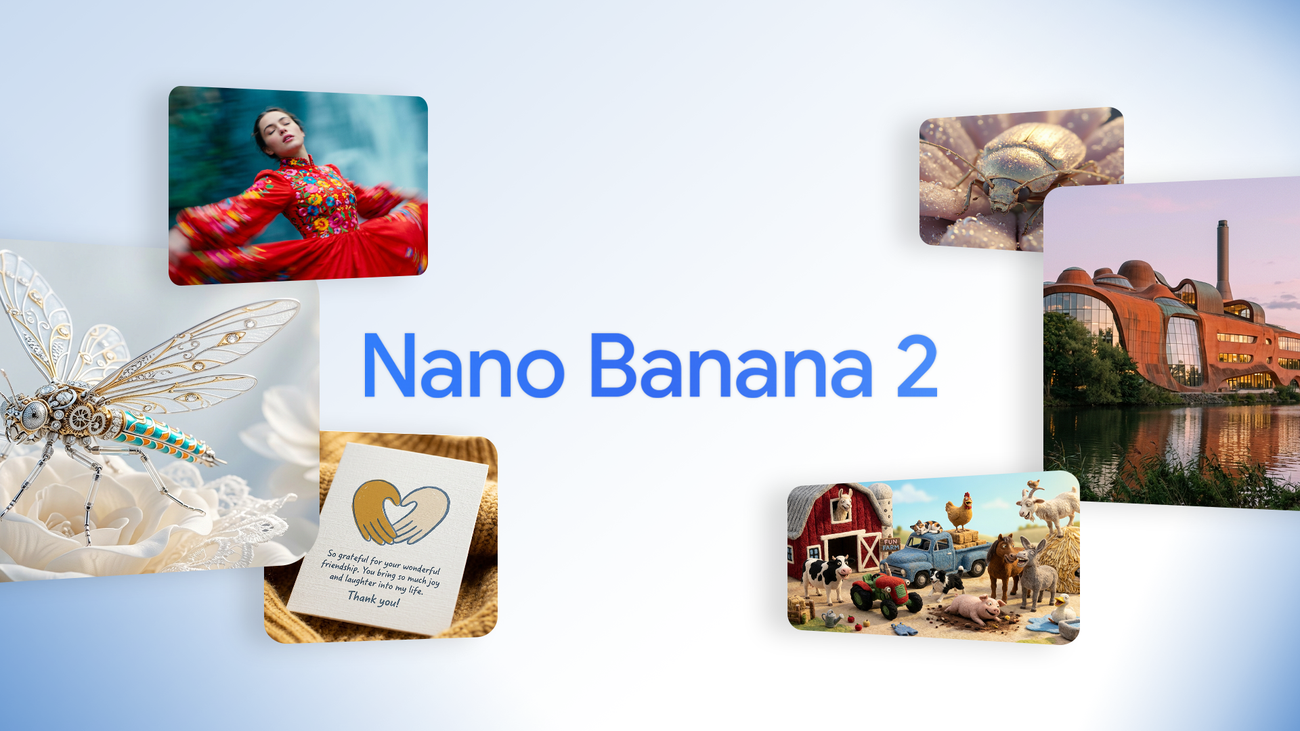
Google just dropped a pro-quality image generation model at half the price. About $0.067 per 1K image, $0.15 for 4K. The name: Nano Banana 2. Official designation: Gemini 3.1 Flash Image. Speed is 2–3x faster, quality stays pro-grade.
What Is It?
"Nano Banana" is Google's internal codename. The official name is the Gemini image model, but the codename stuck in AI communities. The original Nano Banana (Gemini 2.5 Flash Image) launched in August 2025, followed by Pro (Gemini 3 Pro Image) in November. Then on February 26, 2026, Nano Banana 2 (Gemini 3.1 Flash Image) arrived.
The core value prop: "Pro-level quality + Flash-tier speed + half the price." The previous Nano Banana Pro delivered great quality but was slow and expensive — 20–60+ seconds per image at $0.134 (~$0.13) per 1K image. Nano Banana 2 matches that quality in 4–6 seconds at $0.067.
An early tester from Google DeepMind noted: "Human diversity and font-like designs are slightly better on Pro, but overall it feels on par or even better than Pro." That was based on comparing 16 test cases side by side.
The benchmarks back this up. On GenAI-Bench human evaluation, Nano Banana 2 scored Elo 1079 — beating both the original Nano Banana (1073) and GPT-Image 1.5 (1021). In visual quality evaluation, it leads GPT-Image 1.5 by roughly 97 Elo points — a significant margin.
Here's what specifically improved:
- World Knowledge
Leverages Gemini's real-time web search to render specific people, places, and objects more accurately. For example, "Seoul weather in March 2026 as a pop-art infographic" pulls live data to produce an accurate result. - Text Rendering
Generates accurate text within images. Supports multilingual text including Korean, English, and Japanese, and can even translate text in existing images to other languages. - Character Consistency
Maintains consistent appearance for up to 5 people and 14 objects across multiple scenes. Ready to use for storyboards, comics, and children's book illustrations. - Production-Grade Specs
Resolution options from 512px to 4K, with 14 aspect ratios including 1:1, 16:9, 9:16, 4:1, and 1:8. One model covers everything from social media stories to widescreen banners.
What Changes?
Let's compare Nano Banana Pro (Gemini 3 Pro Image) and Nano Banana 2 (Gemini 3.1 Flash Image) head to head. Same company, completely different positioning.
| Nano Banana Pro | Nano Banana 2 | |
|---|---|---|
| Official Name | Gemini 3 Pro Image | Gemini 3.1 Flash Image |
| Generation Speed | 20–60+ seconds | 4–6 seconds |
| 1K Image Price | $0.134 | $0.067 |
| 2K Image Price | $0.134 | $0.101 |
| 4K Image Price | $0.24 | $0.151 |
| Max Resolution | 2K | 4K |
| Elo Score (Overall Preference) | 942 | 1079 |
| Free Tier | Requires Pro/Ultra subscription | Free in Gemini app |
Nano Banana 2 wins or matches Pro in virtually every category. That's why Google replaced it as the default image model in the Gemini app. Pro is now reserved for specialized tasks requiring the highest fidelity.
Here's how it stacks up against other AI image generation tools:
| Model | Company | Price per Image | Text Rendering | Max Resolution | Strengths |
|---|---|---|---|---|---|
| Nano Banana 2 | $0.067 (1K) | Excellent | 4K | Speed + price + quality balance | |
| GPT Image 1.5 | OpenAI | $0.04–$0.17 | Good | 1024px | ChatGPT integration, prompt understanding |
| Midjourney v7 | Midjourney | Subscription ($10/mo+) | Average | 1024px | Art style, aesthetic polish |
| FLUX 2 Max | Black Forest | $0.05 | Good | 2K | Open-source, customizable |
| Imagen 4 | $0.02 (Fast) | Average | 2K | Cheapest, bulk production |
Nano Banana 2 vs GPT Image: Where the Gap Shows
In GenAI-Bench overall preference, Nano Banana 2 (1079) leads GPT-Image 1.5 (1021) by 58 points. The visual quality gap is even wider at 97 points — meaning significant differences in realism, detail sharpness, and artifact reduction. That said, GPT Image's strength is conversational workflow within ChatGPT, while Nano Banana 2 excels in web-search-informed accuracy and multilingual text rendering.
And this isn't just about image generation. The real story is ecosystem integration. Nano Banana 2 is being rolled into these Google services:
- Gemini App — Default image model across Fast, Thinking, and Pro modes
- Google Search — Image generation in AI Mode and Lens, expanded to 141 countries
- Flow — Default image model in Google's AI video editing tool (free)
- Google Ads — Applied to ad campaign creative generation
- Stitch — Expanding to Google's AI UI design tool
- NotebookLM — Generate infographics directly from research notes
Heads Up: SynthID Watermark
Every image generated by Nano Banana 2 automatically includes a SynthID digital watermark. It's invisible to the eye but allows verification of AI-generated content. C2PA Content Credentials are also supported, enabling provenance tracking compatible with Adobe, OpenAI, and Meta. Worth knowing if you're using these commercially.
Getting Started
- Start Free in the Gemini App
Go to gemini.google.com — Nano Banana 2 is already the default image model. Describe what you want: "A cat drinking coffee in front of Seoul Tower, watercolor style." Free quota available for immediate use. - Specify Resolution and Aspect Ratio
Include specs in your prompt: "16:9 ratio, 4K resolution." For rapid iteration, explore at 512px low-res first, then regenerate favorites at 4K to save costs. - Be Explicit About Text
For text within images, specify it directly: "A sign that reads 'Welcome to Seoul.'" For translations, just ask: "Convert this text to Japanese." Multilingual text rendering is a key strength. - Use the API for Bulk Generation (Developers)
Get an API key from AI Studio and generate images programmatically via the Gemini API. Model name:gemini-3.1-flash-image-preview. Also available on Replicate. - Explore the Google Ecosystem
Generate video backgrounds in Flow, auto-create ad creatives in Google Ads, or turn research notes into infographics in NotebookLM — it's embedded across Google services.