From May 2025 to February 2026, 133 patent lawyers at 11 U.S. intellectual property law firms each took part in a 90-day experiment. Ninety received an AI patent drafting tool made by Google; 43 did not. On day 90, the researchers gave everyone an AI-generated patent draft and asked them to edit it without AI.
On the drafting tasks, where AI was available, junior lawyers with less than seven years of experience scored much higher if they had received the tool than if they had not. Their advantage was larger than that of senior lawyers. But on the editing test without AI, there was no clear difference between juniors who received the tool and those who did not. Only seniors who received it scored higher than peers of similar experience who did not. The paper, written by David Autor of MIT and six Google researchers, first appeared as an NBER working paper on September 3, 2026. An October 7 revision removed some analyses and an interview section. The figures in this article come from the revision.
Google and MIT researchers gave an AI patent drafting tool to 90 of 133 U.S. patent lawyers and compared them with 43 who did not receive it over three months
The researchers randomly assigned 133 of the 156 lawyers recommended by their firms, using a 2:1 ratio within each firm. The 90 people in the treatment group received training and access to InFlow, an unreleased Google Labs tool. The 43 in the control group used only their existing legal tools. Participants had an average of 12.4 years of experience, and 89 (67%) were seniors with at least seven years of experience.
- Drafting on day 10
Given a primary claim, drawings and inventor notes, participants had two hours to write dependent claims and a detailed description. The treatment group could use AI. - Drafting on day 90
The task followed the same format but was harder. The treatment group could again use AI. - Editing test on day 90
Everyone edited and commented on a flawed AI-generated patent draft without AI.
Two patent lawyers from other firms graded the responses without knowing whose work they were. They scored each of five categories from 1 to 5.
Not everyone who received AI used it heavily. In each of three monthly surveys, about 20% of the treatment group said they regularly used generative AI. The figures in this article therefore measure the effect of being given the tool, not the effect of actually using AI. The paper does not provide individual usage records. Google conducted and funded the experiment. All participating firms do patent work for Google, and six of the seven authors are Google employees or contractors. The preregistration cited “Google product user acquisition goals” as a reason for making the treatment group twice as large.
AI-assisted draft scores rose because weak work became less common, not because excellent work became more common
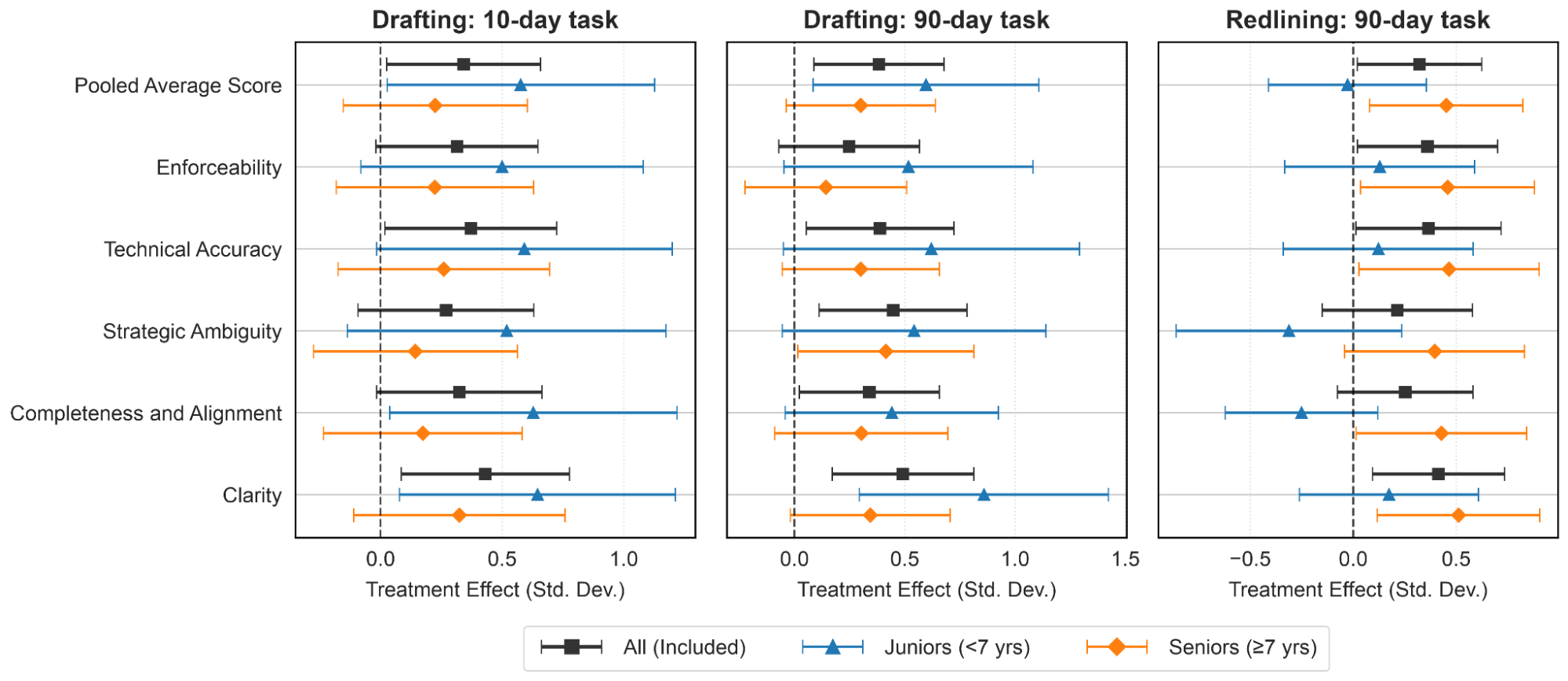
Scores are reported in standard deviations (SD). The spread of scores in the control group is set to 1, and the figures show how far above that group the treatment group scored. Overall, the treatment group scored +0.34 SD higher on the day 10 draft (p=0.03) and +0.38 SD higher on the day 90 draft (p=0.01). The paper explains the higher treatment-group average this way.
“Higher average scores reflect lower prevalence of weak work, not higher prevalence of excellent work.” In other words, the average was higher because there were fewer weak responses, not more excellent ones.
Juniors who received AI scored +0.58 SD higher than juniors who did not on day 10 and +0.60 SD higher on day 90. The corresponding differences for seniors were 0.22 SD and 0.30 SD. But Pacific Stack, a Substack blog written by Moon Young Kim, argued in a critique that the difference between the effects for juniors and seniors was not large enough to distinguish from chance, or statistically significant.
In the day 90 survey, juniors who received AI reported drafting satisfaction +1.48 SD higher than juniors who did not (p<0.01). Seniors who received AI reported satisfaction +0.28 SD higher than seniors who did not (p=0.34), a difference that could not be distinguished from chance. The September 3 first edition identified the difference for juniors as the largest effect among the self-reported measures.
On the editing test without AI, junior averages showed no clear difference, but more of the scores for those given AI fell in the bottom group
The test involved an AI-generated patent draft about an attachment component for an accessory device. The instructions said, “Please DO NOT use any form of AI for this task.” A Google blog post said the draft contained many substantive and stylistic errors, but the public descriptions do not give a count or list of the errors planted in it. Ninety-one people completed the test: 62 in the treatment group and 29 in the control group.
| Difference between those who received AI and those who did not (SD) | Overall | Juniors | Seniors |
|---|---|---|---|
| Day 10 draft (AI available) | +0.34 | +0.58 | +0.22 |
| Day 90 draft (AI available) | +0.38 | +0.60 | +0.30 |
| Day 90 editing (no AI) | +0.32 | −0.03 | +0.45 |
The difference in editing scores between juniors who received AI and those who did not was −0.03 SD (permutation test p=0.93). But only 24 juniors completed the test, including seven in the control group, so the 95% confidence interval is wide, at approximately −0.42 to +0.36. It is consistent with both a substantial benefit and a substantial harm. The firms refused a pre-experiment skills test, so none was conducted. The table therefore shows differences from the control group at the end of the experiment, not how much anyone's skills improved or declined.
The researchers divided editing scores across all participants into five groups, with group 1 at the top and group 5 at the bottom. Compared with juniors who did not receive AI, juniors who did had fewer scores in group 4, the so-so range, and more in group 5, the bottom range. Both differences were distinct enough to be distinguished from chance. The paper's abstract described this as a polarization of junior scores, but the increase in scores in group 2, the second-highest group, could not be distinguished from chance (Pacific Stack calculation: p=0.20). This comparison rests on 50 separate scores assigned by graders to the 24 juniors' edited drafts.
Junior lawyers often identified a defect without fixing it themselves, leaving notes such as “there are antecedent basis issues.” The authors said these notes read like instructions to an AI assistant, but also wrote that they were just as common among juniors in the control group who had not received AI. Two juniors interviewed said the tool eliminated the “blank page problem.” Comparing their accounts with the scores, the first edition stated: “Juniors' accounts of their own development are not reflected in their performance absent AI.” In other words, the growth the juniors felt was not reflected in their scores without AI.
On the test without AI, seniors who had received the tool edited better than those who had not, rewriting whole sections and explaining their changes
On the same editing test, seniors who had received AI scored +0.45 SD higher than seniors who had not (p=0.02). Their scores were also more tightly clustered. The difference pointed in the same direction in a permutation test (p=0.02), when the work was rescored using Gemini 2.5-flash (+0.66 SD), and in analyses that changed the experience cutoff between juniors and seniors to between 3 and 11 years.
There is a qualification. Using an LLM and human review, the researchers suspected that AI had been used covertly in 15 of the 91 editing-test responses. Excluding those 15 reduces the senior difference to 0.39 SD, and it becomes difficult to rule out chance (p≈0.06). The overall difference on the same test also falls from 0.32 SD to 0.25 SD and is no longer distinguishable from chance (p≈0.14).
Details of how seniors edited appear only in the September 3 first edition. The section, removed from the October revision, analyzed edited drafts using Gemini 3.0 Pro and NotebookLM and included interviews with four treatment-group participants. According to that analysis, seniors who had received AI rewrote entire sections on the editing test rather than just polishing sentences. They removed language that narrowed the scope of rights and stated the legal principles behind each change. The public descriptions do not say how the control-group seniors' edits differed. Seniors in both the treatment and control groups spent more time on the test than juniors did.
One senior interviewee called the AI output a “formidable first draft,” as solid as the basic work of a new associate. Another said they used AI as a “logic auditor” to check the logic of their strategy. Both said they did not accept AI-written sentences as they were, and that working with a flawed but structured draft led them to examine logical gaps they might otherwise have overlooked. The Google blog summarized the change: “It weakened attachment to existing prose and forced them to articulate the why and how of structural edits.” In other words, it made them less attached to existing wording and pushed them to explain the reasons for and methods of structural changes.
Only two seniors were interviewed, and the qualitative analysis used LLMs. These accounts are therefore explanations the authors offered alongside the numbers, rather than evidence of what caused the seniors' higher scores.
AI-assisted draft scores made juniors look like the biggest gainers, but scores without AI told a different story
The September 3 first edition's abstract stated: “The largest gains from AI thus accrued to the lawyers who retained the least.” Juniors had the largest advantage over their control group on AI-assisted drafts, but the smallest advantage over their control group on the editing test without AI. The October revision replaced that sentence with a description of AI as a “springboard” for some juniors and a “cushion” for others. A springboard describes cases where AI helped someone perform better even without it; a cushion describes cases where AI supported difficult work, leaving the person worse off without it. The increase in scores in group 5, the bottom group discussed above, is consistent with the cushion account. The increase in group 2 scores, corresponding to the springboard account, was not distinguishable from chance. In a VoxEU column, the authors also wrote, “While our small sample of juniors does not allow for definitive conclusions,” acknowledging that the junior sample was too small for a definitive conclusion.
The language became more cautious, but the revised paper's table still showed a larger advantage over the control group for juniors than for seniors on AI-assisted drafts. On editing without AI, only seniors scored higher than their control group. The authors reported the two scores separately rather than combining them. Each participant spent three months in the experiment, and the authors said the results reflect AI performance in 2024–2025. With only seven juniors in the control group, it remains unclear whether juniors who received AI benefited or were harmed on the test without it.
Looking only at AI-assisted drafts, juniors who received the tool appeared to have the largest advantage. On a separate test without AI, only seniors who had received it scored higher than their control group, while the difference for juniors remained uncertain. The experiment shows that apparent growth in AI-assisted work and scores on a test without AI can tell different stories.
For a closer look
Does better work always mean better workers? Authors Autor and Rodchenko summarize the results alongside charts of treatment effects for juniors and seniors. research.google
Better work, not always better workers All seven authors discuss the limits of interpreting the junior results and specify the period of AI performance reflected in the study. cepr.org
An AI Drafting Experiment Leaves the Junior Question Open This critique argues that conclusions about juniors remain open, citing the seven-person junior control group and Google's interests. pacificstack.substack.com